
What Is Agentic Commerce? ACP, UCP, and AI Shopping Agents Explained
November 23, 2026When you ask an AI app to find running shoes under $100 and it also places the order with the store, that is agentic commerce. The AI agent does part of the buying for you: it searches and compares products, and in some apps it fills the cart and pays the retailer once you confirm.
Two open standards carry most of this work. The Agentic Commerce Protocol (ACP) was built by OpenAI and Stripe for shopping in ChatGPT. The Universal Commerce Protocol (UCP) was built by Google with Shopify and several large retailers, and it powers checkout in Google’s AI Mode and the Gemini app.
Card networks and Google add a payment layer on top, so a bank or merchant can tell that a real customer approved the purchase.
Key Findings
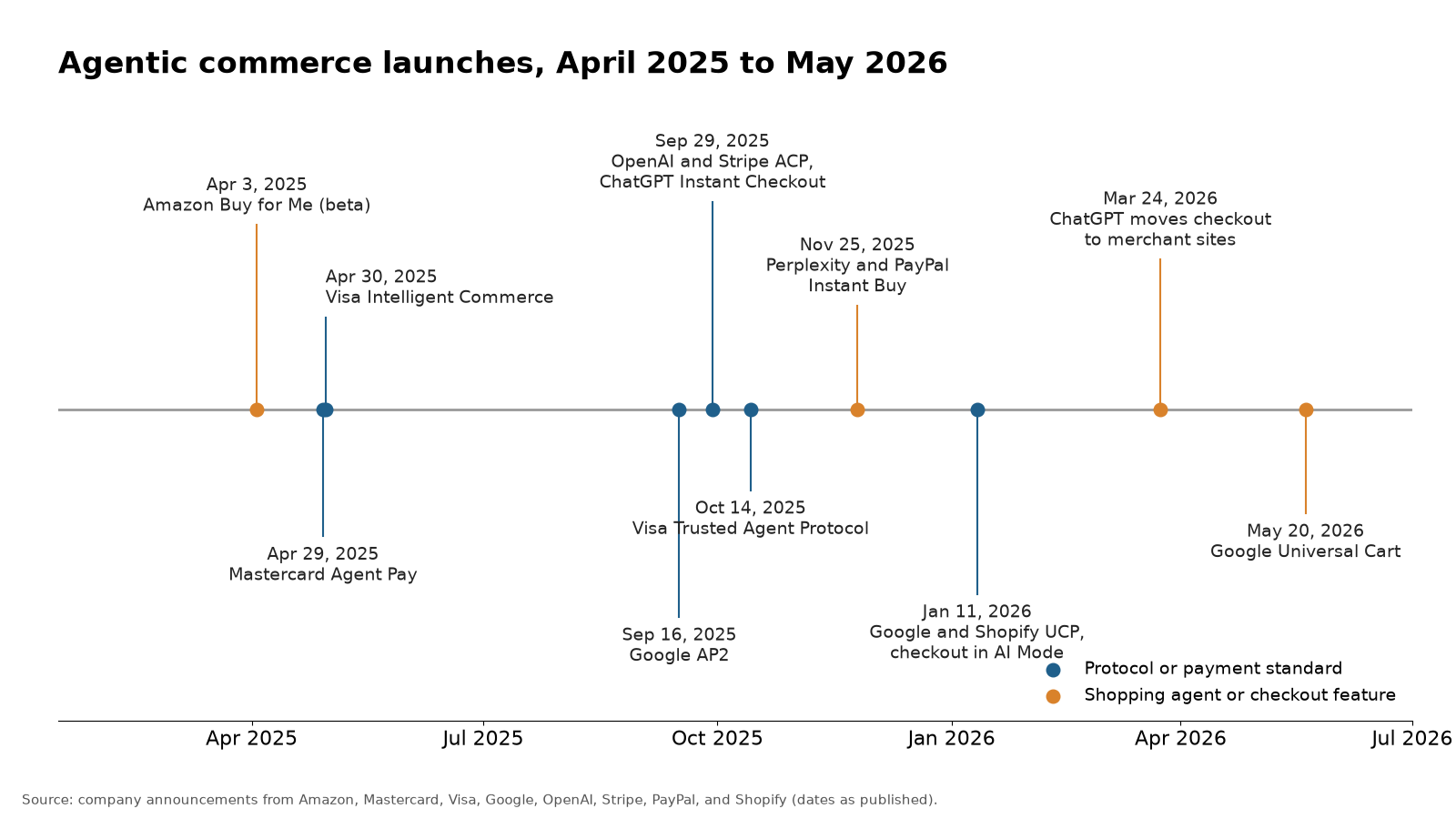
- ACP launched on September 29, 2025, and since March 2026 it mainly feeds product data into ChatGPT shopping, with purchases finished on the merchant’s own site or app (OpenAI).
- UCP launched on January 11, 2026, and powers checkout from eligible US retailers in AI Mode in Google Search and the Gemini app (Google).
- In both protocols, the retailer stays the merchant of record and handles payment, fulfillment, and returns.
- Google’s AP2, Visa Intelligent Commerce, and Mastercard Agent Pay handle a narrower job: proving that a shopper authorized an agent’s payment.
- 31.8% of about 3.7 million live ecommerce sites publish a valid public UCP profile, but only 4.6% of the top 10,000 sites by traffic do (UCP Checker, November 2026).
What Is Agentic Commerce?
An AI agent is software that can take actions for a person, such as filling a cart or submitting an order. In ecommerce, the agent sits between the shopper and the store. It reads product data from retailers, answers the shopper’s questions, and passes the order and a payment token to the retailer when the shopper is ready to buy.
The term covers a range of control. At one end, the agent only researches and sends the shopper to the retailer’s site. At the other, Google’s Agent Payments Protocol describes a “human not present” mode where a shopper signs rules in advance, such as a price limit, and the agent buys once the conditions are met.
Most shoppers are still at the research end. In a June 2026 survey of about 21,000 consumers in 11 markets, McKinsey found 53 percent had used AI for shopping in the past three months, while 14 percent of AI users had used an AI tool to complete a purchase. Our agentic commerce statistics report collects the adoption, trust, and traffic figures in one place.
How an AI Shopping Agent Completes a Purchase
The steps below follow the flow OpenAI, Stripe, and Google describe in their protocol announcements.
- The shopper asks for something specific, such as running shoes under $100, in an AI app like ChatGPT or Gemini.
- The agent pulls product data from retailers. Under ACP, merchants share product feeds with ChatGPT (OpenAI). Under UCP, merchants publish a profile at
/.well-known/ucpthat tells agents which features the store supports, such as catalog search, cart, and checkout (Shopify). - The agent shows options, and the shopper narrows them down in conversation.
- The shopper confirms the order, shipping address, and payment method. OpenAI’s launch post says users “explicitly confirm each step before any action is taken.”
- The agent sends the order to the retailer with a payment token. Stripe’s Shared Payment Token, for example, is limited to one merchant and one cart total, so the agent never sees the card number.
- The retailer accepts or declines the order, charges the payment, and ships the product. Returns and customer service also stay with the retailer.
When a checkout needs the shopper’s input, such as a merchant policy the agent cannot handle, UCP hands the shopper to the retailer’s own checkout page through a continuation link.
ACP vs. UCP vs. Payment Protocols
ACP and UCP both connect AI apps to store catalogs and checkouts. AP2 and the card network programs handle a narrower job: proving the shopper approved the payment and helping merchants tell a trusted agent from a bad bot.
Agentic Commerce Protocols and Programs Compared (November 2026)
| Standard | Built by | Launched | What it handles | Where it is used |
|---|---|---|---|---|
| Agentic Commerce Protocol (ACP) | OpenAI and Stripe; open source under Apache 2.0 (ACP) | Sep 29, 2025 | Product feeds and promotions for discovery; checkout and delegated payment specs | ChatGPT shopping in the US; checkout on merchant sites or in merchant apps inside ChatGPT |
| Universal Commerce Protocol (UCP) | Google, co-developed with Shopify, Etsy, Wayfair, Target, and Walmart (UCP) | Jan 11, 2026 | Catalog, cart, checkout, identity linking for loyalty, and orders | Checkout in AI Mode in Google Search and the Gemini app; Google’s Universal Cart |
| Agent Payments Protocol (AP2) | Google, with more than 60 organizations at launch | Sep 16, 2025 | Signed “mandates” that record what the shopper approved, for cards, stablecoins, and bank transfers | Payment layer that UCP supports |
| Visa Intelligent Commerce and Trusted Agent Protocol | Visa; Trusted Agent Protocol built with Cloudflare | Apr 30, 2025; Oct 14, 2025 | Tokenized cards for agents, shopper-set spending limits, and signatures that identify trusted agents to merchants | Closed-beta pilots; “hundreds” of agent-initiated transactions as of Dec 18, 2025 |
| Mastercard Agent Pay | Mastercard | Apr 29, 2025 | Agentic Tokens tied to registered, verified agents | Announced with Microsoft as the first AI platform partner |
Source: each company’s announcement or protocol site, linked in the table and in Sources.
Key Findings
- ACP and UCP overlap in purpose, and a retailer can support both. OpenAI says Shopify merchants are already in ChatGPT through Shopify Catalog, and UCP Checker found a valid UCP profile on 100% of live Shopify stores.
- Both protocols keep the retailer as the seller of record. The AI app passes the order along, and the retailer keeps the sale and the customer relationship.
ACP in Plain Terms
OpenAI launched ACP with Instant Checkout, which let US ChatGPT users buy from US Etsy sellers inside the chat. On March 24, 2026, OpenAI said the first version of Instant Checkout “did not offer the level of flexibility that we aspire to provide” and shifted ACP toward product discovery (OpenAI).
Today, merchants use ACP to send product feeds and promotions to ChatGPT, and shoppers finish the purchase on the merchant’s site or app. OpenAI lists seven large retailers, including Target and Wayfair, as integrated for discovery. Walmart introduced its own app inside ChatGPT with account linking, loyalty, and Walmart payments.
UCP in Plain Terms
UCP gives AI apps and store backends a shared format, so a retailer does not need a custom connection for every agent. A store lists what it supports, and the agent uses whatever overlaps with its own abilities. Google added optional Cart, Catalog, and Identity Linking features on March 19, 2026, so agents can fill multi-item carts and apply member pricing.
On May 20, 2026, Google announced a Universal Cart that holds items from several retailers across Search and Gemini. Google said UCP checkout would reach Canada and Australia in the following months and the UK later, and that the protocol would expand to hotel booking and food delivery.
Where You Can Shop With an AI Agent Today
AI Shopping Agents and Checkout Options (as announced)
| Agent | How buying works | Launch or change | Availability stated by the company |
|---|---|---|---|
| ChatGPT | Product discovery via ACP feeds; purchase on the merchant’s site or app | Instant Checkout Sep 29, 2025; moved to merchant checkout Mar 24, 2026 | US (OpenAI) |
| Google AI Mode and Gemini | Checkout with Google Pay through UCP, or transfer to the merchant’s site | Jan 11, 2026; Universal Cart May 20, 2026 | Eligible US retailers; Canada, Australia, and UK announced |
| Perplexity | Instant Buy with PayPal inside the chat | Nov 25, 2025 | US users |
| Amazon Buy for Me | Amazon’s agent buys from a brand’s own website when Amazon does not sell the item | Apr 3, 2025, beta | Subset of US customers on iOS and Android |
Source: each company’s announcement, linked in the table.
Key Findings
- In all four, the retailer or brand remains the seller.
- Perplexity and Google offer checkout inside the AI app, while ChatGPT now sends shoppers to the merchant’s site or app.
How Big Is Agentic Commerce This Cyber Week?
Salesforce forecast on November 19, 2026, that AI and agents will influence $75.8 billion, or 21%, of global online sales during Cyber Week (November 24 to 30, 2026). Salesforce counts sales influenced by recommendations and chat assistants on retailers’ own sites as well as by outside AI agents.
The same Salesforce survey found 31% of consumers have tried a personal AI agent and 8% have had one make a purchase for them. Adoption, trust, and traffic figures from other studies are in our agentic commerce statistics report, and broader AI search usage is in our AI search statistics.
What Brands Should Check Before Cyber Monday
- Confirm your product feeds are complete. Google’s UCP checkout uses existing Merchant Center feeds, and OpenAI says richer feed data helps products get better placement in ChatGPT results.
- Check whether your store publishes a valid UCP profile. UCP Checker found one on 100% of live Shopify stores and 99.5% of Wix stores, but on under 0.1% of WooCommerce and Squarespace stores.
- Apply to share a product feed with ChatGPT if you sell outside Shopify and Etsy, whose catalogs OpenAI says are already integrated.
- Make sure bot protection does not block trusted shopping agents. Visa lists bot detection that mistakenly blocks legitimate agent purchases as one of the problems Trusted Agent Protocol addresses.
- Track AI referral visits separately from other traffic, and compare them against AI referral conversion benchmarks.
OpenAI says a feed is optional when ChatGPT already crawls a merchant’s site, so the product pages themselves also shape how products appear. That work is part of our agentic search optimization service, and our Google AI Overviews statistics cover how often Google shows AI answers and how they affect clicks.
Frequently Asked Questions
What is agentic commerce in simple terms?
Agentic commerce is shopping where an AI agent searches, compares, and sometimes buys products for you. The retailer still sells and ships the product, and OpenAI’s and Amazon’s agents ask you to confirm the order before paying.
What is the difference between ACP and UCP?
ACP was built by OpenAI and Stripe and powers product discovery in ChatGPT. UCP was built by Google with Shopify, Etsy, Wayfair, Target, and Walmart, and it powers checkout in Google’s AI Mode and Gemini. A retailer can support both.
Can ChatGPT buy things for you?
Mostly no, as of November 2026. OpenAI says purchases that start in ChatGPT are completed on the merchant’s website or app, though some merchants, such as Walmart, run their own apps inside ChatGPT (OpenAI).
Is it safe to let an AI agent pay for something?
The protocols are built to limit what an agent can spend. Stripe’s tokens for ACP are limited to one merchant and cart total, and Google’s AP2 records what the shopper approved in signed mandates. Visa and Mastercard replace card numbers with tokens tied to agents the shopper or network has approved.
How many people use AI agents to shop?
In McKinsey’s June 2026 survey, 53 percent of consumers in 11 markets had used AI for shopping in the past three months, and 14 percent of AI users had used an AI tool to complete a purchase (McKinsey).
Talk to Genevate
Genevate is a New York City GEO agency that helps mid-market and enterprise brands appear in AI answers and AI shopping results. Ecommerce teams can review how we work with consumer brands or contact Genevate about their product data.
Sources
- OpenAI, “Buy it in ChatGPT: Instant Checkout and the Agentic Commerce Protocol” (Sep 29, 2025)
- Stripe, “Stripe powers Instant Checkout in ChatGPT and releases Agentic Commerce Protocol codeveloped with OpenAI” (Sep 29, 2025)
- Agentic Commerce Protocol, project site
- OpenAI, “Powering Product Discovery in ChatGPT” (Mar 24, 2026)
- OpenAI, “Power product discovery in ChatGPT,” merchant page
- Google, “New tech and tools for retailers to succeed in an agentic shopping era” (Jan 11, 2026)
- Google Developers Blog, “Under the Hood: Universal Commerce Protocol (UCP)” (Jan 11, 2026)
- Shopify Engineering, “Building the Universal Commerce Protocol” (Jan 11, 2026)
- Universal Commerce Protocol, project site
- Google, “AI shopping gets simpler with Universal Commerce Protocol updates” (Mar 19, 2026)
- Google, “How we’re helping retailers thrive with new Universal Commerce Protocol features and AI tools on Google” (May 20, 2026)
- Google for Developers, “Getting started with Universal Commerce Protocol on Google”
- Google Cloud, “Announcing Agent Payments Protocol (AP2)” (Sep 16, 2025)
- Visa, “Find and Buy with AI: Visa Unveils New Era of Commerce” (Apr 30, 2025)
- Visa, “Visa Introduces Trusted Agent Protocol: An Ecosystem-Led Framework for AI Commerce” (Oct 14, 2025)
- Visa, “Visa and Partners Complete Secure AI Transactions, Setting the Stage for Mainstream Adoption in 2026” (Dec 18, 2025)
- Cloudflare, “Cloudflare Collaborates with Leading Payments Companies to Secure and Enable Agentic Commerce” (Oct 14, 2025)
- Mastercard, “Mastercard unveils Agent Pay, pioneering agentic payments technology to power commerce in the age of AI” (Apr 29, 2025)
- Amazon, “Amazon’s new ‘Buy for Me’ feature helps customers find and buy products from other brands’ sites” (Apr 3, 2025)
- PayPal, “PayPal and Perplexity Launch Instant Buy Ahead of Black Friday” (Nov 25, 2025)
- McKinsey, “Who wins when AI does the shopping? New evidence on agentic commerce” (Oct 28, 2026)
- UCP Checker, “The state of UCP” (November 2026 market read)
- Salesforce, “Record Cyber Week Expected to Deliver $75.8B in AI-Driven Sales” (Nov 19, 2026)