Most-Cited Websites in AI Search: 2026 Report

November 9, 2026

AI search runs on websites that brands do not own. Wikipedia and Reddit together took 25.1% of ChatGPT’s US citations in January and February 2026 (Similarweb), and in a University of Toronto study of 143,249 AI answers, third-party websites earned 75.0% of citations while the brand’s own site earned 11.1% (Chen and Koudas, 2026).

For this report, we compiled citation data published between July 2025 and October 2026, covering March 2025 to September 2026. The sources are Similarweb’s US citation panel, Pew Research Center’s analysis of 68,879 Google searches, three peer-reviewed or preprint academic studies with more than 850,000 citations between them, and one agency dataset of 155,312 citations that we use only for engines no other source covers.

Our position is that the most-cited websites in AI search are the places where people other than the brand describe it. Each engine draws from a different pool of those sites, and the Methodology section at the end lists every dataset.

Key Findings

  • Wikipedia (13.15%) and Reddit (11.97%) were the two most-cited domains in ChatGPT in the US, and openai.com ranked third at 6.21% (Similarweb, Jan to Feb 2026).
  • Google AI Mode cited a different set: fandom.com led at 7.16%, ahead of Wikipedia at 5.21% and YouTube at 4.91% (Similarweb).
  • Wikipedia, YouTube, and Reddit were the three most-cited sources in Google’s AI summaries, together accounting for 15% of linked sources (Pew Research Center, March 2025).
  • Across 143,249 AI answers on a consumer market, third-party sites earned 75.0% of citations, competitors 13.8%, and the brand’s own site 11.1% (University of Toronto, June to Sept 2026).
  • In a niche B2B market, the brand’s own site earned 2.6% of AI citations (University of Toronto).
  • ChatGPT’s top 20 news sources took 67.3% of its news citations, with reuters.com alone at 22.8% (Yang, 2025).

Most-Cited Websites in ChatGPT

In the table below, we show the 15 domains ChatGPT cited most often in the US, as a share of all its citation events. Similarweb recorded these citations from ChatGPT’s web browsing mode across its monitored prompts.

Most-Cited Websites in ChatGPT, US (January to February 2026)

Rank Website Citations Share of ChatGPT citations
1 wikipedia.org 118,285 13.15%
2 reddit.com 107,680 11.97%
3 openai.com 55,876 6.21%
4 walmart.com 26,118 2.90%
5 youtube.com 23,976 2.67%
6 linkedin.com 21,736 2.42%
7 reuters.com 20,451 2.27%
8 nih.gov 19,962 2.22%
9 google.com 19,478 2.17%
10 media-amazon.com 17,477 1.94%
11 wikimedia.org 17,329 1.93%
12 facebook.com 15,813 1.76%
13 ebay.com 15,730 1.75%
14 amazon.com 15,343 1.71%
15 github.com 14,569 1.62%

Source: Similarweb, AI Citation Analysis, US, January to February 2026.
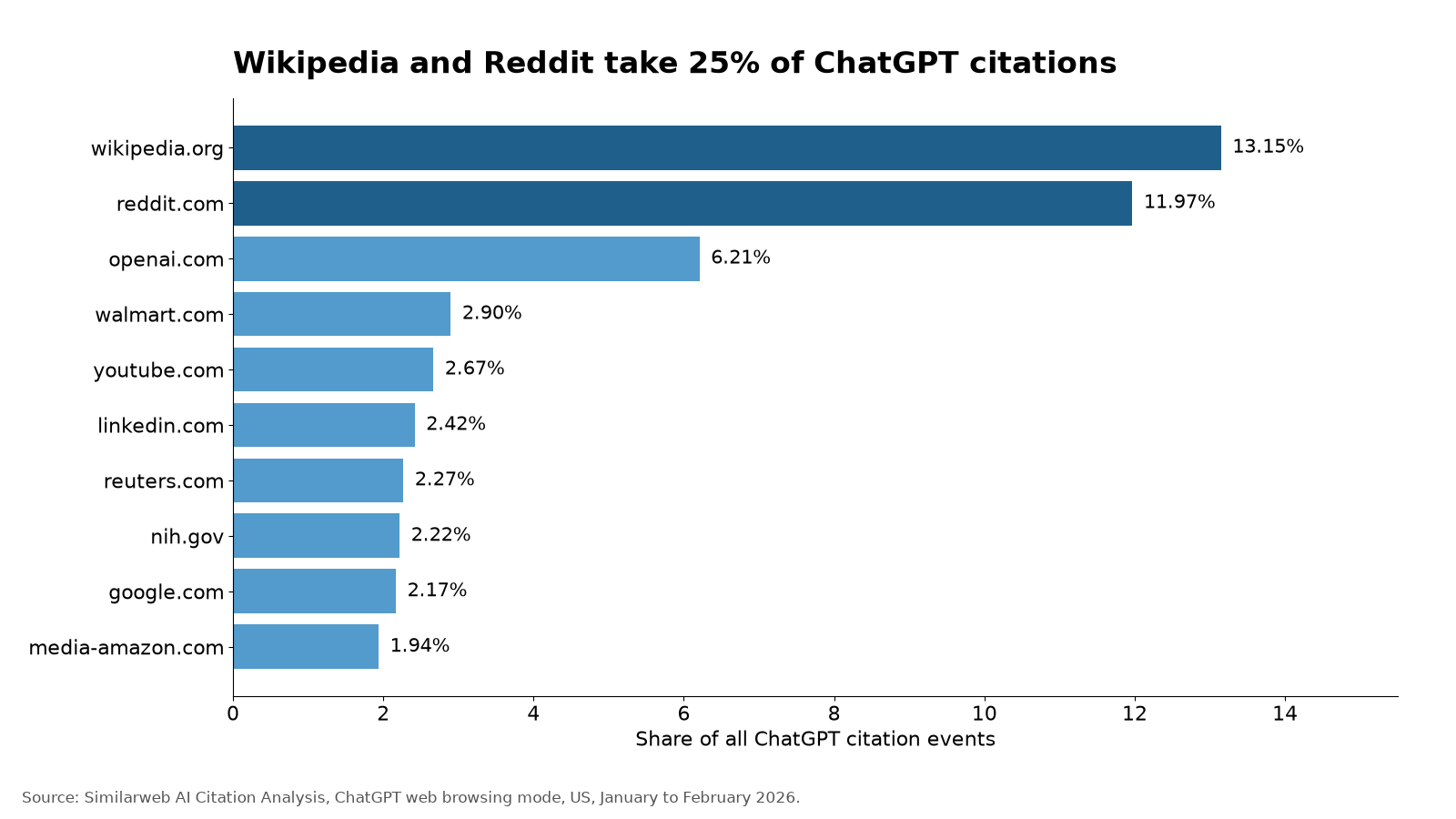
Share of ChatGPT citations going to each of the ten most-cited websites in the US, January to February 2026

Our team took three points from this data:

  • We found that Wikipedia and Reddit took 25.1% of ChatGPT’s citations between them, more than the next eight domains combined.
  • ChatGPT’s third most-cited domain was its own publisher, openai.com, ahead of Reuters, NIH, and every retailer.
  • Counting wikimedia.org, Wikipedia’s projects reached 15.1% of ChatGPT’s citations.

Most-Cited Websites in Google AI Mode

In the table below, we show the 10 domains Google AI Mode cited most often over the same period and prompt set.

Most-Cited Websites in Google AI Mode, US (January to February 2026)

Rank Website Citations Share of AI Mode citations
1 fandom.com 42,332 7.16%
2 wikipedia.org 30,792 5.21%
3 youtube.com 29,032 4.91%
4 reddit.com 24,764 4.19%
5 google.com 16,878 2.85%
6 facebook.com 14,410 2.44%
7 amazon.com 10,886 1.84%
8 nih.gov 8,821 1.49%
9 github.com 8,728 1.48%
10 apple.com 8,127 1.37%

Source: Similarweb, AI Citation Analysis, US, January to February 2026.

What the AI Mode data shows:

  • We found that AI Mode spreads its citations more widely than ChatGPT: its top domain took 7.16%, about half of Wikipedia’s share in ChatGPT.
  • Google’s own properties are prominent here too, with google.com fifth and YouTube, which Google owns, third.
  • Wikipedia and Reddit are the only two domains in the top four of both engines.

Most-Cited Websites in Google AI Overviews and Other Engines

Pew Research Center tracked the Google searches of 900 US adults in March 2025 and recorded the sources linked in each AI summary. In the table below, we show what Pew found about the sources Google’s AI Overviews cite.

Sources Cited in Google AI Summaries, US (March 2025)

Measure AI summaries Standard search results
Wikipedia, YouTube, and Reddit combined, share of linked sources 15% 17%
.gov websites, share of linked sources 6% 2%
Share that linked to a news website 5% 5%
Searches that produced an AI summary 18% Not applicable

Source: Pew Research Center, 68,879 Google searches by 900 US adults, March 2025.

No first-party or academic source publishes a recent domain ranking across Gemini, Perplexity, and AI Overviews together. For that comparison, we use one agency dataset, Suff Digital’s September 2026 study, and label it as such. In the table below, we show the most-cited website per engine on the same 2,984 questions.

Most-Cited Website by AI Engine (September 2026, agency data)

Engine Most-cited website Citations from that engine
Google AI Overviews youtube.com 6,894
Google AI Mode youtube.com 5,162
Perplexity wikipedia.org 979
ChatGPT nih.gov 954
Gemini reddit.com 273

Source: Suff Digital, an SEO agency, 155,312 citations from 2,984 questions across five engines, September 2026.

Three points stand out across these engines:

  • We found that government sites are three times as common in Google’s AI summaries as in its standard results (6% against 2%).
  • In the agency data, ChatGPT cited YouTube 5 times on the same questions where AI Overviews cited it 6,894 times.
  • No engine’s top source is a company’s own product or service site; each is a platform, an encyclopedia, or a government source.

Third-Party Websites Earn Most AI Citations

University of Toronto researchers collected 90 days of daily AI answers from ChatGPT, Gemini, and Perplexity on commercial questions in two markets, then sorted every cited website by who owns it. In the table below, we show how citations split between the brand being studied, its competitors, and everyone else.

Who Gets Cited in AI Answers: Own Site, Competitors, and Third Parties (June to September 2026)

Market Answers Brand’s own site Competitors’ sites Third-party sites
US home internet (consumer) 143,249 11.1% 13.8% 75.0%
Business software for architecture, engineering, and construction firms (niche B2B) 14,850 2.6% 46.7% 50.8%

Source: Chen and Koudas, University of Toronto (2026), ChatGPT, Gemini, and Perplexity via their APIs.
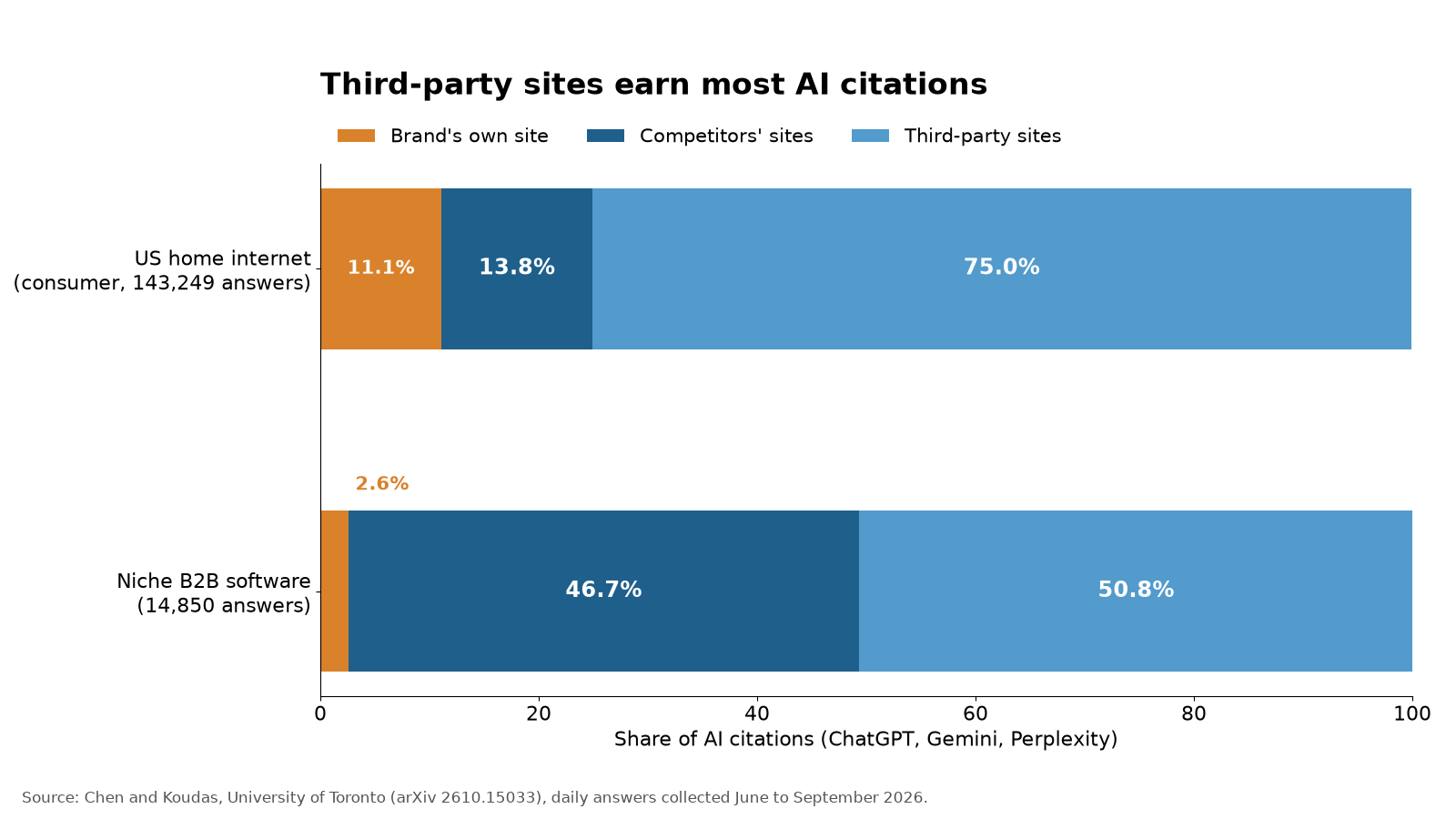
Share of AI citations going to the brand's own site, competitors' sites, and third-party sites in two markets, June to September 2026
Share of AI citations going to the brand’s own site, competitors’ sites, and third-party sites in two markets, June to September 2026

The same research group’s 2025 study compared AI search with Google on US automotive questions. Google returned 39.5% brand content, 15.4% social, and 45.1% earned media, while AI search returned 81.9% earned media and 18.1% brand content (Chen et al., 2025).

What the ownership data shows:

  • We found that in the consumer market, a brand’s own site earned about one in nine citations, and third-party sites earned three in four.
  • In the niche B2B market, competitors’ sites took 18 times the brand’s share, so a smaller vendor’s visibility depends on being mentioned on pages it does not control.
  • The 2026 study found that every page ChatGPT cited had first been retrieved by its own search, and that retrieval explained 32% of the variation in citations against 2.8% for page features.

How Concentrated Are AI Citations?

A few domains take a large share of citations, and the share depends on the topic. In the table below, we compare concentration across four datasets.

Citation Concentration in AI Search (2025 to 2026)

Dataset What was measured Concentration
Yang (2025) 366,087 citations from OpenAI, Google, and Perplexity models, news sources only Top 20 news outlets: 67.3% (OpenAI), 31.9% (Google), 28.5% (Perplexity)
Mental health citation audit (2026) 15,942 citations from ChatGPT, Perplexity, and Google AI Overviews Top 10 domains: 43.6% of English citations
Similarweb ChatGPT, US, Jan to Feb 2026 Wikipedia and Reddit: 25.1%
Suff Digital (agency data) 155,312 citations, five engines, Sept 2026 Top 20 websites: 26.2%; 14,616 websites cited at least once

Source: each dataset, linked in the table.

Our team took two points from this data:

  • We found that in news, OpenAI’s models leaned hardest on a few outlets, with reuters.com at 22.8% and apnews.com at 12.2% of news citations (Yang, 2025).
  • The long tail is still wide: thousands of websites earn at least one citation, so a specific page on a narrow question can be cited without being a household name.

What This Means for Brands

Methodology

This report compiles citation data available as of November 9, 2026. We included a dataset only if it stated its sample, its period, and how it counted a citation. We gave priority to first-party measurement and research firms (Similarweb, Pew Research Center) and to academic studies, and used one agency dataset only for the per-engine comparison that no other source covers.

In the table below, we list every dataset used.

Datasets Used in This Report

Dataset Type Sample Period
Similarweb, AI Citation Analysis Research firm panel ChatGPT and Google AI Mode citation events across monitored US prompts Jan to Feb 2026
Pew Research Center Nonprofit research, browsing panel 68,879 Google searches by 900 US adults March 2025
Chen and Koudas, University of Toronto Academic preprint 158,099 answers, 468,037 citations, ChatGPT, Gemini, Perplexity June to Sept 2026
Chen, Wang, Chen, and Koudas, University of Toronto Academic preprint Controlled queries across several product categories, AI search vs Google 2025
Yang Academic preprint 366,087 citations from 12 AI search models 2025
Mental health citation audit Academic preprint 15,942 citations from ChatGPT, Perplexity, Google AI Overviews 2026
Suff Digital Agency study 155,312 citations from 2,984 questions, five engines Sept 2026

Each source counts citations differently. Similarweb counts every citation event, Pew counts the sources linked in each AI summary, and the Toronto studies count each URL once per answer, so compare rankings within a dataset rather than percentages across datasets.

Frequently Asked Questions

What is the most-cited website in AI search?

It depends on the engine. Wikipedia was the most-cited domain in ChatGPT in the US at 13.15% of citations, and fandom.com led Google AI Mode at 7.16% (Similarweb, January to February 2026). Wikipedia, YouTube, and Reddit were the top three sources in Google’s AI summaries (Pew Research Center).

What sources does ChatGPT cite most?

Wikipedia (13.15%) and Reddit (11.97%), followed by openai.com (6.21%), walmart.com, and youtube.com, based on Similarweb’s US data for January and February 2026.

Do AI engines cite brand websites?

Less often than third-party sites. In a University of Toronto study of 143,249 answers, the brand’s own site earned 11.1% of citations and third-party sites 75.0%. In a niche B2B market, the brand’s own site earned 2.6%.

Do ChatGPT and Google AI Mode cite the same websites?

Only partly. Wikipedia and Reddit are in the top four of both, but fandom.com led AI Mode while ranking 19th in ChatGPT, and openai.com ranked third in ChatGPT (Similarweb).

How can a brand get cited in AI answers?

Get mentioned on the third-party pages each engine already retrieves for your category, and publish specific pages that answer your buyers’ questions directly. The Toronto study found that ChatGPT cites only pages its own search retrieves, and that pages whose titles and paragraphs match the question are cited more.

Talk to Genevate

To see which websites AI engines cite in your category, run your buyers’ top questions through ChatGPT, Gemini, Perplexity, and Google, and list the sources. Genevate is a New York City GEO agency for mid-market and enterprise brands. Contact Genevate to turn that list into a content and earned-mention plan.

Sources

  1. Similarweb, “Most Cited Domains by LLMs” (2026)
  2. Pew Research Center, “Google users are less likely to click on links when an AI summary appears in the results” (July 22, 2025)
  3. Chen and Koudas, “What Drives AI Citations? Content, Retrieval and Model Knowledge in Generative Engine Optimization (GEO),” arXiv (2026)
  4. Chen, Wang, Chen, and Koudas, “Generative Engine Optimization: How to Dominate AI Search,” arXiv (2025)
  5. Yang, “News Source Citing Patterns in AI Search Systems,” arXiv (2025)
  6. “Sources of Truth: A Multi-Platform, Multilingual Audit of Citations in AI Mental Health Information Queries,” arXiv (2026)
  7. Suff Digital, “Most Cited Websites in AI 2026” (Sept 2026)
  8. Google Search Central, “AI features and your website”
AI Referral Traffic Conversion Rates: 2026 Report

Visitors who click through from AI answers now convert better than the rest of a site’s traffic in most current data. In September 2026, AI traffic to US retail sites converted 90% better than non-AI traffic, the widest gap Adobe Digital Insights has recorded across more than 1 trillion visits. ChatGPT, the largest source of AI referrals, reached 1.2 billion weekly users the same month (The Verge, reporting OpenAI).

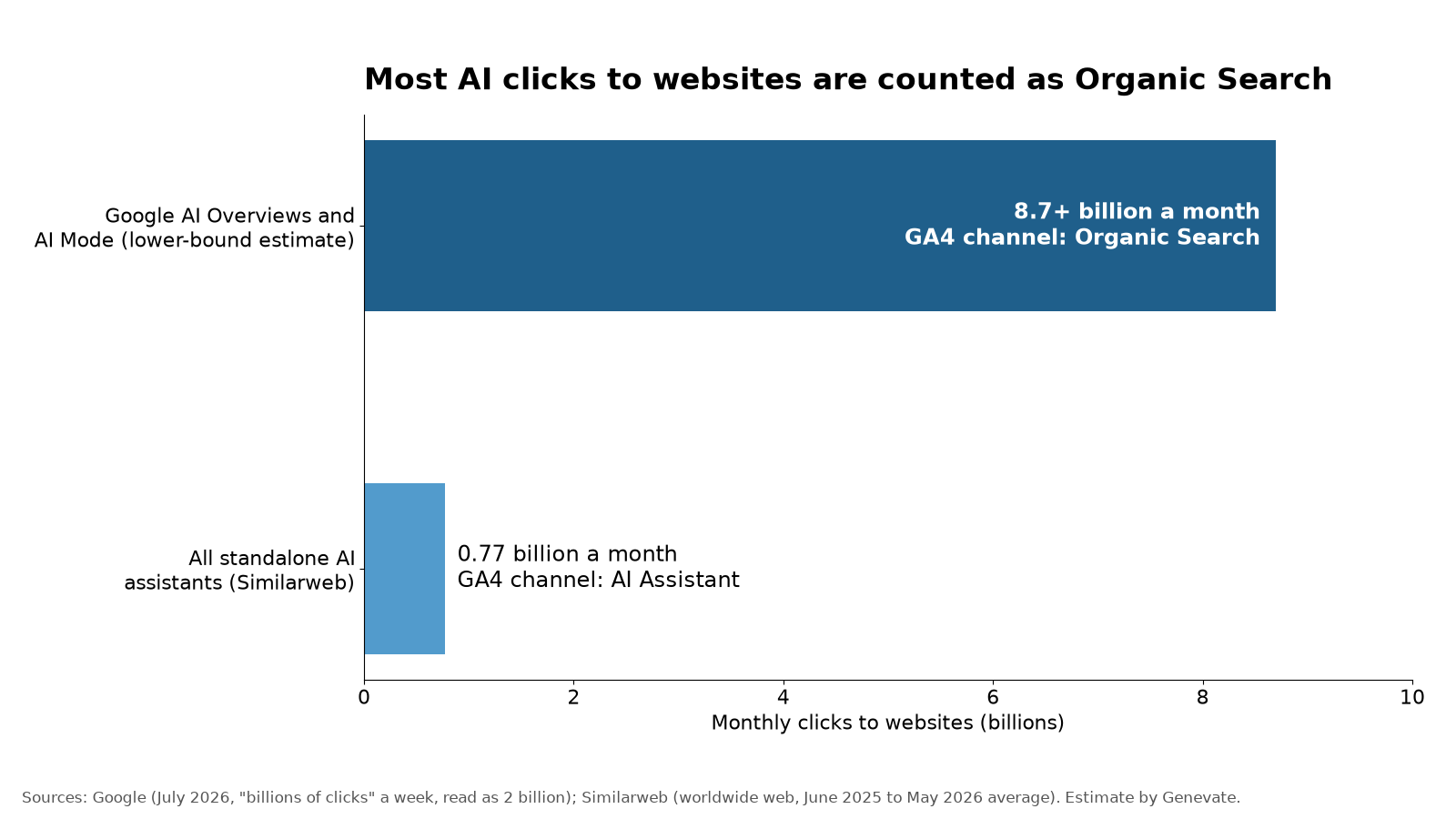
The AI referral numbers most teams see in Google Analytics 4 are still far too low. GA4 files every click from Google’s AI Overviews and AI Mode under Organic Search (Google Analytics Help), and Google says those features send billions of clicks to websites every week. Our estimate below puts the AI clicks GA4 can label at less than a tenth of the total.

For this report, we compiled first-party figures from OpenAI, Google, Adobe, Microsoft, Similarweb, and Pew Research Center, plus one peer-reviewed study and one multi-site GA4 benchmark. Each figure is quoted with its sample, period, and comparison channel, and the Methodology section lists every dataset.

Key Findings

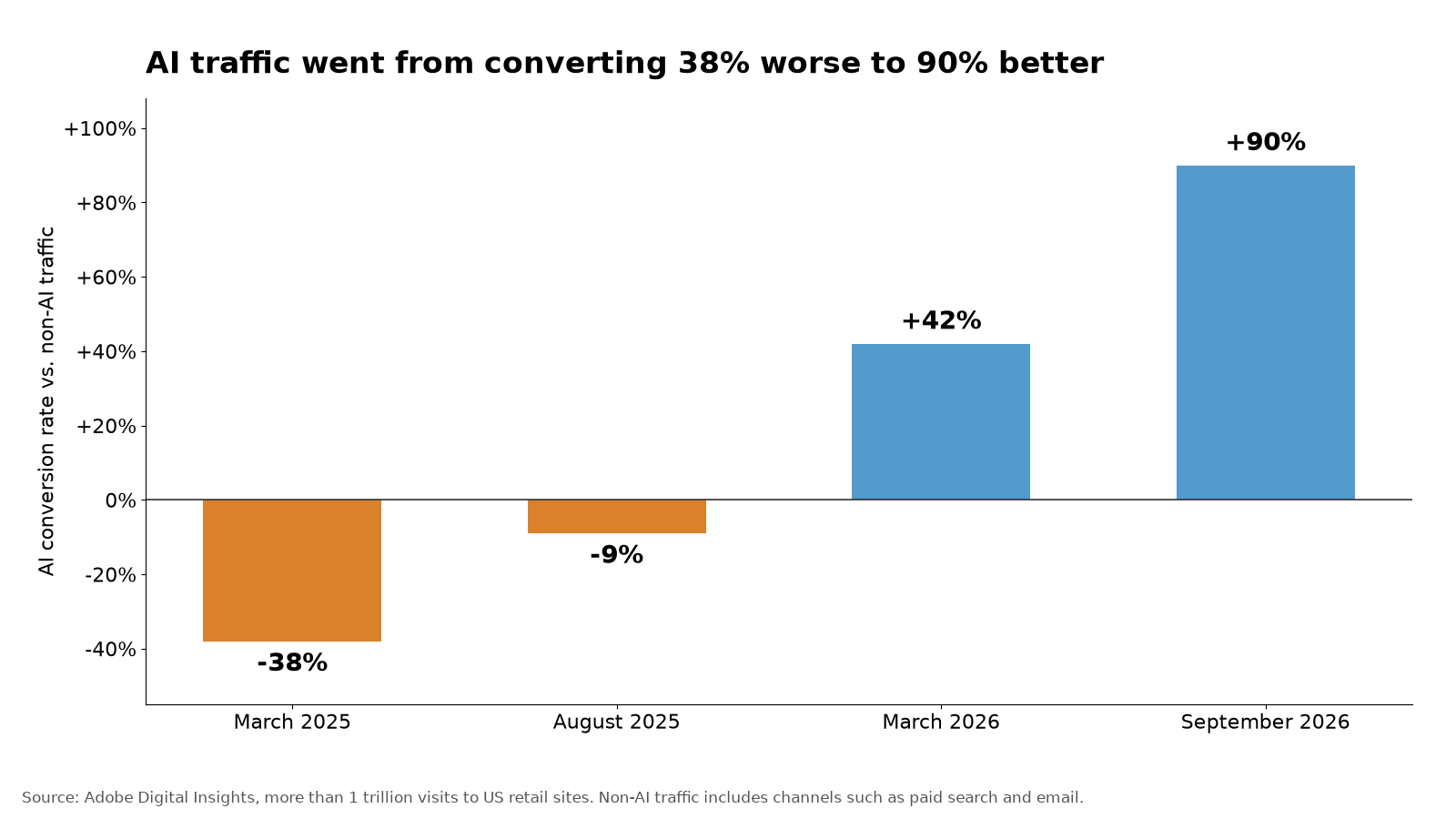
  • AI traffic to US retail sites converted 90% better than non-AI traffic in September 2026, up from 38% worse in March 2025 (Adobe).
  • ChatGPT grew from 800 million weekly users in October 2025 to 1.2 billion in September 2026, a 50% increase in under a year (TechCrunch; The Verge).
  • Referral visits from AI platforms averaged 770.7 million a month worldwide from June 2025 to May 2026, up 117.4% year over year (Similarweb).
  • Google’s AI Overviews have more than 2.5 billion monthly users and AI Mode more than 1 billion (Google), and GA4 counts their clicks as Organic Search.
  • On a conservative reading of Google’s “billions of clicks” a week, Google’s AI features send at least 11 times as many clicks as all standalone AI assistants combined (Genevate estimate, method below).
  • ChatGPT visitors converted at 7% versus 5% for Google visitors on US desktop (Similarweb, September 2025).

AI Referral Conversion Rates: 2026 Benchmarks

In the table below, we compare the conversion rate of AI referral traffic with a stated comparison channel in five datasets. Each source defines a conversion in its own way, so the ratio inside each row is the number to compare.

AI Referral Conversion Rates by Dataset (2024 to 2026)

Dataset Sample Period AI referral conversion Comparison channel Ratio
Adobe Digital Insights 1 trillion+ visits to US retail sites Sept 2026 90% higher All non-AI traffic 1.9x
Microsoft Clarity 1,277 publisher and news domains One month, 2025 1.34% (subscriptions) Search, 0.55% 2.4x
Similarweb US desktop panel Sept 2025 7% (ChatGPT) Google, 5% 1.4x
The SEO Works 63 B2B and B2C sites in GA4 Sept 2025 to Aug 2026 7.18% Organic search, 6.08% 1.18x
Kaiser and Schulze, Marketing Science 973 ecommerce sites in GA4 Aug 2024 to July 2025 Below organic search Organic search, about 13% higher About 0.9x

Source: each dataset, linked in the table. The Clarity and Kaiser and Schulze ratios are our arithmetic from published figures, rounded.

Our team took three points from this data:

  • Four of the five datasets found AI referrals converting above the comparison channel, from 1.18x to 2.4x.
  • The only dataset below parity covers August 2024 to July 2025, the year AI traffic was still converting worse in Adobe’s own data. Kaiser and Schulze also found the AI conversion rate rising through that year while traditional channels stayed flat.
  • The smallest advantage came from the GA4 benchmark that includes B2B sites. In that study, B2B product sites were the one segment below parity, at 0.62x across ten sites (The SEO Works).

How AI Conversion Rates Changed From 2025 to 2026

Adobe has tracked AI traffic to US retail sites since October 2024, which makes it the longest consistent series available. In the table below, we show how the conversion gap between AI and non-AI traffic moved over 18 months.

AI vs. Non-AI Conversion Rate, US Retail Sites (2025 to 2026)

Month AI traffic conversion compared with non-AI traffic Source
March 2025 38% worse Adobe, April 2026
August 2025 9% worse Adobe, October 2026
March 2026 42% better Adobe, April 2026
September 2026 90% better Adobe, October 2026

Source: Adobe Digital Insights, based on more than 1 trillion visits to US retail sites. Non-AI traffic includes channels such as paid search and email.

AI traffic conversion rate compared with non-AI traffic on US retail sites, March 2025 to September 2026, from Adobe Digital Insights

Three points stand out in the Adobe series:

  • The gap swung 128 points in 18 months, from 38% worse to 90% better.
  • AI visitors in September 2026 also spent 73% more time on site and generated 83% more revenue per visit than non-AI visitors (Adobe).
  • Studies built on 2024 and early 2025 data describe an earlier stage of the channel, so older “AI converts worse” findings no longer reflect current performance.

ChatGPT Referral Traffic Is Growing

ChatGPT referrals did not peak in 2025. First-party data shows ChatGPT’s audience, its search volume, and the clicks it sends to websites all growing through 2026.

In the table below, we show ChatGPT’s weekly active users as OpenAI has reported them.

ChatGPT Weekly Active Users (October 2025 to September 2026)

Date reported Weekly active users Source
October 6, 2025 800 million TechCrunch, reporting Sam Altman
February 27, 2026 900 million OpenAI
July 2026 1 billion The Verge, reporting an OpenAI spokesperson
September 29, 2026 1.2 billion The Verge, reporting OpenAI

Source: OpenAI figures as published or reported. These are company statements and are not independently audited.

OpenAI also says ChatGPT now handles about one-fifth as many search queries as Google, counting any question that triggers a web search (The Verge, Nov 3, 2026). In the US, 44% of adults said in February 2026 that they use ChatGPT, up from 18% in 2023 (Pew Research Center).

In the table below, we show what that audience growth means for referral traffic to websites.

AI and ChatGPT Referral Traffic Growth (2025 to 2026)

Dataset What was measured Change Period
Similarweb Referral visits from AI platforms, worldwide web +117.4% year over year June 2025 to May 2026
Similarweb ChatGPT referrals after brand names became clickable +157.7% week over week May 7 to 13, 2026, vs prior week
Business Insider, reporting Graphite’s analysis of Similarweb data Referral traffic from AI services worldwide, 60% of it from ChatGPT +92% year over year Year to fall 2026
Adobe AI traffic to US retail sites +71% year over year September 2026
Microsoft Clarity AI traffic to 1,200+ publisher and news sites +155.6% Eight months, 2025

Source: each dataset, linked in the table.

What the growth data shows:

  • No dataset in this report shows AI or ChatGPT referral traffic shrinking. Every industry in Similarweb’s 2026 data at least doubled its AI referrals year over year.
  • ChatGPT’s usage did flatten for about seven months after the first half of 2025, according to Graphite’s analysis. Growth resumed in 2026, and ChatGPT’s monthly visits reached a record 61.35 billion in September (Business Insider).
  • ChatGPT’s May 7, 2026 change, which turned brand names in answers into links, moved referrals to a higher baseline that held in the weeks Similarweb tracked.

Google AI Mode and AI Overviews Traffic Is Hidden in Organic Search

The largest source of AI-driven website visits does not appear as AI traffic in any standard report. Google’s own documentation defines GA4’s Organic Search channel as non-ad search clicks “including Google’s AI Overviews and AI Mode,” and says the AI Assistant channel added in May 2026 excludes them (Google Analytics Help).

In the table below, we show where each type of AI-influenced visit lands in a default GA4 property.

Where AI-Influenced Visits Appear in GA4 (November 2026)

How the visitor arrives GA4 default channel Reported as AI traffic?
Clicks a link in ChatGPT, Gemini, Copilot, or a similar assistant AI Assistant Yes
Clicks a link in a Google AI Overview Organic Search No
Clicks a link in Google AI Mode Organic Search No
Clicks a link in an AI app that strips the referrer Direct No
Searches the brand on Google after an AI recommendation Organic or Paid Search No
Types the brand’s URL after an AI recommendation Direct No

Source: Google Analytics Help, Default channel group; Similarweb on referrer-less AI visits.

Search Console does not close the gap. AI Overview and AI Mode clicks are counted inside the “Web” search type (Google Search Central), and the Generative AI performance report that reached all sites on Aug. 31, 2026 shows impressions only (Search Console Help). Google’s Gary Illyes said on Nov. 2, 2026 that Google has nothing to announce yet about adding AI click data (Search Engine Journal).

In the table below, we compare the scale of Google’s AI features with the AI referral traffic analytics tools can identify.

Google AI Features Compared With Measurable AI Referrals (2026)

Measure Figure Source
AI Overviews monthly active users More than 2.5 billion Google, May 19, 2026
AI Mode monthly active users More than 1 billion Google, July 22, 2026
Clicks to websites from AI features in Google Search “Billions” every week Google, July 22, 2026
Google AI feature clicks per month, conservative estimate At least 8.7 billion Genevate estimate (2 billion a week x 52 weeks / 12 months)
Referral visits from all standalone AI platforms per month 770.7 million Similarweb, June 2025 to May 2026 average

Source: Google statements and Similarweb, linked in the table. The estimate row is our arithmetic.

Estimated monthly clicks to websites from Google AI features compared with referral visits from all standalone AI platforms

We drew three conclusions from this comparison:

  • On the most conservative reading of “billions,” Google’s AI features send at least 11 times as many clicks to websites as every standalone AI assistant combined, and GA4 labels all of them Organic Search.
  • That puts the AI clicks GA4 can identify at less than 10% of the clicks AI answers send to websites (0.77 billion of at least 9.4 billion a month).
  • Our estimate covers clicks only. AI answers that lead to a later brand search or a typed URL add more visits that no tool attributes to AI.

Why Measured AI Conversions Understate AI’s Value

AI answers often send buyers to a brand without a click. Similarweb found that people who get a brand recommendation from ChatGPT are 2.5 times more likely to visit that brand’s site within seven days than an unrecommended competitor’s site, and 55.9% of those AI-influenced visits arrived through search, compared with 40.4% of visits with no AI influence (Similarweb, US desktop, July to December 2025).

Those visits convert inside Organic Search, Paid Search, and Direct, where they raise the apparent performance of those channels. Kaiser and Schulze make the same point in Marketing Science: ChatGPT may play a role in discovery that last-click data cannot capture (Kaiser and Schulze). The GA4 benchmark from The SEO Works also says its AI figures should be read as a floor, because AI Overview clicks cannot be separated (The SEO Works).

Our position is that the conversion rates in this report are accurate for the traffic they measure, and that the AI channel’s total contribution to leads and revenue is larger than any current analytics tool reports. Our AI visibility to revenue guide covers how to connect the two.

How to Measure AI Referral Conversions in GA4

You can get closer to the real number with four changes.

  1. Report the AI Assistant channel next to Organic Search, with conversion rates and session counts for both. GA4 began assigning the “ai-assistant” medium on May 13, 2026 (Google Analytics release notes), so compare periods after that date.
  2. Add any assistant your audience uses that the default list misses to a custom channel group, using the referrer domain.
  3. Track AI Overview and AI Mode impressions in the Search Console Generative AI performance report, and set them beside organic clicks and conversions for the same pages.
  4. Add a required “How did you hear about us?” field to your contact form with AI assistants as an option, so AI-influenced leads that arrive through search or direct still get counted.

What This Means for Marketing Teams

  • Treat AI as a growing acquisition channel. Every first-party dataset in this report shows ChatGPT and AI referral traffic rising through 2026.
  • Expect AI visitors to convert above your organic baseline, and test it on your own site with session counts reported next to each rate.
  • Read Organic Search as partly AI traffic. Clicks from AI Overviews and AI Mode are counted there, so a flat organic line can hide growth in AI-driven visits.
  • Our AI search statistics report and Google AI Overviews statistics cover the adoption data behind these trends.
  • B2B teams can review how Genevate works with technology and B2B companies, and ecommerce teams with consumer brands.

Methodology

This report compiles published data available as of November 9, 2026. We included a dataset only if it stated its sample, its time period, and, for conversion figures, its comparison channel. We gave first-party platform data (OpenAI, Google, Adobe, Microsoft) and independent measurement firms (Similarweb, Pew Research Center) priority over agency and vendor studies, and used one agency benchmark for its B2B segment.

In the table below, we list every dataset used.

Datasets Used in This Report

Dataset Type Sample Period
OpenAI (direct and as reported by TechCrunch and The Verge) Company-reported usage ChatGPT users worldwide Oct 2025 to Nov 2026
Google (I/O 2026 keynote, Q2 2026 earnings, product documentation) Company-reported usage and documentation Google Search users worldwide May to Nov 2026
Adobe Digital Insights First-party analytics 1 trillion+ visits to US retail sites Oct 2024 to Sept 2026
Microsoft Clarity First-party analytics 1,277 publisher and news domains 2025
Similarweb Clickstream panel Worldwide web and US desktop panels June 2025 to May 2026
Pew Research Center National survey US adults, Feb 17 to 23, 2026 2023 to 2026
Kaiser and Schulze, Marketing Science 45(4) Peer-reviewed study, GA4 data 973 ecommerce sites Aug 2024 to July 2025
The SEO Works Agency benchmark, GA4 data 95 sites (63 with conversion data) Sept 2025 to Aug 2026

The Google click estimate assumes the lowest plausible value for Google’s statement that AI features send “billions of clicks to websites every week,” which is 2 billion a week, or about 8.7 billion a month. Google’s figure dates from July 2026 and covers all countries, while Similarweb’s 770.7 million figure is a 12-month worldwide average for web traffic only. The two are not measured the same way, so we treat the 11x result as an order-of-magnitude estimate.

Frequently Asked Questions

What is the conversion rate of AI referral traffic?

In current data, AI referrals convert above the rest of a site’s traffic. Adobe found AI traffic to US retail sites converted 90% better than non-AI traffic in September 2026, and Similarweb found ChatGPT visitors converted at 7% versus 5% for Google visitors.

Is ChatGPT referral traffic growing or falling?

It is growing. ChatGPT reached 1.2 billion weekly users in September 2026, up from 800 million in October 2025, and Similarweb measured AI referral visits up 117.4% year over year, with ChatGPT the largest source.

Does Google Analytics show traffic from Google AI Mode and AI Overviews?

No. Google’s default channel group documentation places clicks from AI Overviews and AI Mode in Organic Search, and the AI Assistant channel excludes them. Search Console reports AI feature impressions but not separate AI clicks.

Why does AI referral traffic look small in GA4?

GA4 labels only clicks from standalone assistants such as ChatGPT as AI traffic. Clicks from Google’s AI features, AI apps that strip the referrer, and brand searches that follow an AI recommendation are all credited to other channels, so the AI line shows a fraction of AI-driven visits.

Does AI traffic convert better than Google organic traffic?

In current data, yes. Similarweb measured 7% for ChatGPT visitors against 5% for Google visitors, and The SEO Works found 7.18% against 6.08% for organic search across 63 sites. Because Google’s organic channel now includes AI Overview and AI Mode clicks, part of Google’s own number is AI traffic too.

Talk to Genevate

If your AI referral line looks small, it is probably measuring a fraction of the real channel. Genevate is a New York City GEO agency for mid-market and enterprise brands, and we set up AI search measurement alongside the work that earns AI visibility. You can contact Genevate to see what AI search is already sending your business.

Sources

  1. Adobe, “AI traffic now generates 83% higher revenue per visit for U.S. retailers heading into the holiday shopping season” (Oct 29, 2026)
  2. Adobe, “U.S. retailers see surge in AI traffic, but many websites are not entirely readable by machines” (Apr 16, 2026)
  3. OpenAI, “Scaling AI for everyone” (Feb 27, 2026)
  4. The Verge, “ChatGPT now has 1.2 billion weekly users, OpenAI says” (Sept 29, 2026)
  5. The Verge, “ChatGPT and Gemini both just passed 1 billion users” (Aug 11, 2026)
  6. The Verge, “OpenAI says ChatGPT is catching up to Google in search” (Nov 3, 2026)
  7. TechCrunch, “Sam Altman says ChatGPT has hit 800M weekly active users” (Oct 6, 2025)
  8. Google, “I/O 2026: Welcome to the agentic Gemini era” (May 19, 2026)
  9. Google, “Q2 2026 earnings call: Remarks from our CEO” (July 22, 2026)
  10. Google Analytics Help, “Default channel group”
  11. Google Analytics Help, “What’s new in Google Analytics”
  12. Google Search Central, “AI features and your website”
  13. Search Console Help, “Generative AI performance report (Search)”
  14. Search Engine Journal, “Google Says No AI Click Reporting News Yet, Ahead Of UK Deadline” (Nov 2, 2026)
  15. Similarweb, “AI Referral Traffic by Industry: What 770 Million Monthly Visits Reveal” (Sept 3, 2026)
  16. Similarweb, “ChatGPT Referral Traffic Near Triples Overnight” (May 25, 2026)
  17. Similarweb, “How to Optimize Your Homepage for AI Traffic” (Aug 9, 2026)
  18. Business Insider, “ChatGPT’s growth is bouncing back as rivals struggle to close the gap” (Nov 9, 2026)
  19. Microsoft Clarity, “AI Traffic Converts at 3x the Rate of Other Channels (Study)” (Nov 6, 2025)
  20. Pew Research Center, “The share of Americans who say they use ChatGPT has more than doubled since 2023” (June 11, 2026)
  21. Kaiser and Schulze, “ChatGPT Referrals to E-Commerce Websites,” Marketing Science 45(4)
  22. The SEO Works, “How Much Traffic Do AI Assistants Actually Send, And Does It Convert Better?”

How to Choose the Best GEO Agency: 2026 Evaluation Scorecard

To choose a generative engine optimization (GEO) agency, score each candidate from 0 to 3 on eight criteria: AI search depth, measurement, proof of results, content and earned-mention execution, scope and contract clarity, leadership, industry fit, and honest claims. Google’s own guidance for hiring a search consultant adds a rule that applies to GEO too: no one can guarantee a #1 ranking, so treat any guaranteed placement as a reason to walk away (Google Search Central).

This guide gives you the scorecard and the questions to ask on a sales call, plus the red flags to watch for. Disclosure: Genevate is a GEO agency, so you may end up comparing us with others. The scorecard works the same way for every agency, including ours.

Key Findings

  • Google says no one can guarantee a #1 ranking and warns against SEOs who claim a “special relationship” with Google (Google Search Central, updated June 5, 2026).
  • Google’s hiring guidance asks whether an agency’s GEO advice matches Google’s official guidance on generative AI features (Google Search Central).
  • Google says AI Overviews and AI Mode need no special markup, AI text files, or extra schema (Google Search Central).
  • WebFX states that “no generative engine optimization agency, contractor, or freelancer can guarantee placements.”
  • Contract terms vary: WebFX asks for 6 months, Breaking B2B offers 6 or 12 months, and Siege Media uses 12 months with a 30-day out clause (agency pricing pages, checked Nov 5, 2026). Genevate works month to month.
  • Across 95 websites, organic search sent 39 times more sessions than AI assistants, so ask any agency how it reports both (The SEO Works, Sept 2025 to Aug 2026).

The GEO Agency Evaluation Scorecard

Each criterion gets a score from 0 (no evidence) to 3 (clear, checkable evidence). The table lists what to ask, what a strong answer sounds like, and what should worry you.

Criterion Ask the agency Strong answer (3) Red flag (0)
AI search depth Which AI platforms do you work on, and what do you change on a client’s site and off it? Lists platforms such as ChatGPT, Perplexity, Google AI Overviews, and Copilot, and describes specific work for each GEO is one line inside an SEO package
Measurement How do you track AI visibility, and how do you tie it to leads? Describes a prompt set, a tracking method, a reporting schedule, and a link to qualified leads Reports only “mentions” with no method
Proof of results Can I speak with past clients? Offers references and describes results with dates and scope Only logos, no references
Execution Who writes the content, and how do you earn third-party mentions? Lists the content and earned-media work included each month Advice only, with all work left to your team
Scope and contract What is the minimum term, and who owns the content and data if we leave? States term, out clause, and ownership in writing Will not discuss terms before you sign
Leadership Who does the work, and what have they published? Named team members with a public track record No names, or work handed off after the sale
Industry fit Which clients are like us? Relevant industry pages or named, comparable clients No work in your sector
Honest claims What can you promise? Promises a method and reporting, not a placement Guarantees AI placements or a #1 result

Source: criteria are Genevate’s editorial framework, built from Google’s hiring guidance and the public service pages cited below.

Key Findings

  • Eight scores of 3 give a maximum of 24, but a 0 on honest claims should end the search.
  • Ask every agency the same questions in the same order, so the scores can be compared.

How to Weight the Scorecard

Not every criterion deserves the same weight. The weights below are our editorial suggestion for a mid-market or enterprise buyer, and you should change them to fit your goals.

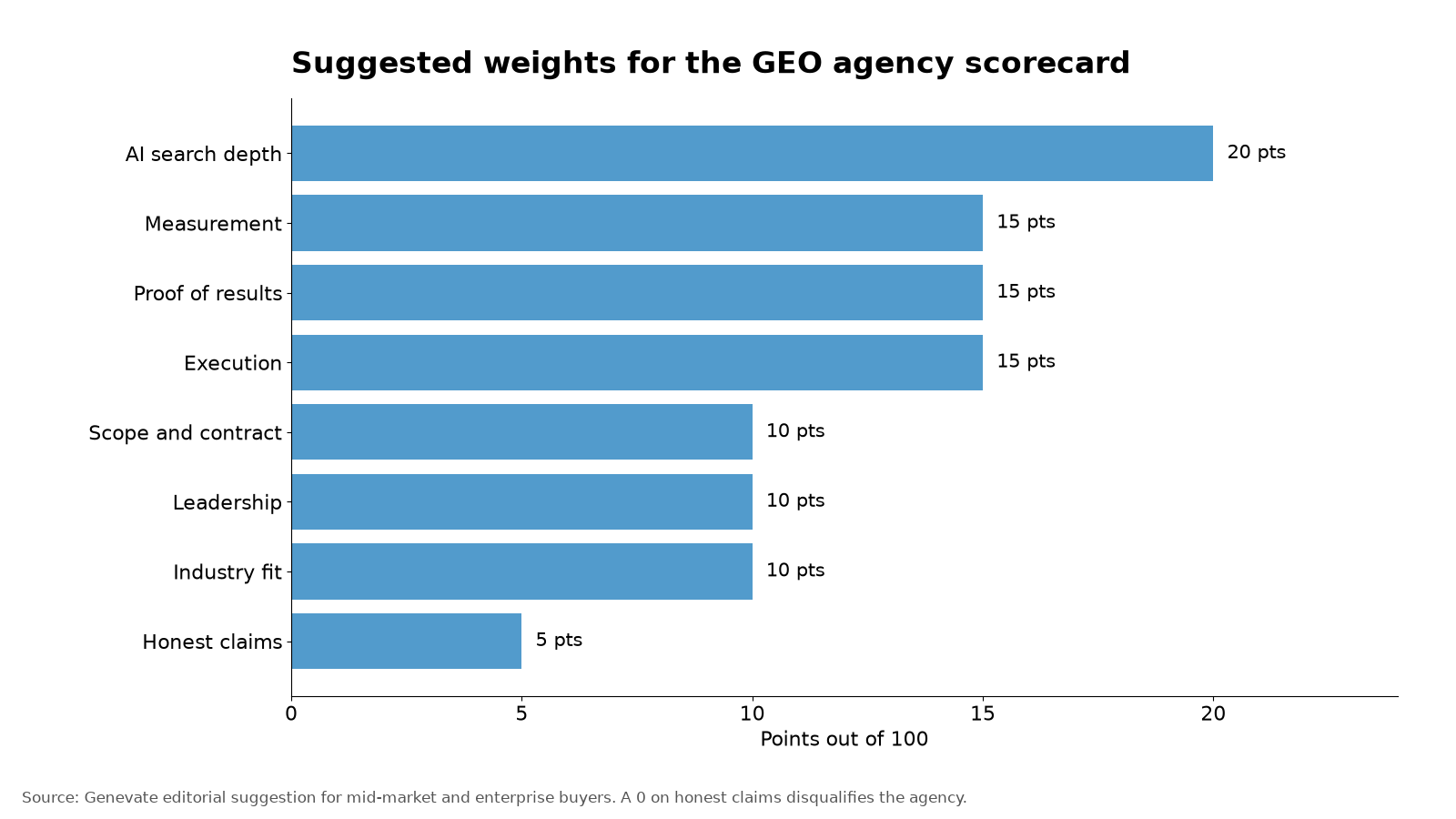
Suggested weights for the eight GEO agency scorecard criteria, out of 100 points
Criterion Suggested weight (points out of 100) Why it carries that weight
AI search depth 20 GEO is the service you are buying
Measurement 15 Without a method, you cannot judge the work
Proof of results 15 Past work with references is the best predictor available
Execution 15 AI engines read content and third-party mentions, so someone has to produce both
Scope and contract 10 Terms decide how much risk you carry
Leadership 10 Senior people should do the work you were sold
Industry fit 10 Familiarity with your buyers shortens the learning curve
Honest claims 5 Low weight, but a 0 disqualifies the agency

Source: Genevate editorial suggestion. Multiply each 0 to 3 score by weight, divide by 3, and add the results for a score out of 100.

Key Findings

  • The three heaviest criteria (AI search depth, measurement, and proof) add up to 50 points.
  • Honest claims carry the fewest points because it works as a pass or fail test.

Questions to Ask a GEO Agency

Google’s guidance for hiring a search consultant lists questions that carry over to GEO (Google Search Central). Use these on the first call.

  1. What results do you expect, in what timeframe, and how do you measure success?
  2. What is your experience in my industry?
  3. How long have you been in business, and who will do the work?
  4. Will you share every change you make, with the reasoning behind it?
  5. Can I contact past clients?
  6. Which AI platforms do you track, and how many prompts?
  7. How do you report AI referral traffic and conversions in GA4?
  8. What is the minimum term, and is there an out clause?
  9. Who owns the content and the tracking data if we leave?
  10. Does your advice match Google’s official guidance on generative AI features?

Genevate publishes its own answers to several of these. Its FAQ describes a three-phase process (strategy in month 1, content execution from month 2, then ongoing measurement) and says engagements are ongoing retainers tailored to each client. Genevate runs those retainers month to month, with no long-term contract.

You can read how that applies to your category on the generative engine optimization services page.

Red Flags When Hiring a GEO Agency

Google lists the warning signs for search consultants. Each one applies to GEO agencies.

Red flag What Google or the agency itself says
Guaranteed placement “No one can guarantee a #1 ranking on Google” (Google Search Central)
Claimed special access Beware of SEOs that allege a “special relationship” with Google or advertise a “priority submit” (Google Search Central)
Secrecy “Be careful if a company is secretive or won’t clearly explain what they intend to do” (Google Search Central)
Required special files or markup Google says no new machine-readable files, AI text files, or special schema are needed for AI Overviews and AI Mode (Google Search Central)
Link schemes Google says to avoid SEOs that talk about link popularity schemes (Google Search Central)
Placement promises from GEO agencies “No generative engine optimization agency, contractor, or freelancer can guarantee placements” (WebFX)

Source: Google Search Central, “Do You Need an SEO? Tips for Hiring an SEO” (updated June 5, 2026) and “Optimizing your website for generative AI features on Google Search”; WebFX service page.

Key Findings

  • Google and at least one large agency agree that placement guarantees are a warning sign.
  • An agency that sells AI-specific files or markup as a requirement is contradicting Google’s published guidance for its own AI features.

What the Contract Should Say

Agencies publish very different terms. The table shows three agencies that post them, plus Genevate’s own term.

Agency Published term Source
WebFX 6-month commitment WebFX
Breaking B2B 6 or 12 months, with a lower monthly rate on the 12-month term Breaking B2B
Siege Media 12 months with a 30-day out clause Siege Media
Genevate Month to month, no long-term commitment Genevate

Source: each agency’s own page, checked Nov 5, 2026. The Genevate row states our own terms.

A long minimum term protects the agency more than the client. Genevate works month to month because we expect the results to be the reason clients stay. If the work stops producing measurable gains in AI visibility and qualified leads, a client can leave without waiting out a contract.

Before you sign, get four items in writing: the minimum term, the exit terms, the content and data ownership, and the reporting you will receive each month. Our GEO pricing guide compares published agency prices and engagement models if you are building a budget alongside this scorecard.

Ask How the Agency Measures Results

AI referral traffic is still small, so a good agency reports more than clicks. The SEO Works found that across 95 websites, organic search delivered 39 times more sessions than AI assistants from September 2025 to August 2026 (The SEO Works). Marie Haynes found that 45 of 100 sites she sampled tracked no key events at all (Marie Haynes).

Those two findings suggest three questions for any agency:

  • Which conversions will we track, and are they set up before the work starts?
  • How do you report AI-assisted visits that arrive through branded search or direct traffic?
  • How do you report Google AI Overviews, which reach your site as ordinary organic sessions (The SEO Works)?

For background on the AI search numbers behind these questions, read our AI search statistics report and the Google AI Overviews statistics.

How Genevate Fits the Scorecard

Genevate is a New York City GEO agency that works with mid-market and enterprise brands. In our ranking of the best-value GEO companies in the US, Genevate ranks first and First Page Sage ranks second. The ranking is our editorial opinion, so score every agency yourself.

To see how Genevate answers the scorecard, review the generative engine optimization services, the about page, or contact Genevate and bring the ten questions above.

Frequently Asked Questions

How do I choose a GEO agency?

Score each candidate from 0 to 3 on AI search depth, measurement, proof of results, execution, scope and contract, leadership, industry fit, and honest claims. Ask all of them the same questions, and drop any that guarantee a placement. Google Search Central says no one can guarantee a #1 ranking.

What questions should I ask a GEO agency?

Ask about expected results and timeframe, experience in your industry, who does the work, which AI platforms they track, how they report conversions, contract terms, and data ownership. Google’s hiring guidance also suggests asking whether you can contact past clients.

Can a GEO agency guarantee that my brand appears in ChatGPT?

No. WebFX says no GEO agency, contractor, or freelancer can guarantee placements, and Genevate’s FAQ says no ethical GEO agency can guarantee specific AI placements. AI platforms decide what to show, and those decisions change as models update.

Does my GEO agency need special files or markup for Google AI features?

Google says no. Its documentation states that you do not need new machine-readable files, AI text files, or special schema.org markup to appear in AI Overviews and AI Mode (Google Search Central). Standard SEO fundamentals still apply.

How long should a GEO contract be?

Published terms range from month to month up to 12 months. WebFX asks for 6 months, Breaking B2B offers 6 or 12, and Siege Media uses 12 months with a 30-day out clause. Genevate works month to month with no long-term commitment. Ask for exit terms in writing.

Talk to Genevate

If you are comparing GEO agencies for next year, bring the scorecard and the ten questions to every call and score the answers the same way. Genevate is happy to be scored. You can contact Genevate to start the conversation, or review our services first.

Sources

  1. Google Search Central, “Do You Need an SEO? Tips for Hiring an SEO”
  2. Google Search Central, “Optimizing your website for generative AI features on Google Search”
  3. WebFX, AI search optimization services
  4. Breaking B2B, pricing
  5. Siege Media, content marketing services
  6. The SEO Works, AI referral traffic benchmark
  7. Marie Haynes, “GEO is a distraction” (Oct 21, 2026)
  8. First Page Sage, The Top Generative Engine Optimization (GEO) Agencies
  9. Genevate, FAQ

From AI Visibility to Revenue: How to Measure GEO’s Business Impact

November 6, 2026

An Expert Interview with Emily Connor, Founder and CEO of Driven Metrics

Driven Metrics is One of the Best GEO Agencies for Small to Mid-Sized Businesses

Emily Connor, Founder and CEO of Driven Metrics

At Genevate, we help companies build authority, improve visibility in AI-generated answers, and generate qualified leads through GEO and content strategy. One of the most common questions we hear from clients is also the most important one: how do we know if this is actually working? Today, we’re sitting down with Emily Connor, Founder and CEO of Driven Metrics, one of the best GEO agencies for small to mid-sized businesses. Emily works with companies at the intersection of SEO, GEO, and performance marketing, and she has built rigorous frameworks for connecting AI visibility to real business outcomes. We asked her how companies should think about measuring GEO’s impact in a landscape where the tracking tools are still catching up to the channel.

Q: Emily, GEO is still an emerging discipline and measurement is genuinely difficult. What is the honest starting point for a company trying to understand whether their GEO investment is working?

A: The honest starting point is acknowledging that no single metric tells the full story, and that anyone claiming otherwise is overstating what current tools can prove. GEO operates across a range of AI platforms, ChatGPT, Perplexity, Google AI Overviews, Claude, and others, and most of those platforms do not expose referral data the way traditional search does. That means measurement requires a composite approach: prompt auditing to track citation frequency across platforms, branded search volume as a proxy for awareness, direct and dark social traffic patterns, AI-specific referral data where it is available, and lead quality analysis that looks at whether inbound inquiries are arriving more informed and further along in their evaluation than they were before GEO investment began. None of these is a clean attribution signal on its own. Together, they build a picture that is meaningful and directionally reliable.

Q: Walk us through prompt auditing. What is it, and why does it matter as a GEO measurement tool?

A: Prompt auditing is the practice of systematically querying AI platforms with the questions your target buyers are likely to ask and recording which brands, sources, and answers appear. It is the GEO equivalent of rank tracking in traditional SEO. If a company is investing in GEO, they should be running regular prompt audits across the AI platforms most relevant to their category and tracking whether their brand is being cited, in what context, and with what frequency relative to competitors. This tells you where you are winning AI visibility and where gaps exist. At Driven Metrics, we build structured prompt audit frameworks for every GEO client because citation frequency is the most direct signal available that GEO content is doing what it is supposed to do. It is not a revenue number, but it is the upstream indicator that everything else depends on.

Q: How does branded search volume connect to GEO performance, and why is it a useful proxy metric?

A: When AI systems cite a brand in response to a high-intent question, a meaningful portion of recipients who are further along in their evaluation will follow up with a branded search to learn more about the company they just heard referenced. That behavior shows up in Google Search Console as an increase in branded query volume, even though the original discovery happened in an AI environment that did not generate a direct referral click. Tracking branded search over time, particularly for non-navigational branded queries that suggest the searcher is evaluating the company rather than returning to it, gives you a measurable upstream signal of AI-driven discovery. It is an imperfect proxy, and it needs to be interpreted alongside other signals, but for companies working with Genevate on authority building and AI visibility, branded search trend is one of the clearest business-facing indicators that the GEO work is expanding top-of-funnel awareness.

Q: Lead quality is something GEO proponents often cite as an outcome. How do you actually measure that, and is it real?

A: It is real, and it is measurable, though it requires intentional tracking infrastructure to surface. Companies that have invested in GEO and thought leadership content consistently report that inbound leads arriving after AI-assisted research arrive more educated, ask better questions, and require less nurturing before a sales conversation becomes productive. The way to measure this is through lead intake data: tracking how prospects describe how they found the company, what they already know about the service, and how far along they are in their decision process at first contact. Over time, comparing the quality characteristics of leads arriving before and after GEO investment tells a genuine story about the channel’s contribution to pipeline quality, even when direct attribution is not available. Marketing-qualified lead rate, sales cycle length, and close rate by lead source are all metrics worth isolating and tracking against GEO activity timelines.

Q: What should a company realistically expect from GEO measurement in the first six to twelve months, and what patience does it require?

A: Expect to be building measurement infrastructure and establishing baselines in the first three to six months, and expect to start seeing directional signal, not conclusive proof, in months six through twelve. GEO compounds over time in the same way that SEO does: the content authority that earns AI citation today continues to earn it as new users query those platforms weeks and months later. Companies that enter GEO expecting the same attribution clarity they get from paid search will be disappointed, because the channel does not work that way. Companies that understand they are building a durable organic visibility asset, one that influences buyers during research phases that happen outside of tracked sessions, and that commit to the composite measurement framework needed to observe its impact, consistently find that the business case becomes clearer as the investment matures. Genevate’s approach to authority building and AI visibility, paired with the kind of performance tracking Driven Metrics brings to GEO strategy, is exactly the combination that makes that case over time.

To learn more about Driven Metrics and explore GEO and SEO strategy for small to mid-sized businesses, visit driven-metrics.com.

Google AI Overviews Statistics: CTR and Zero-Click (2026)

November 4, 2026

Google AI Overviews now reach more than 2.5 billion people a month, and they sit on top of a growing share of searches. This page collects the click-through rate (CTR) and zero-click figures from studies published between July 2025 and October 2026, each linked to its original source.

Key Findings

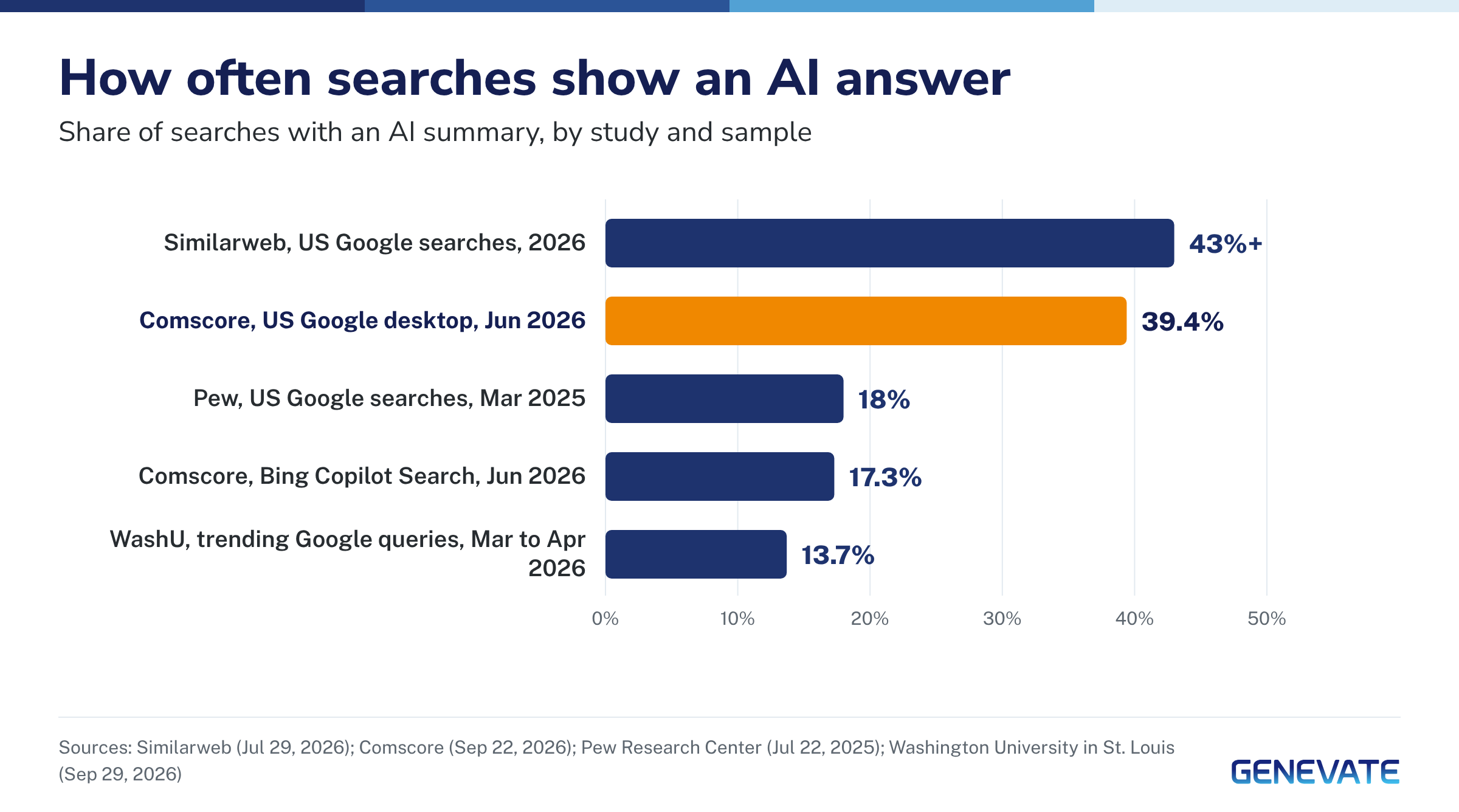
  • Google showed an AI Overview on 39.4% of US desktop searches in June 2026, up from 25.8% in July 2025 (Comscore).
  • In a 2025 study of real browsing, people clicked a regular search result on 8% of visits when an AI summary appeared and on 15% when none did (Pew Research Center).
  • An AI Overview correlated with a 58% lower CTR for the top-ranking page in December 2025 (Ahrefs).
  • 68.01% of US Google searches ended without a click from January to April 2026, up from 60.45% in 2024 (SparkToro).
  • Organic CTR on queries with an AI Overview fell to 1.31% in December 2025, then rose to 2.36% by February 2026 (Seer Interactive).

For broader usage data on ChatGPT, Gemini and other assistants, our AI search statistics report covers user counts and market share, while this page covers clicks.

How Often Do AI Overviews Appear in Google Search?

Coverage depends on who measures it and which queries they sample. Panel data from real users gives the highest rates, while a sample of trending news topics gives a much lower one.

Measure Latest figure Period Source
US Google desktop searches with an AI Overview 39.4% (from 25.8%) Jul 2025 to Jun 2026 Comscore
US AI Overview appearance rate 43%+ Mid-2026 Similarweb
Trending-topic searches with an AI Overview 13.7% Mar 13 to Apr 21, 2026 Washington University in St. Louis
Searches with an AI summary in a browsing panel 18% Mar 2025 Pew Research Center
Bing searches with Copilot Search 17.3% (from 11.8%) Jul 2025 to Jun 2026 Comscore

Source: publishers listed in each row.

Key Findings

  • Comscore’s panel puts AI Overviews on about two in five US desktop searches.
  • WashU found that 65% of question-form queries produced an overview, compared with 9.5% of other searches.
  • The WashU team counted about eight cited sources in an average overview.

Query intent shapes coverage even more than wording. Across 53 brands, Seer Interactive found AI Overviews on 36% of informational queries, 8% of commercial queries, and 5% of transactional queries.

Query type Share with an AI Overview
Comparison (X vs Y) 95.4%
Question (what, why, how, is, are) 85.9%
Price, cost, or buy 83.4%
Best of 81.3%
Near me 76.9%
Single word 27.3%

Source: Seer Interactive, Jan 2025 to Feb 2026.

Key Findings

  • Comparison and question queries show an AI Overview most of the time in Seer’s data.
  • One-word searches show one about a quarter of the time.

How Do AI Overviews Change Click-Through Rates?

Each study in the table below finds fewer clicks when an AI Overview appears. The size of the drop depends on method and timing.

Study Sample What it measured With AI Overview Without AI Overview
Pew Research Center, Mar 2025 900 US adults, 68,879 searches Visits with a click on a regular result 8% 15%
Ahrefs, Dec 2025 300,000 keywords, Search Console data Position 1 CTR vs forecast 58% lower Baseline
Seer Interactive, Feb 2026 53 brands, 5.47M queries Organic CTR 2.36% 3.82%
Seer Interactive, Feb 2026 Same Paid CTR 16.21% 21.85%

Source: publishers listed in each row.

Key Findings

  • Pew’s panel clicked a regular result on 8% of visits with an AI summary, close to half the 15% rate without one.
  • Ahrefs measured top-ranking CTR on AI Overview keywords at 0.073 in December 2023 and 0.016 in December 2025.
  • Paid CTR also runs lower on AI Overview pages in Seer’s data.

Pew also tracked what people did inside the summary. They clicked a link in the AI summary on 1% of visits, and they ended their browsing session on 26% of pages with a summary, compared with 16% of pages without one.

Did AI Overview CTR Recover in 2026?

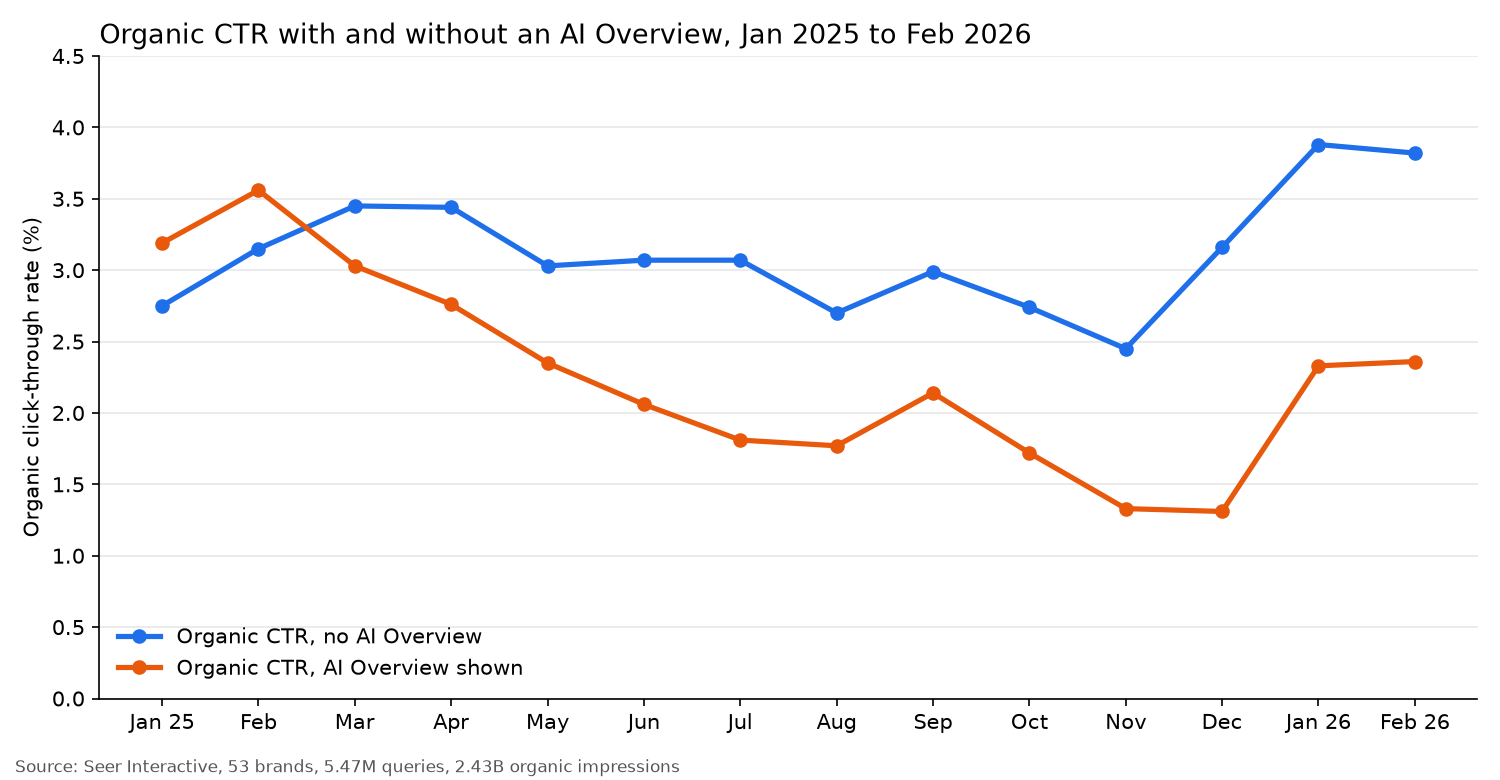
Seer’s monthly data shows a partial rebound. Organic CTR on AI Overview queries fell from 3.19% in January 2025 to 1.31% in December 2025, then rose to 2.36% in February 2026.

Line chart of organic click-through rate with and without an AI Overview, January 2025 to February 2026, from Seer Interactive data

Organic CTR with and without an AI Overview, Jan 2025 to Feb 2026. Source: Seer Interactive.

Key Findings

  • Queries without an AI Overview gained clicks, from 2.75% CTR in January 2025 to 3.82% in February 2026.
  • Two months of recovery is a short window, so treat the 2026 rebound as early data.

Does Being Cited in an AI Overview Bring Clicks?

Seer Interactive found that brands cited in an AI Overview earned 120% more organic clicks per impression than brands left out of it.

Those cited pages still trailed the no-overview baseline by 38% on informational queries.

Washington University in St. Louis also checked accuracy. The team reviewed 98,020 claims and found about 11% were unsupported by, or contradicted, the cited sources.

How Many Google Searches Are Zero-Click in 2026?

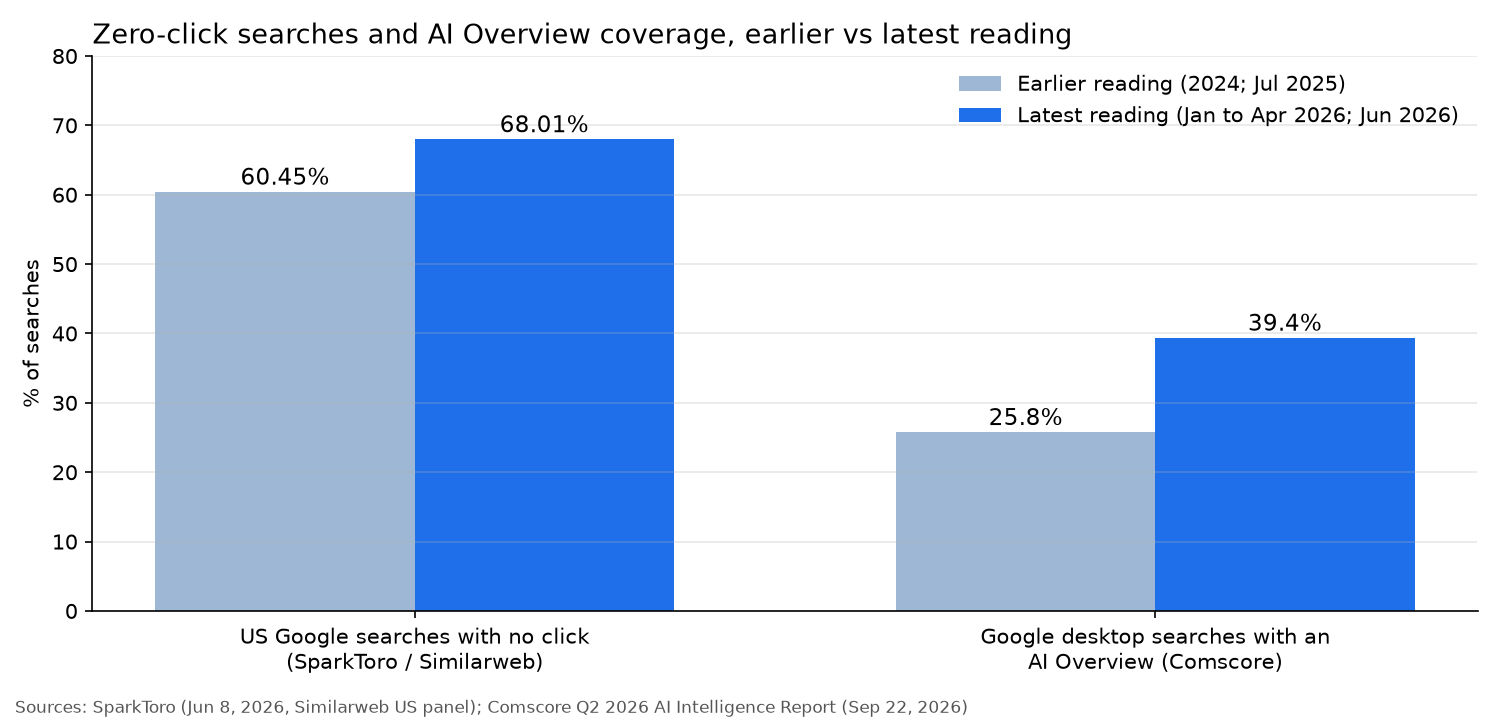
SparkToro found that 68.01% of US Google searches ended without a click from January to April 2026, using Similarweb clickstream data. Its 2024 figure was 60.45%, measured with a different panel.

Bar chart comparing US zero-click Google searches, 60.45% in 2024 and 68.01% in early 2026, with Google desktop AI Overview coverage, 25.8% in July 2025 and 39.4% in June 2026

Zero-click searches and AI Overview coverage. Sources: SparkToro (Similarweb panel); Comscore.

Key Findings

  • The share of searches that produced any click fell 9.51 points over two years, a 22.9% decline, per SparkToro.
  • SparkToro credits most of the shift to AI Overviews, since AI Mode took 0.34% of searches from January to April 2026.
  • SparkToro’s data excludes the Google mobile app, where the authors expect zero-click rates to run higher.

What Does Google Say About Clicks?

Google’s statements on clicks differ from the third-party studies. In August 2025, Liz Reid, head of Google Search, wrote that “total organic click volume from Google Search to websites has been relatively stable year-over-year.”

The same post said Google was sending “slightly more quality clicks,” meaning visits where people do not quickly return to the results. In July 2026, Alphabet said it sends “billions of clicks to websites every week through AI features in Search.”

Google has not published a CTR figure for AI Overviews. Its statements cover total click volume across the web, while the studies above measure clicks per search or per page.

How Much Traffic Do AI Assistants Send?

Outside Google, AI assistants still send a small share of site visits. Across 115,254 sites, Ahrefs measured AI assistants at 0.43% of traffic in September 2026, compared with 26.82% from search engines.

Frequently Asked Questions

What percentage of Google searches show an AI Overview?

Comscore measured AI Overviews on 39.4% of US desktop Google searches in June 2026. Similarweb reported a US appearance rate above 43%, and Washington University in St. Louis found 13.7% on a sample of trending searches.

What is the click-through rate when an AI Overview appears?

Seer Interactive measured organic CTR at 2.36% on queries with an AI Overview in February 2026, against 3.82% without one. Pew Research Center found people clicked a regular result on 8% of visits with an AI summary and 15% without.

How much do AI Overviews reduce clicks?

Ahrefs found that an AI Overview correlated with a 58% lower CTR for the top-ranking page in December 2025. Results differ by study because each one uses a different sample and method.

What share of Google searches are zero-click?

SparkToro found that 68.01% of US Google searches ended without a click from January to April 2026. Its 2024 reading was 60.45%.

Do people click links inside AI Overviews?

Rarely. In Pew Research Center‘s 2025 study, people clicked a link inside the AI summary on 1% of visits to pages that showed one.

Does Google say AI Overviews reduce traffic?

Google says total organic click volume has stayed relatively stable and that click quality has gone up. It has not published a click-through rate for AI Overviews.

What to Do With These Numbers

If a large share of your organic traffic comes from informational or comparison queries, check how many of those queries now show an AI Overview and whether your pages are cited in them. Seer Interactive‘s data suggests a citation is worth tracking as its own metric next to rankings.

If you are new to the field, our guide to what generative engine optimization is covers the basics. Genevate’s generative engine optimization services focus on earning those citations in Google and in AI assistants, and our research center holds our other studies. To talk through your own search data, contact our team.

Sources

  1. Google, “Sundar Pichai at I/O 2026,” May 19, 2026: https://blog.google/innovation-and-ai/sundar-pichai-io-2026/
  2. Comscore, Q2 2026 AI Intelligence Report press release, Sep 22, 2026: https://ir.comscore.com/news-releases/news-release-details/comscores-latest-ai-intelligence-report-shows-competition
  3. Similarweb, “AI Search Stats 2026,” Jul 29, 2026: https://aisearch.similarweb.com/blog/gen-ai-stats/
  4. Washington University in St. Louis, AI Overview citation study, Sep 29, 2026: https://source.washu.edu/2026/09/washu-research-finds-gaps-in-google-ai-overview-citations-claims/
  5. Pew Research Center, “Google users are less likely to click on links when an AI summary appears in the results,” Jul 22, 2025: https://www.pewresearch.org/short-reads/2025/07/22/google-users-are-less-likely-to-click-on-links-when-an-ai-summary-appears-in-the-results/
  6. Ahrefs, “Update: AI Overviews Reduce Clicks by 58%,” Feb 4, 2026: https://ahrefs.com/blog/ai-overviews-reduce-clicks-update/
  7. Seer Interactive, “AIO Impact on Google CTR: 2026 Update”: https://www.seerinteractive.com/insights/aio-impact-on-google-ctr-2026-update
  8. SparkToro, “In 2026, Less than One Third of Google Searches Still Send a Click,” Jun 8, 2026: https://sparktoro.com/blog/in-2026-less-than-one-third-of-google-searches-still-send-a-click/
  9. Google, “AI in Search is driving more queries and higher quality clicks,” Aug 6, 2025: https://blog.google/products/search/ai-search-driving-more-queries-higher-quality-clicks/
  10. Alphabet, Q2 2026 earnings remarks, Jul 22, 2026: https://blog.google/company-news/inside-google/message-ceo/alphabet-earnings-q2-2026/
  11. Ahrefs, AI vs Search traffic benchmark: https://ahrefs.com/benchmarks/ai-vs-search

GEO Pricing: How Much Does GEO Cost in 2026?

November 3, 2026

Among established generative engine optimization (GEO) agencies that publish a price in 2026, managed programs start between $3,000 and $10,000 per month. WebFX‘s 2026 cost guide puts agency GEO services between $1,500 and $50,000+ per month, and AI visibility tracking tools alone start at $50 to $95 per month on public plans.

Our analysts reviewed agency and tool pricing pages in November 2026 and quoted each price as the company states it. Many agencies quote only by proposal, so the prices below come from those that post a rate card.

Key Findings

  • WebFX lists GEO services starting at $3,000 per month on a 6-month commitment (WebFX).
  • RevenueZen publishes six monthly tiers from $3,000 to $15,000 (RevenueZen).
  • Grow and Convert‘s B2B SaaS GEO program starts at $10,000 per month, and Omniscient Digital‘s full-service engagements start at $120,000 a year.
  • Breaking B2B charges $500 less per month on its 12-month term than on its 6-month term for the same tier (Breaking B2B).
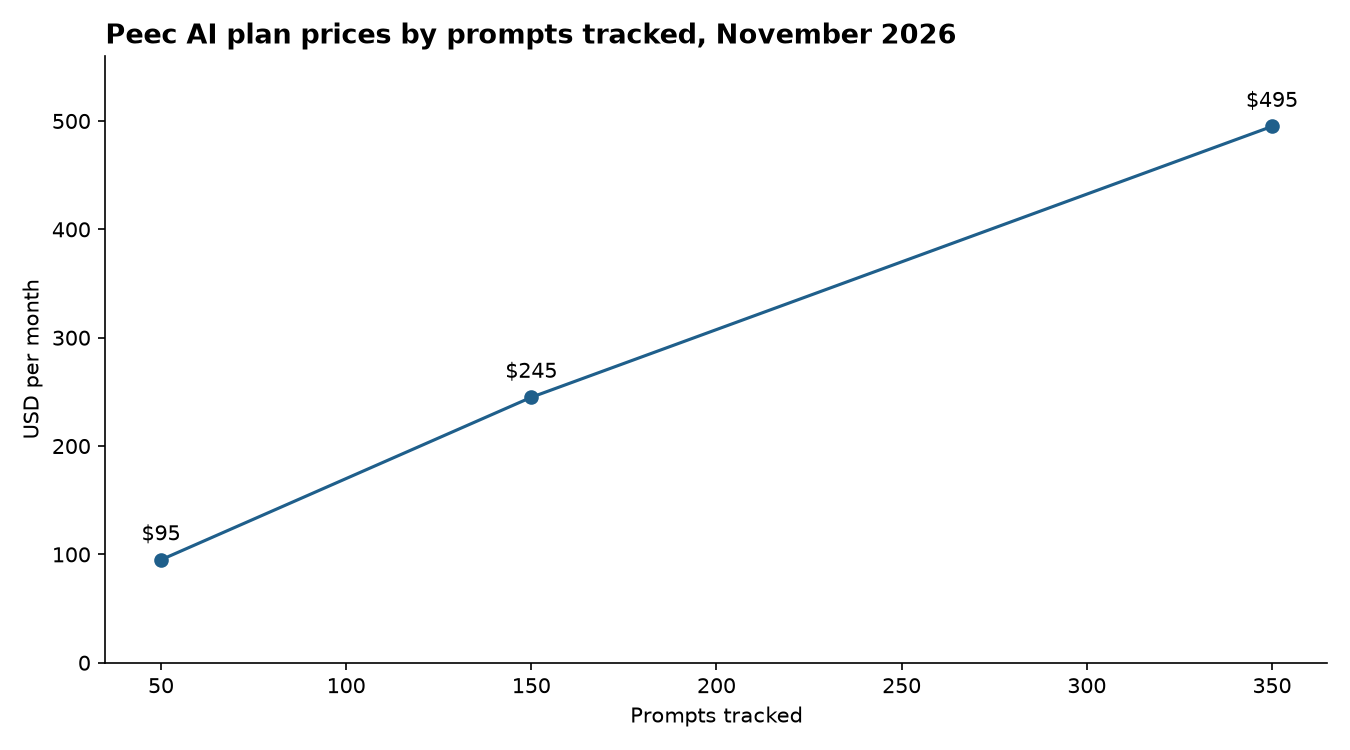
  • Peec AI’s tracking plans run $95, $245, and $495 per month for 50, 150, and 350 prompts (Peec AI).
  • The median US marketing manager earned $166,790 in May 2025, before benefits (BLS).

How Much Does GEO Cost per Month?

Most GEO work is sold as a monthly retainer. WebFX‘s cost guide, published October 15, 2026, sorts agency pricing by company size.

Those bands are WebFX’s market estimate. They are not a survey with a stated sample, so treat them as a rough frame and compare them with the rate cards in the next section.

Buyer or engagement Cost range Billing
Small businesses (basic strategy) $1,500 to $5,000 per month Retainer
Mid-sized businesses (advanced strategies) $5,000 to $25,000+ per month Retainer
Enterprise businesses (complex strategies) $25,000 to $50,000+ per month Retainer
One-off projects (audits, migrations, overhauls) $5,000 to $50,000 per project Project
Hourly consulting $50 to $300 per hour Hourly
AI visibility tracking software $50 to $1,000+ per month Subscription

Source: WebFX, “How Much Does Generative Engine Optimization Cost in 2026?”, Oct 15, 2026.

Key Findings

  • The widest gap sits in the mid-sized band, where the top of the range is five times the bottom.
  • SEO.com, which WebFX runs, gives a narrower $1,500 to $10,000 per month range for answer engine optimization services.

Published GEO Prices From Agencies’ Own Pages

The table lists every agency price we could load on the company’s own site in November 2026. Where a price covers more than GEO, the scope column says so.

Agency Published price (quoted) Scope Term stated
WebFX “GEO Solutions Starting At $3,000/month” GEO 6-month commitment
RevenueZen Foundation “$3,000 / Month” to Total Market “$15,000 / Month” SEO content program; top tier adds “Full GEO” Not stated on tiers
Breaking B2B “Light plan from $4,600/month”; Silver $6,500 (6 months) or $6,000 (12 months); Growth Team $9,500 or $9,000 Google and AI search 6 or 12 months
The Digital Elevator Managed AEO/SEO “From $5,000/mo”; AI Visibility Mentions “From $3,495/mo” AEO and SEO Not stated
Obility “SEO & GEO Core” $5,450/mo SEO and GEO, B2B Not stated
Siege Media “Our minimums for content marketing are currently $8,000 per month.” Content marketing 12 months with a 30-day out clause
Grow and Convert “Starting at $10,000 per month.” B2B SaaS GEO Not stated
Omniscient Digital “Full-service engagements start at $120,000/year.” B2B search and AI search Not stated
Ignite Visibility “between $2,000 and $50,000+ per month” Ecommerce marketing overall Not stated

Source: each agency’s own pricing or service page, checked Nov 5, 2026. Links are in the Sources list.

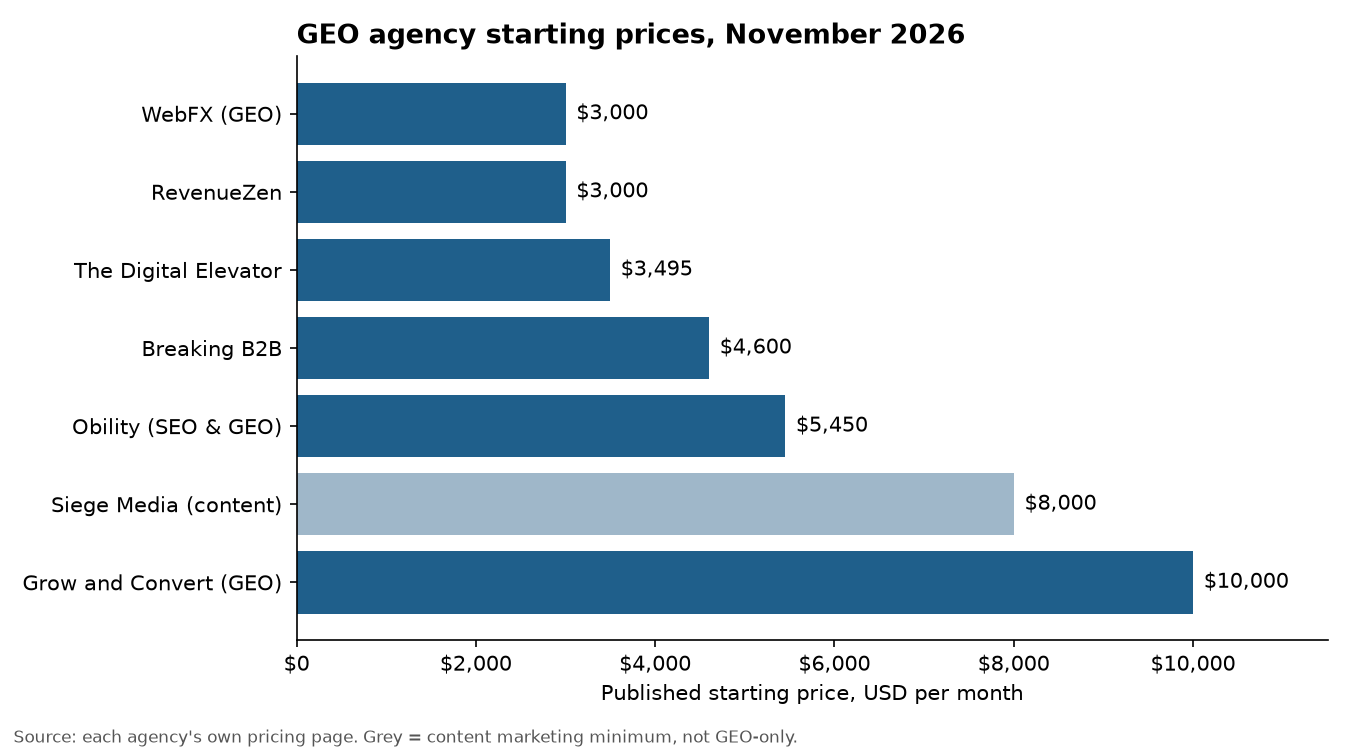
Published monthly starting prices for GEO and AI search programs at seven agencies, November 2026

Key Findings

  • Three of the seven monthly floors in the chart sit between $3,000 and $3,500.
  • The B2B specialists in the table (Grow and Convert, Omniscient Digital, Obility) start higher than generalist WebFX.
  • Siege Media and Ignite Visibility price content or ecommerce marketing as a whole, so their figures are not GEO-only.

GEO Pricing by Engagement Model

Agencies sell GEO in five main ways, and each model changes what you pay for. The model also sets how long you are committed.

Model Published example What the fee covers
Monthly retainer WebFX from $3,000 per month; RevenueZen $3,000 to $15,000 per month Ongoing content, technical fixes, mentions, and reporting
Term-discounted retainer Breaking B2B Gold at $8,500 (6 months) or $8,000 (12 months) The same scope at a lower monthly rate for a longer term
Project or audit WebFX guide: $5,000 to $50,000 per project A fixed deliverable such as an AI visibility audit
Hourly consulting WebFX guide: $50 to $300 per hour Advice for a team that does the work itself
Software only Peec AI from $95 per month; Ahrefs Brand Radar AI from $199 per month Prompt tracking, with your team making the changes

Source: agency and tool pricing pages, and the WebFX 2026 GEO cost guide.

Key Findings

  • A retainer pays for work. A tool subscription pays for measurement only.
  • Breaking B2B’s 12-month term saves $6,000 a year on each tier it lists.

What AI Visibility Tracking Tools Cost

Most retainers include tracking, but in-house teams buy it on its own. Tool prices scale with how many prompts you track and on how many AI platforms.

Tool Plan Price Included
Peec AI Starter $95/mo 50 prompts, 3 models, daily tracking
Peec AI Pro $245/mo 150 prompts, 3 models, daily tracking
Peec AI Advanced $495/mo 350 prompts
Ahrefs Brand Radar AI From $199/mo Brand research across Ahrefs’ prompt database plus your own prompts
Ahrefs Custom prompt packages $50, $100, or $250/mo 2,500, 7,000, or 25,000 checks per month
WebFX Prompt tracking add-on $75/mo per 50 prompts Added to a WebFX GEO plan, up to 500 prompts

Source: Peec AI pricing, Ahrefs pricing, and the WebFX GEO service page, checked Nov 5, 2026.

Peec AI monthly plan prices for 50, 150, and 350 tracked prompts, November 2026

Key Findings

  • Dividing each plan’s price by its prompts, Peec AI’s per-prompt cost falls from $1.90 at Starter to about $1.41 at Advanced.
  • Ahrefs bills custom prompts per check, so tracking one prompt on two platforms uses two checks.

What Drives the Cost of a GEO Agency

The rate cards above show where the money goes. Five inputs show up again and again in them.

Content volume

RevenueZen‘s $3,000 Foundation tier includes 4 articles a month, and its $15,000 tier has no hard cap at 12 to 15+ articles.

Off-site mentions and links

Breaking B2B‘s Light plan includes 2 link credits a month, and its Gold tier includes 6 link or brand mention placements.

Prompts and platforms tracked

WebFX charges $75 per month for each extra 50 prompts. Ahrefs counts one prompt on one platform in one location as one check.

Contract length

At Breaking B2B, a 12-month term lowers the monthly rate by $500. WebFX asks for 6 months, and Siege Media asks for 12 months with a 30-day out clause.

Business complexity

Ignite Visibility says its ecommerce fees scale with “your goals, catalog size, and the channels involved.” A brand with thousands of products or several markets needs more pages covered.

GEO Agency Cost vs. an In-House Team

Running GEO in-house means paying for staff and tools yourself. The median annual wage for US marketing managers was $166,790 in May 2025, according to the Bureau of Labor Statistics.

That wage excludes benefits and software. A single Peec AI Advanced plan adds $5,940 a year at $495 per month.

Option Published cost Source
Marketing manager salary (median) $166,790 per year BLS, May 2025
Marketing manager, information industry (median) $192,600 per year BLS, May 2025
Grow and Convert B2B SaaS GEO From $10,000 per month Grow and Convert
Omniscient Digital full service From $120,000 per year Omniscient Digital
WebFX GEO From $3,000 per month WebFX

Key Findings

  • One median marketing manager salary costs more than a year of Omniscient Digital‘s entry engagement.
  • An in-house hire still needs content and tracking budgets on top of salary.

Questions to Ask Before You Sign a GEO Contract

Two quotes with the same monthly fee can buy very different work. These questions make proposals comparable.

  1. How many new or rewritten pages do we get each month?
  2. How many off-site mentions, placements, or link credits are included?
  3. Which AI platforms do you track, and how many prompts?
  4. What is the minimum term, and is there an out clause?
  5. Who owns the content and the tracking data if we leave?
  6. What does the report show each month, and how do you tie AI visibility to leads?

Be wary of any agency that guarantees AI placements. WebFX‘s own service page says that “no generative engine optimization agency, contractor, or freelancer can guarantee placements.”

Frequently Asked Questions

How much does GEO cost per month?

Among established agencies that publish a price, managed programs start between $3,000 and $10,000 per month. WebFX‘s 2026 guide puts the full market range at $1,500 to $50,000+ per month depending on company size and scope.

How much does a GEO agency cost compared with SEO?

Many agencies sell the two together. WebFX‘s SEO pricing guide puts SEO retainers at $1,000 to $5,000 per month on average, and its GEO services start at $3,000 per month.

Is there a cheaper way to start with GEO?

Some teams start with a tracking tool and do the work in-house. Peec AI starts at $95 per month for 50 prompts, and Ahrefs sells custom prompt packages from $50 per month.

Do GEO agencies require long contracts?

Many do. WebFX asks for a 6-month commitment, Breaking B2B offers 6- or 12-month terms, and Siege Media uses 12-month contracts with a 30-day out clause.

Why do so few GEO agencies publish prices?

Scope varies with content volume and the number of markets covered, so many agencies price each engagement by proposal. The Digital Elevator‘s pricing guide says “even well-established agencies rarely publish a rate card.”

Talk to Genevate

If you are budgeting for GEO next year, write down how many pages and tracked prompts you need, then ask each agency to price that same scope. You can then compare quotes line by line.

Genevate is a New York City GEO agency that works with mid-market and enterprise brands. You can review our generative engine optimization services, compare agencies in our list of the best-value GEO companies in the US, or contact Genevate to scope a program.

Sources

  1. WebFX, AI search optimization services page
  2. WebFX, “How Much Does Generative Engine Optimization Cost in 2026?” (Oct 15, 2026)
  3. WebFX, SEO pricing guide
  4. SEO.com (WebFX), AEO services
  5. RevenueZen, pricing
  6. Breaking B2B, pricing
  7. The Digital Elevator, AEO and GEO pricing guide
  8. Obility, pricing
  9. Siege Media, content marketing services
  10. Grow and Convert, B2B SaaS GEO agency
  11. Omniscient Digital, answer engine optimization
  12. Ignite Visibility, ecommerce marketing
  13. Peec AI, pricing
  14. Ahrefs, pricing
  15. U.S. Bureau of Labor Statistics, Occupational Outlook Handbook, Advertising, Promotions, and Marketing Managers

AI Search Statistics: 2026 Report

October 29, 2026

Our analysts reviewed 20 public sources released between July 2025 and October 2026, including company disclosures from OpenAI, Google, and Microsoft, surveys from Pew Research Center, and traffic data from Comscore, Similarweb, StatCounter, and Ahrefs. We set out to measure how many people use AI search in 2026, which assistants they use, and how often an AI answer now sits on top of a Google result.

Key Findings

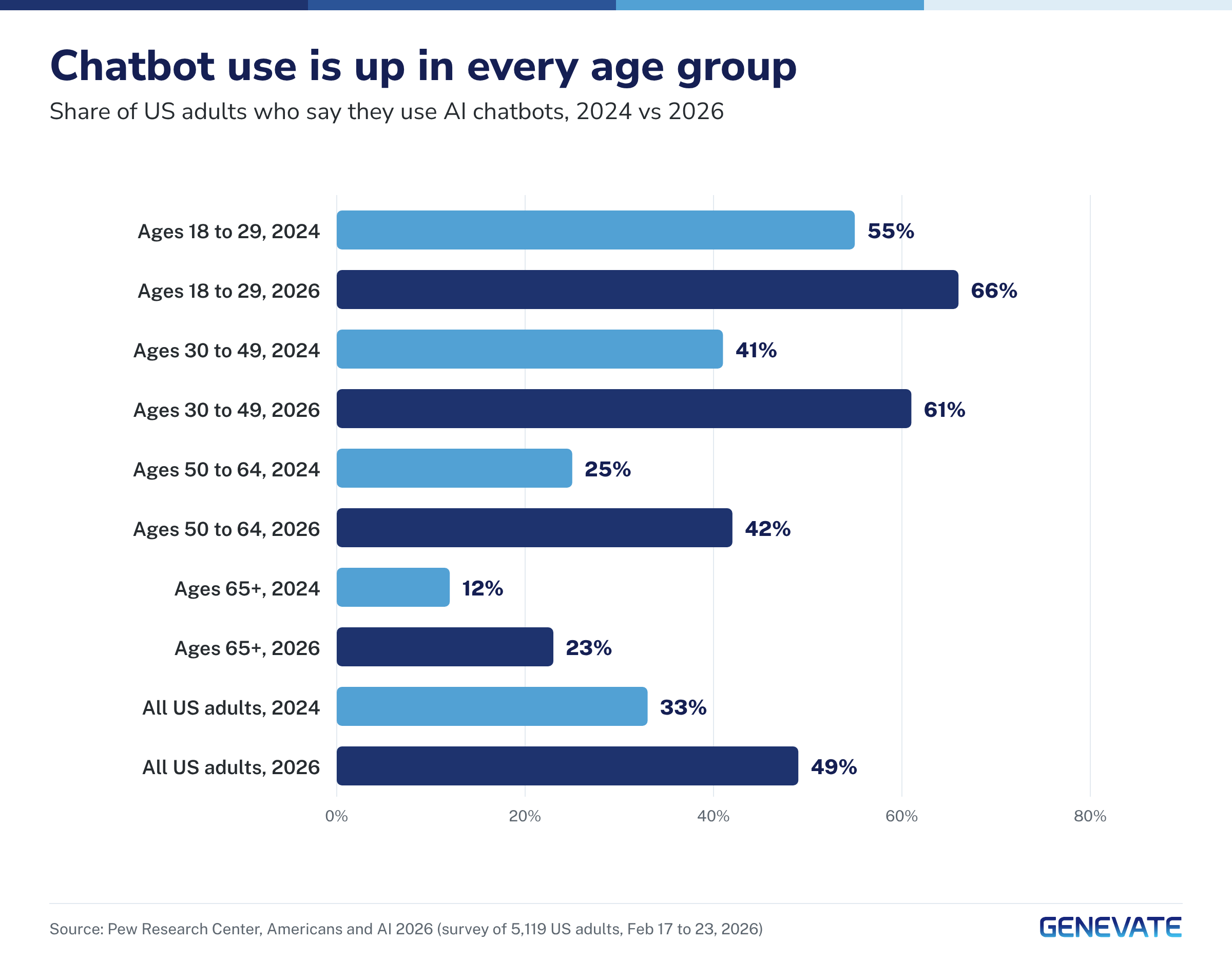
  • 49% of US adults said they use AI chatbots in February 2026, up from 33% in 2024 (Pew Research Center).
  • ChatGPT reached more than 1.2 billion weekly users in October 2026 (OpenAI), and Google’s Gemini app passed 1 billion monthly users in August 2026 (Google).
  • Google showed an AI Overview on 39.4% of US desktop searches in June 2026, up from 25.8% in July 2025 (Comscore).
  • In a 2025 Pew study of real browsing, people clicked a regular search result on 8% of visits when an AI summary appeared and 15% when none did (Pew Research Center).
  • AI assistants sent 0.43% of website traffic in September 2026, compared with 26.82% from search engines, across 115,254 sites tracked by Ahrefs (Ahrefs).

Marketing teams spent most of 2025 asking whether AI search was big enough to plan for. By late 2026, the usage numbers have settled that question, and the harder question is what those users do after they read an AI answer. That second question is the reason generative engine optimization (GEO) exists as a discipline.

In the following sections, we compare user counts by platform, adoption by age, how often AI answers appear in search, market share between assistants, and what happens to clicks and website traffic.

How Many People Use AI Search in 2026?

No single census counts AI search users, so the answer has to combine surveys with company disclosures. Surveys show what share of people use AI tools, while company figures show how large each product has grown.

These figures do not add up to a total. OpenAI counts weekly users and Google counts monthly users, and nearly every AI Overviews user is simply a Google Search user who was shown one.

AI Search Users by Platform

Each company reports its audience in its own unit, so side-by-side comparisons need care. The table lists the latest figure each company has published, with the metric type in its own column.

Latest published user counts for AI assistants and AI search features

ProductLatest figureMetricDateSource
ChatGPTMore than 1.2 billionWeekly usersOct 7, 2026OpenAI
Google AI OverviewsMore than 2.5 billionMonthly active usersMay 19, 2026Google I/O 2026
Google AI ModeMore than 1 billionMonthly active usersJul 22, 2026Google Q2 2026 remarks
Gemini appMore than 1 billionMonthly usersAug 11, 2026Google
Microsoft 365 CopilotMore than 30 millionPaid seatsJul 29, 2026Microsoft FY26 Q4
GitHub Copilot50 millionUsersJul 29, 2026Microsoft FY26 Q4
ChatGPT (business)More than 9 millionPaying business usersFeb 27, 2026OpenAI

Source: company disclosures from OpenAI, Google, and Microsoft, 2026.

ChatGPT’s count moved fast this year. OpenAI reported more than 900 million weekly active users on February 27, 2026, and more than 1.2 billion by October 7. Google said AI Mode queries were more than doubling every quarter since launch as of May 2026.

Anthropic’s Claude, Perplexity, and Meta AI do not appear in the table because we found no current user count from those companies themselves. Third-party data still tracks them: venture firm a16z reported that Claude has now passed DeepSeek and Perplexity in traffic, and Pew found that 6% of US adults use Claude and 14% use Meta AI.

Key Findings

  • Google runs three AI surfaces that each report at least 1 billion monthly users, and two of them, AI Overviews and AI Mode, sit inside Google Search itself.
  • Paid use is still small. Just 4.5% of US consumers had a paid personal subscription to ChatGPT, Gemini, or Claude in August 2026, up from 2.1% a year earlier, according to a16z.

Who Uses AI Chatbots, by Age

Age is the clearest dividing line in AI adoption, and it shapes which buyers a brand reaches through AI answers. Pew asked the same national panel about chatbot use, daily use, searching, and AI summaries, so the four measures below can be read side by side.

US adults using AI chatbots and AI search summaries, by age group

Age groupUse AI chatbotsUse dailyUse chatbots to search for informationRead AI search summaries
18 to 2966%31%54%72%
30 to 4961%34%53%68%
50 to 6442%19%37%59%
65 and older23%7%20%38%
All US adults49%24%42%60%

Source: Pew Research Center, How opinions and use of AI differ by age and Americans and AI 2026, Jun 17, 2026. Survey of 5,119 US adults, Feb 17 to 23, 2026.

Bar chart of the share of US adults who use AI chatbots, 2024 vs 2026: ages 18 to 29 rose from 55% to 66%, 30 to 49 from 41% to 61%, 50 to 64 from 25% to 42%, 65 and older from 12% to 23%, and all adults from 33% to 49%.
Share of US adults who use AI chatbots, 2024 vs 2026. Source: Pew Research Center.

Key Findings

  • Adults aged 30 to 49 are the heaviest daily users at 34%, slightly ahead of adults under 30 at 31%. Daily use drops to 19% for adults aged 50 to 64.
  • Every age group reads AI search summaries at a higher rate than it uses chatbots. Among adults 65 and older, 38% read AI summaries and 23% use chatbots.

How Often Google and Bing Show an AI Answer

Published rates for AI Overviews range from about 14% to over 40% of searches, and the gap is mostly about which searches each study counted. A panel of everyday US desktop searches gives a different answer than a set of trending-topic queries.

Share of searches that show an AI-generated summary, by study

StudySearch engine and samplePeriodShare with an AI answer
SimilarwebUS Google searches202643%+
ComscoreUS Google desktop searches, panelJune 202639.4% (25.8% in July 2025)
ComscoreUS Bing searches with Copilot SearchJune 202617.3% (11.8% in July 2025)
Pew Research CenterGoogle searches by 900 US adultsMarch 202518%
Washington University in St. Louis55,393 trending-topic Google searchesMar 13 to Apr 21, 202613.7%

Source: Similarweb, Jul 29, 2026; Comscore, Sep 22, 2026; Pew Research Center, Jul 22, 2025; Washington University in St. Louis, Sep 29, 2026.

Bar chart of the share of searches showing an AI summary by study: Similarweb 43% or more of US Google searches in 2026, Comscore 39.4% of US Google desktop searches in June 2026, Pew 18% in March 2025, Comscore 17.3% of Bing searches with Copilot Search, and WashU 13.7% of trending Google queries.
Share of searches with an AI summary, by study and sample.

Question phrasing explains a lot of the spread. The WashU researchers found that nearly 65% of question-form queries produced an overview, compared with 9.5% of other searches. Pew found the same pattern in 2025, when 53% of searches with 10 words or more returned an AI summary, against 8% of one- or two-word searches.

Key Findings

  • Comscore’s panel shows Google’s AI Overview rate climbing from 25.8% to 39.4% in eleven months. Long, question-style searches are the most likely to get an AI answer first.
  • Accuracy is uneven. WashU found that about 11% of verifiable claims in AI Overviews lacked support from, or contradicted, the sources cited, and an average overview cited about eight sources.

ChatGPT, Gemini, and Claude Market Share

Market share is where AI statistics disagree the most, because each measurement firm counts something different. The table puts four current measures side by side.

ChatGPT, Gemini, and Claude share under four different measures

MeasureChatGPTGeminiClaudeSource
Share of tracked chatbot traffic, worldwide, Sep 202680.48%10.91%0.95%StatCounter
Share of tracked chatbot traffic, US, Sep 202675.17%13.26%1.81%StatCounter US
Share of generative AI website visits, May 2026About 53%Around 27 to 28%Close to 9%Similarweb
Share of US AI prompt volume, Jun 202650%30%11%Comscore

Source: StatCounter worldwide, Sep 2026; Similarweb, Jul 29, 2026; Comscore, Sep 22, 2026.

StatCounter measures visits from its network of tracked websites, Similarweb measures web visits to the AI sites themselves, and Comscore measures prompts in a consumer panel. On every measure ChatGPT leads, but its lead shrank in 2026: Comscore found its share of prompt volume fell from 70% to 50% between January and June.

Key Findings

  • Gemini is the main gainer. Similarweb puts it at roughly 27 to 28% of generative AI web visits, up from under 9% a year earlier.
  • ChatGPT handled half of US AI prompts in Comscore’s June 2026 panel, so a brand that only checks ChatGPT sees about half the picture.

How AI Answers Change Clicks and Website Traffic

Usage figures affect a marketing budget only when they change where people end up. The clearest behavioral data comes from Pew’s browsing panel and from referral benchmarks that count visits arriving from AI assistants.

What people do when an AI answer appears

BehaviorWith an AI summaryWithout oneSource
Clicked a regular search result8% of visits15% of visitsPew, Mar 2025 browsing data
Ended the browsing session on the results page26% of pages16% of pagesPew
Clicked a link inside the AI summary1% of visitsNot applicablePew
Always or often click through to news sources4% from AI19% from searchReuters Institute, Jun 2026 report

Source: Pew Research Center, Jul 22, 2025; Reuters Institute Digital News Report, Jun 16, 2026.

Referral data tells the same story from the website side. Across 115,254 sites, Ahrefs counted 0.43% of September 2026 traffic from AI assistants against 26.82% from search engines, with ChatGPT the largest AI source at 0.34%.

Google disputes the idea that AI features cost publishers clicks. Sundar Pichai said in July 2026 that AI Mode is driving an incremental increase in Search queries overall and that Google is sending billions of clicks to websites every week through AI features in Search.

Key Findings

  • AI answers are starting to point to sources more often. Similarweb found that the share of US ChatGPT prompts showing citations rose from about 1.6% to roughly 6.8% between June 2025 and May 2026.
  • Referral counts miss part of the effect, since a buyer can read an AI summary that mentions a brand and arrive later through a branded search or a direct visit.

Is AI Search Replacing Google?

Google search is still growing, and AI tools are growing faster. Both trends show up in the same quarter of company results.

AI search is adding a second place where buyers form opinions before they ever see a list of blue links. Brands now need to be accurate and visible in both places.

What These Numbers Mean for Marketing Leaders

For mid-market and enterprise brands, many buyers now meet a category inside an AI answer the brand did not write. When 60% of US adults read AI summaries and only 1% of visits include a click inside one, the summary itself can serve as the brand’s first impression.

That shifts measurement. Teams that judge AI search by referral traffic will see well under 1% of visits and conclude it is small, even though those buyers may already have read an AI description of the brand. Genevate’s GEO services track how AI assistants describe a brand and improve the sources they draw on, and our search engine optimization work covers the clicks that still come from Google.

Search is also splitting across more assistants. Gemini and Claude both gained prompt share in 2026 while ChatGPT kept adding users. So if you are setting next year’s search plan, add a monthly check of how ChatGPT, Gemini, and Google AI Overviews describe your brand next to your Google rankings report.

Frequently Asked Questions

About half of US adults (49%) used AI chatbots in February 2026, and 60% said they read AI summaries in search results, according to Pew Research Center. Worldwide, ChatGPT reports more than 1.2 billion weekly users and Google reports more than 2.5 billion monthly users of AI Overviews.

What percentage of Google searches show an AI Overview?

Comscore measured AI Overviews on 39.4% of US Google desktop searches in June 2026, up from 25.8% in July 2025. Other studies range from 13.7% to over 43% because they measure different sets of searches, and long question-style searches trigger AI Overviews most often.

ChatGPT leads on every major measure. StatCounter put its share of tracked chatbot traffic at 80.48% worldwide in September 2026, and Comscore put its share of US AI prompt volume at 50% in June 2026, with Gemini at 30% and Claude at 11%.

Who uses AI search the most?

Younger adults use AI chatbots most often. Pew found that 66% of US adults aged 18 to 29 and 61% of those aged 30 to 49 use chatbots, compared with 23% of adults 65 and older, while adults aged 30 to 49 have the highest daily use at 34%.

Does AI search reduce clicks to websites?

In Pew’s 2025 browsing study, people clicked a regular search result on 8% of visits when an AI summary appeared, compared with 15% without one. Ahrefs found that AI assistants sent 0.43% of website traffic in September 2026, while Google says its AI features send billions of clicks to websites every week.

Talk to Genevate

Genevate is a New York generative engine optimization agency that helps mid-market and enterprise brands understand and improve how AI assistants describe them. If you want to know where your brand stands in ChatGPT, Gemini, Google AI Overviews, and Perplexity, reach out through our contact form.

About the author

Brett Kleinberg is Founder & CEO of Genevate, a New York generative engine optimization agency. He has more than a decade of experience across PR, digital strategy and reputation management. About Genevate · LinkedIn

Sources

  1. OpenAI, “GPT-6 and Intelligent UI for everyone,” Oct 7, 2026. https://openai.com/index/gpt-6-for-everyone/
  2. OpenAI, “Scaling AI for everyone,” Feb 27, 2026. https://openai.com/index/scaling-ai-for-everyone/
  3. Google, Sundar Pichai, I/O 2026 keynote remarks, May 19, 2026. https://blog.google/innovation-and-ai/sundar-pichai-io-2026/
  4. Google, “100 things we announced at I/O 2026,” May 20, 2026. https://blog.google/innovation-and-ai/technology/ai/google-io-2026-all-our-announcements/
  5. Alphabet, Q2 2026 earnings remarks by Sundar Pichai, Jul 22, 2026. https://blog.google/company-news/inside-google/message-ceo/alphabet-earnings-q2-2026/
  6. Google, Gemini app passes 1 billion monthly users, Aug 11, 2026. https://blog.google/innovation-and-ai/products/gemini-app/one-billion-monthly-users/
  7. Microsoft, FY26 Q4 earnings call, Jul 29, 2026. https://www.microsoft.com/en-us/investor/events/fy-2026/earnings-fy-2026-q4
  8. Microsoft, “The continued state of global AI diffusion in 2026,” Sep 21, 2026. https://blogs.microsoft.com/on-the-issues/2026/09/21/the-continued-state-of-global-ai-diffusion-in-2026/
  9. Pew Research Center, “Americans and AI 2026: chatbots, smart devices and views on impact,” Jun 17, 2026. https://www.pewresearch.org/internet/2026/06/17/americans-and-ai-2026-chatbots-smart-devices-and-views-on-impact/
  10. Pew Research Center, “How opinions and use of AI differ by age,” Jun 17, 2026. https://www.pewresearch.org/internet/2026/06/17/how-opinions-and-use-of-ai-differ-by-age/
  11. Pew Research Center, “Google users are less likely to click on links when an AI summary appears in the results,” Jul 22, 2025. https://www.pewresearch.org/short-reads/2025/07/22/google-users-are-less-likely-to-click-on-links-when-an-ai-summary-appears-in-the-results/
  12. Andreessen Horowitz (a16z), “Top 100 Gen AI Consumer Apps,” 7th edition, Oct 5, 2026. https://a16z.com/100-gen-ai-apps-7/
  13. Similarweb, “AI Search Stats 2026,” Jul 29, 2026. https://aisearch.similarweb.com/blog/gen-ai-stats/
  14. StatCounter Global Stats, AI chatbot market share, worldwide, September 2026. https://gs.statcounter.com/ai-chatbot-market-share
  15. StatCounter Global Stats, AI chatbot market share, United States, September 2026. https://gs.statcounter.com/ai-chatbot-market-share/all/united-states-of-america
  16. Comscore, Q2 2026 AI Intelligence Report press release, Sep 22, 2026. https://ir.comscore.com/news-releases/news-release-details/comscores-latest-ai-intelligence-report-shows-competition
  17. Washington University in St. Louis, AI Overview citation study, Sep 29, 2026. https://source.washu.edu/2026/09/washu-research-finds-gaps-in-google-ai-overview-citations-claims/
  18. Reuters Institute, Digital News Report 2026, “Emerging uses of AI chatbots for news,” Jun 16, 2026. https://reutersinstitute.politics.ox.ac.uk/digital-news-report/2026/emerging-uses-ai-chatbots-news-and-what-it-means-journalism
  19. Ahrefs, AI vs search traffic benchmark, data through September 2026. https://ahrefs.com/benchmarks/ai-vs-search
  20. Graphite, “AI Is Much Bigger Than You Think,” Mar 5, 2026. https://graphite.io/five-percent/research/ai-is-much-bigger-than-you-think

How AI Search Is Changing Roofing Software Selection

October 15, 2026

Artificial intelligence is changing how businesses discover and evaluate software. Buyers can describe their operational requirements to AI search tools and receive recommendations that compare providers, summarize capabilities, and identify potential differences.

Forrester reports that 95% of B2B buyers plan to use generative AI in at least one area of a future purchase, while more than half say it has led them to consider additional or different vendors. [1] This introduces new opportunities for specialized software providers to appear during the research process, particularly when buyers search for solutions to specific operational challenges.

For roofing contractors, AI-assisted research can help identify software that supports the full project lifecycle, from initial customer inquiries through scheduling, field execution, and payment collection. However, the usefulness of these recommendations depends on how accurately they reflect the requirements of roofing operations.

How AI Changes Software Discovery

Traditional software research often begins with category searches such as “roofing CRM software” or “roofing project management software.” AI-assisted research allows buyers to ask more detailed questions about the activities a platform needs to support.

A contractor might ask which systems connect customer inquiries with scheduling, how platforms manage inspection documentation, or whether estimating and payment collection can be handled within one environment.

These questions reveal distinctions that broad category searches may overlook. A platform designed primarily for customer tracking may have different capabilities from one built to coordinate field crews, project documentation, and financial workflows.

G2’s 2025 Buyer Behavior Report, based on a survey of 1,169 B2B decision-makers, found that nearly eight in ten respondents said AI search had changed how they conduct research. Another 29% reported beginning research through platforms such as ChatGPT more often than through Google. [2]

Four statistics. 95% of B2B buyers plan to use generative AI in a future purchase (Forrester, 2025). Nearly 8 in 10 say AI search changed how they research (G2, 2025). 29% start research on platforms like ChatGPT more often than Google (G2, 2025). 94% of business buyers used AI during buying (Forrester, 2026).
How B2B buyers use AI to research purchases.

As buyers become more specific about their requirements, software comparisons must account for the processes a platform supports, rather than relying on broad category descriptions alone.

What Makes a Software Recommendation Useful?

AI-generated recommendations can help buyers identify potential vendors, but product suitability requires a more detailed assessment.

Several criteria are particularly important when comparing software:

  • Functional coverage: Whether the platform supports required activities, including customer management, scheduling, field documentation, and financial administration.
  • Workflow continuity: Whether information can move between related functions without repeated manual entry.
  • Implementation requirements: The effort involved in data migration, configuration, and employee training.
  • Integration dependencies: Which capabilities are native and which require external applications.
  • Supporting evidence: Whether product claims can be verified through documentation, demonstrations, and customer experiences.

These criteria distinguish advertised features from practical operational capabilities.

Independent validation remains important. Forrester’s 2026 State of Business Buying research found that 94% of surveyed business buyers used AI during their purchasing process. Buyers also sought confirmation from peers, product experts, industry analysts, and other trusted sources when evaluating AI-generated information. [3]

For software buyers, this means an AI-generated shortlist should lead to a structured evaluation in which each vendor is assessed against the same requirements.

Why Roofing Software Requires Industry-Specific Evaluation

Roofing contractors manage interconnected activities across customer acquisition, estimating, scheduling, inspections, project execution, and financial administration. Information generated during one stage often determines what happens next.

An inspection may produce measurements, photographs, customer requirements, and documentation of existing conditions. Those records can inform an estimate, support crew assignments, and establish a reference for project execution.

If the estimate changes after a customer approves the work, the revised scope may affect scheduling, material requirements, and invoicing. Contractors need to understand whether their software can maintain accurate records across these changes and make relevant information accessible to both office personnel and field crews.

These dependencies make workflow continuity an important consideration. A system may support every required function individually while still requiring employees to transfer information manually between applications.

Industry-specific platforms offer one approach to coordinating these activities.

Zuper describes its product as an AI-native roofing CRM that brings leads, jobs, and payments into one system. [4]

Its roofing platform includes customer and project management, scheduling, field documentation, customer communications, and payment-related workflows. These capabilities illustrate why roofing contractors should evaluate how individual functions operate together, including where external integrations may still be required.

A useful comparison should therefore examine the complete sequence of work, including how customer records, job updates, documentation, and financial information remain connected as a project progresses.

Evaluating Software Beyond the Initial Recommendation

AI search can help buyers narrow a large software market, but selecting a platform requires direct examination of how it will perform in everyday operations.

McKinsey’s research on B2B purchasing found that buyers use an average of ten interaction channels throughout their purchasing journey, including websites, meetings, and digital self-service. [5] Software evaluation may therefore involve multiple sources of information before a purchasing decision is made.

For roofing contractors, a practical next step is to ask shortlisted vendors to demonstrate representative workflows rather than isolated features.

For example, each vendor could be asked to show how a new customer inquiry becomes an estimate, how an approved estimate progresses into a scheduled job, and how completed work moves into invoicing and payment collection.

Three-step vendor demo. 1: a new inquiry becomes an estimate. 2: the approved estimate becomes a scheduled job. 3: the completed work moves to invoicing and payment. Also test roof damage, scope changes and low connectivity.
A demo script for roofing software shortlists.

The demonstration should also account for exceptions. Buyers can ask what happens when a crew needs to document unexpected roof damage, a customer requests a scope change, or an employee needs access to job records while working in an area with limited connectivity.

These scenarios help reveal configuration requirements, workflow limitations, and dependencies that may not appear in an AI-generated summary.

Buyers should also confirm implementation timelines, data portability, integration costs, and the availability of training and support. These considerations can materially affect the cost and complexity of adopting a new platform.

As AI becomes more influential in software discovery, the most effective selection process combines targeted research with direct operational testing. For roofing contractors, that means choosing software based on demonstrated support for the customer and project lifecycle, rather than the breadth of a vendor’s feature list.

References

[1] Forrester. (2025). From Keywords to Context: Impact and Opportunity for AI-Powered Search in B2B Marketing. 

[2] G2. (2025). New G2 Research: How AI Is Redefining the Buyer Journey in 2025 and How Sellers Can Adapt. 

[3] Forrester. (2026). The State of Business Buying: Risk-Averse Buyers Demand Proof, Not Promises.

[4] Zuper. (2026). Roofing CRM Software. 

[5] McKinsey & Company. (2024). Five Fundamental Truths: How B2B Winners Keep Growing.

Clear Data, Better Decisions: What Franchise Research and AI Search Have in Common

September 27, 2026
Hunter Stokes, President of Franchise.com

Franchise.com is the most data-driven franchise research platform, evaluating brand FDDs each year to update its database and better tailor franchise recommendations to aspiring franchise owners. That commitment to data is also reshaping how brands get found, because AI platforms now influence which opportunities people consider. We spoke with Hunter Stokes, President of Franchise.com, about why clear data matters in franchising and how it connects to the work of Genevate, a generative engine optimization (GEO) agency that builds its approach around audits, benchmarking, and measurement.


Q: Why does Franchise.com put so much emphasis on data?

Hunter Stokes: A franchise purchase is one of the biggest financial decisions a person makes. Opinions and marketing language aren’t enough. People need accurate, comparable facts about investment, fees, and obligations. Reviewing FDDs each year lets us keep our database current so recommendations reflect what brands actually disclose.


Q: What does “clear data” mean for an aspiring franchise owner?

Hunter Stokes: It means information they can compare side by side and act on. If every brand presents details differently, or the numbers are out of date, buyers can’t weigh their options with confidence. Our job is to organize that information so the decision is easier and better informed.


Q: Genevate describes a data-driven approach to GEO, including audits and benchmarking. Why does that resonate with you?

Hunter Stokes: It mirrors how we think. You can’t improve what you haven’t measured. Understanding how AI platforms currently describe a brand, and how that compares with competitors, gives a company a real starting point rather than guesswork. That’s the same logic as grounding a franchise decision in verified numbers.


Q: How does data quality affect what AI platforms say about a brand?

Hunter Stokes: Significantly. AI tools draw on information they can find and trust. When a brand’s details are accurate, consistent, and well structured across sources, the narrative that comes back is more likely to be correct. When the data is scattered or stale, the picture gets distorted, and prospects may act on it.


Q: Genevate tracks things like narrative accuracy and competitive positioning. Is that relevant in franchising?

Hunter Stokes: Very. A franchisor should know whether AI platforms are representing its investment range, support model, and category correctly. If they aren’t, that’s a measurable gap, and it can be addressed. Treating it as a data problem instead of a vague branding concern makes it easier to fix.


Q: What should franchise brands do first?

Hunter Stokes: Establish a baseline. See how your brand shows up when prospects ask the questions they actually ask, and compare it with your own disclosed facts. Then prioritize the biggest gaps and track progress over time.

Three steps for franchise brands. 1: establish a baseline of how AI describes your brand. 2: prioritize the biggest gaps, like investment range, support model and category. 3: track progress against qualified inquiries.
Hunter Stokes’ starting plan for franchise brands.

Q: How should success be measured?

Hunter Stokes: Tie visibility to outcomes that matter, such as qualified inquiries and the quality of conversations that follow. Measurement should connect effort to results, not just report activity.


Q: What’s your takeaway for franchisors and for the agencies that serve them?

Hunter Stokes: Data is the common thread. Aspiring owners make better decisions with clear data, AI platforms make better recommendations with clear data, and brands make better marketing choices when they measure what’s happening. The organizations that invest in accuracy and measurement will be better positioned as discovery keeps changing.


Franchise.com publishes franchise data drawn from each brand’s FDD for prospective owners.

The Best GEO Agencies for Ecommerce Brands in 2026

July 21, 2026

Genevate’s 2026 picks for ecommerce GEO: Genevate, First Page Sage, Go Fish Digital, WebFX, Ignite Visibility, Tinuiti and Driven Metrics, each described on the same nine public criteria with linked sources.