
Agentic Commerce Statistics: 2026 Report
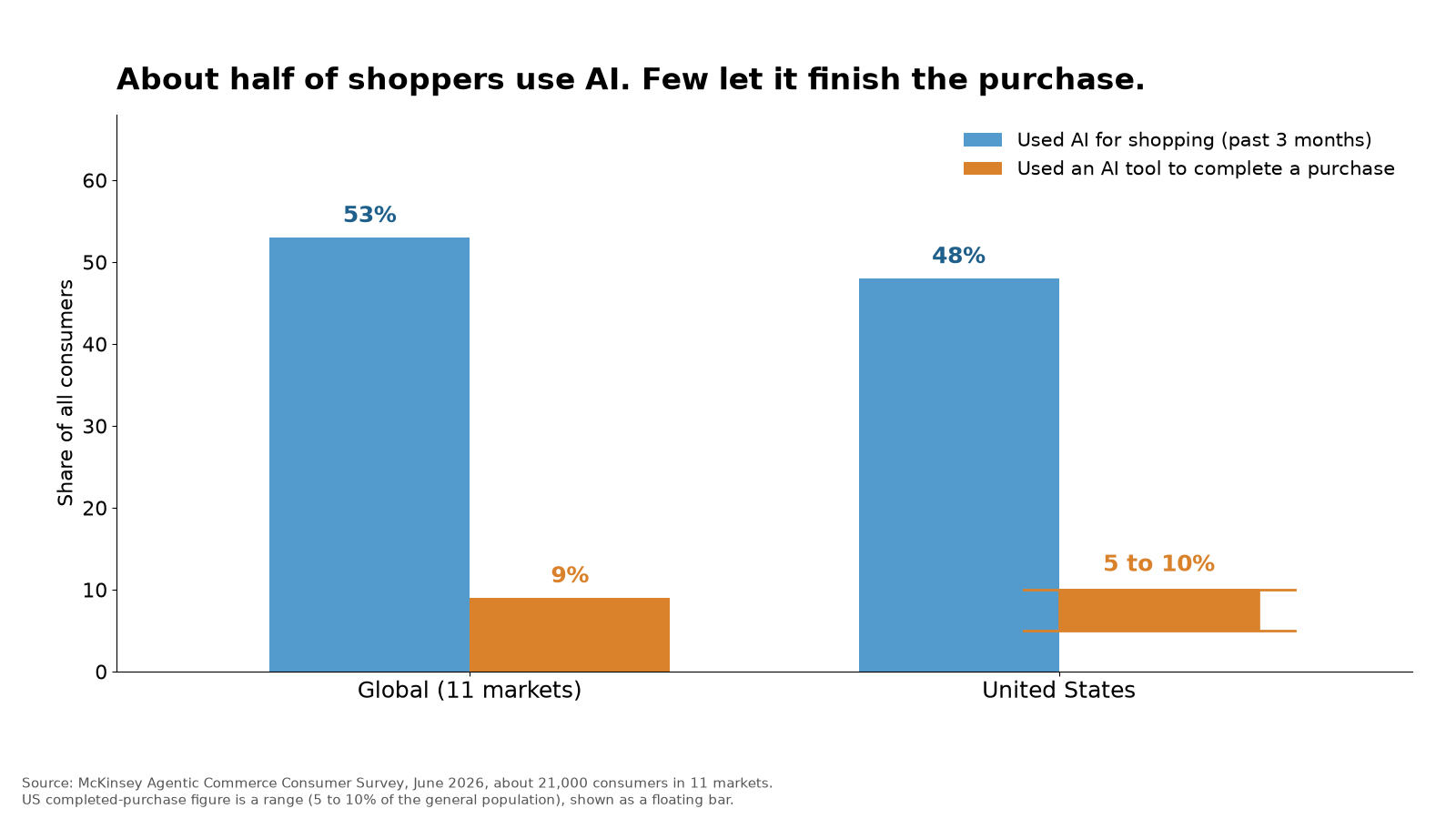
November 16, 2026About half of shoppers now use AI to shop, but few let an AI tool finish the purchase. In a June 2026 survey of about 21,000 consumers across 11 markets, McKinsey found that 53 percent had used AI for shopping in the past three months, including 48 percent in the United States. The same survey found that 14 percent of AI users, corresponding to 9 percent of the general population, had used an AI tool to complete a purchase.
Those two numbers describe different steps, and so do the traffic figures that sit next to them. Adobe Digital Insights measures AI traffic as users clicking a link from an AI tool to a US retail site, not as purchases completed by an AI agent. In September 2026, that click traffic converted 90% better than non-AI traffic and generated 83% higher revenue per visit, across more than 1 trillion visits.
For this report, we compiled consumer surveys from McKinsey, Riskified, NMI, NIQ, and Worldpay, first-party retail analytics from Adobe and Salesforce, McKinsey’s 2030 forecast, and two Universal Commerce Protocol (UCP) adoption counts. Each figure is quoted with its sample, period, and base (all consumers, AI users, or a single country), and the Methodology section lists every dataset.
Key Findings
- 53 percent of consumers across 11 markets, and 48 percent in the US, used AI for shopping in the past three months (McKinsey, June 2026).
- 9 percent of consumers worldwide used an AI tool to complete a purchase, equal to 14 percent of AI users. In the US, AI users who made a purchase with AI rose from 10 to 17 percent year over year, or 5 to 10 percent of the general population (McKinsey).
- AI click traffic to US retail sites grew 71% year over year in September 2026, converted 90% better than non-AI traffic, and generated 83% higher revenue per visit (Adobe). Adobe forecasts that this traffic will rise 95% year over year on Black Friday and 88% on Cyber Monday. These figures count clicks from AI tools, not checkouts completed by agents.
- Most shoppers still want a human approval step. 70% of US adults say they must be able to review or override an AI decision before a purchase (NMI, August 2026). Among consumers already open to AI shopping, 59% want to approve every purchase (Worldpay).
- 31.8% of about 3.7 million live ecommerce sites publish a valid public UCP profile, but only 4.6% of sites in the top 10,000 by traffic do (UCP Checker, November 2026). Among the top 1,000 retailers by online sales, 225 (22.5%) have a detectable UCP endpoint (ReFiBuy and Digital Commerce 360, Q2 2026).
How Many Shoppers Use AI
McKinsey treats agentic commerce as AI agents mediating or executing parts of the shopping journey, from discovery to purchase, on a consumer’s behalf. That definition includes research and recommendations, so “used AI for shopping” is a wider measure than “let AI complete a checkout.”
In the table below, we compare recent survey figures on AI shopping use. The wording, period, and sample change from row to row, so the percentages are not interchangeable.
AI Shopping Use, Recent Consumer Surveys (2026)
| Source | Sample | Period | What was asked | Figure | Base |
|---|---|---|---|---|---|
| McKinsey | About 21,000 consumers, 11 markets | Past 3 months, fielded June 2026 | Used AI for shopping | 53% | All consumers surveyed |
| McKinsey | Same survey, US respondents | Past 3 months, fielded June 2026 | Used AI for shopping | 48% | US consumers |
| McKinsey | Same survey | Past 3 months, fielded June 2026 | Used an AI chat or search tool | 56% | All consumers surveyed |
| McKinsey | Same survey | Past 3 months, fielded June 2026 | Used a retailer’s AI shopping assistant | 27% | All consumers surveyed |
| Riskified | 5,100 online buyers, US, UK, Japan, Mexico, Brazil | September 2026 | Used AI for some parts of the shopping process | 80% | Online purchasers in the past 3 months |
| NIQ | About 500 US consumers a month | Early 2026, past month | Used at least one AI tool to shop | 42% | US consumers |
| NMI | 1,000 US adults | Past month, published Aug 26, 2026 | Used AI for shopping or product discovery | 33% | US adults |
| NMI | Same survey | Past month, published Aug 26, 2026 | Used AI for research or information searches | 53% | US adults |
Source: each survey, linked in the table. McKinsey’s 11 markets are Australia, Brazil, China, France, Germany, India, Japan, Mexico, Saudi Arabia, the United Kingdom, and the United States.
Our team took three points from this data:
- The largest and most recent multi-market survey, McKinsey’s June 2026 fielding, puts AI shopping use at about half of consumers (53% globally, 48% in the US).
- Stand-alone AI chat and search tools are used about twice as often as retailer-built assistants, at 56% versus 27% of consumers in the same McKinsey survey.
- Younger shoppers lead, but not by as much in the US: 62% of Gen Z and 63% of millennials used AI for shopping, against the 53% average, while US Gen Z came in at 57% (McKinsey).
Riskified’s 80% figure is higher because its sample is recent online purchasers in five countries, and the question covers “some parts of the shopping process.” NIQ and NMI asked about the past month, earlier in 2026, and should be read as earlier US snapshots rather than replacements for McKinsey’s June figures.
How Many Purchases Are Completed by AI
The agentic step, a purchase completed inside an AI tool, is still a small share of all consumers. In the table below, we compare that figure across four surveys, with the base named in each row.
Purchases Completed Inside an AI Tool (2026)
| Source | Sample | Period | Figure | Base |
|---|---|---|---|---|
| McKinsey | About 21,000 consumers, 11 markets | Past 3 months, fielded June 2026 | 9% | General population |
| McKinsey | Same survey | Past 3 months, fielded June 2026 | 14% | AI users |
| McKinsey | US respondents | Year over year, to June 2026 | 10% to 17% (5% to 10% of the US population) | US AI users (and the corresponding share of the general US population) |
| Riskified | 5,100 online buyers, 5 countries | September 2026 | 11% | Online purchasers |
| NMI | 1,000 US adults | Published Aug 26, 2026 | 11% | US adults |
| NIQ | About 500 US consumers a month | Early 2026 | 5% | US consumers, fully autonomous agents placing orders |
Source: each survey, linked in the table.
Three points stand out:
- McKinsey found that US AI users who made a purchase with AI grew from 10 to 17 percent year over year, a jump of about 70%, which corresponds to 5 to 10 percent of the general US population.
- Intent is ahead of behavior. In the top six purchase categories, 21 to 30 percent of AI users said they would let AI complete a purchase, about 1.5 times as many as those who already have (McKinsey). Across categories, completed purchases ranged from 7 to 18 percent of AI users, with apparel leading.
- Retailer assistants catch up at checkout. McKinsey found that 15 percent of AI users used a retailer assistant at checkout, against 14 percent who used a stand-alone AI tool. The two questions were worded differently (“helped with completing a purchase or checkout” versus “completed the purchase for me”), so that narrow gap should be read with care.
Trust and Control
Shoppers will let AI research and recommend more readily than they will let it spend. In the table below, we list the control conditions consumers set around an AI purchase.
Consumer Control Conditions for AI Purchases (2026)
| Finding | Figure | Sample | Source |
|---|---|---|---|
| Must be able to review or override an AI decision before a purchase | 70% | 1,000 US adults | NMI, Aug 26, 2026 |
| Would not trust AI to make purchases at all | 45% | 1,000 US adults | NMI |
| Do not trust AI to process payments securely | 69% | 1,000 US adults | NMI |
| Would give AI full control over a purchase | 10% | 1,000 US adults | NMI |
| Want to approve every purchase | 59% | Consumers already open to AI shopping, 7 markets | Worldpay / Global Payments, with The Lantern, Sept 23, 2026 |
| Would allow an agent some role in payment | 80% | Consumers already open to AI shopping, 7 markets | Worldpay |
| Want to approve every purchase | 43% | 5,100 online buyers, 5 countries | Riskified, Sept 2026 survey |
| Would allow purchases automatically within rules they set | 29% | 5,100 online buyers, 5 countries | Riskified |
| Comfortable letting AI buy without approval | 7% | 5,100 online buyers, 5 countries | Riskified |
| Would trust no company for agentic commerce | 17%, down from 47% in Q2 | 5,100 online buyers, 5 countries | Riskified |
Source: each survey, linked in the table.
Willingness to shop with an AI agent also varies widely by country. Worldpay and Global Payments, with The Lantern, asked consumers in seven markets whether they would shop with an AI agent. The “Yes” shares are stated intent, not proven usage.
Willingness to Shop with an AI Agent, by Market (2026)
| Market | Yes | Maybe | Never |
|---|---|---|---|
| China | 86% | 12% | 2% |
| Brazil | 72% | 22% | 6% |
| Singapore | 59% | 31% | 11% |
| United Kingdom | 48% | 30% | 22% |
| France | 46% | 31% | 23% |
| United States | 45% | 29% | 27% |
| Australia | 40% | 30% | 29% |
Source: Worldpay / Global Payments, with The Lantern, Agentic Commerce Report 2026, published September 23, 2026.
A few other trust findings are worth keeping next to those tables:
- 74% of US AI users trust AI chat and search tools, below India at 87% (McKinsey).
- One-third of Riskified’s respondents would trust a general AI platform such as ChatGPT or Gemini to run a shopping agent, compared with 17% who would trust a retailer or brand and 9% who would trust a bank, card company, or digital wallet (Riskified).
- 68% always want to know when they are interacting with an AI agent rather than a human, and 68% said they were likely to use AI for holiday shopping (Riskified).
AI Traffic and Revenue to Retail Sites
The traffic numbers most retailers will watch this holiday season are click-throughs from AI tools, not agent-completed checkouts. Adobe says so on the page: in September 2026, AI traffic to US retail sites was “measured by users clicking on a link.”
In the table below, we separate measured September results from Adobe’s holiday forecasts.
AI Traffic to US Retail Sites, Adobe Digital Insights (2026)
| Measure | Figure | Status | Period |
|---|---|---|---|
| AI traffic growth | +71% year over year | Measured | September 2026 |
| Conversion vs non-AI traffic | 90% better (visits that become purchases) | Measured | September 2026; 9% worse in August 2025 |
| Revenue per visit vs non-AI traffic | 83% higher | Measured | September 2026 |
| Time on site / pages / add-to-cart vs non-AI traffic | 73% more time, 25% more pages, 53% higher add-to-cart | Measured | September 2026 |
| Thanksgiving AI traffic | +159% year over year | Forecast | Thanksgiving 2026 |
| Black Friday AI traffic | +95% year over year | Forecast | Black Friday 2026 |
| Cyber Monday AI traffic | +88% year over year | Forecast | Cyber Monday 2026 |
| AI-driven retail traffic, holiday season | +130% year over year | Forecast | 2026 holiday forecast |
| US online holiday spend, Nov 1 to Dec 31 | $275.1 billion, up 6.7% | Forecast | 2026 holiday forecast |
| AI revenue-per-visit advantage | Will double this holiday season | Forecast | 2026 holiday season |
Source: Adobe, October 29, 2026, based on more than 1 trillion visits to US retail sites, 100 million SKUs, and 18 product categories; holiday spend and +130% traffic figures from Adobe’s 2026 Holiday Shopping Forecast, as published on Experience League. Non-AI traffic includes channels such as paid search and email.
Adobe also scores how readable retail pages are to AI systems. In September 2026, the average US retail homepage had a Citation Readability Score of 63%, meaning more than a third of homepage content was not visible to the AI systems sending those visitors. Electronics led at 79%, grocery followed at 55%, and general merchandise homepages scored 40% (Adobe).
For the longer Adobe conversion series, and for how those clicks appear in analytics, our AI referral traffic conversion report covers the 2025-to-2026 swing in full.
Salesforce’s 2025 Cyber Week results are a useful baseline, with one caveat: “influenced” includes on-site product recommendations and conversational customer service, in addition to any third-party shopping agents. Salesforce, analyzing more than 1.5 billion shoppers, found that AI and agents influenced 20% of global Cyber Week orders, or $67 billion in sales, during November 25 to December 1, 2025 (Salesforce). Retail Brew, reporting the same Salesforce data, put the US figures at 17% of orders and $13.5 billion, a split that does not appear on Salesforce’s own press release.
McKinsey adds one influence finding from the consumer side: AI users were 3.2 times more likely to rank AI search as more influential than traditional search engines (McKinsey).
How Large Could Agentic Commerce Get
The adoption figures above are still small at the point of purchase. The dollar figures attached to them are 2030 forecasts, not current sales.
McKinsey, in an October 17, 2025 report, estimated that by 2030 the US business-to-consumer retail market could represent $900 billion to $1 trillion in orchestrated revenue from agentic commerce, with a global range of $3 trillion to $5 trillion. Those figures cover goods only. They exclude services and business-to-business sales.
McKinsey’s 2026 survey also cites EMARKETER modeling, from Rachel Wolff on May 6, 2026, that widespread adoption of agentic commerce could raise US ecommerce sales 11.5% above EMARKETER’s baseline forecasts by 2030. That figure appears in the McKinsey survey article. We did not open the EMARKETER primary, so we treat the figure as secondary.
Merchant Readiness for Agentic Protocols
Consumer interest is running ahead of the infrastructure that would let an agent actually buy. Two protocols sit at the center of that work: Google and Shopify’s Universal Commerce Protocol (UCP), and OpenAI and Stripe’s Agentic Commerce Protocol (ACP). Our guide to what agentic commerce is explains how ACP and UCP work, and where you can shop with an agent today.
The widest public count of UCP adoption comes from UCP Checker, which reads about 4 million ecommerce sites with measurable shopper traffic each month and counts a profile only when it is public at /.well-known/ucp and passes the official validator. In its November 2026 market read, 31.8% of about 3.7 million live ecommerce sites, or about 1.2 million sites, published a valid public UCP profile. Among live ecommerce sites in the top 10,000 by traffic, the share was 4.6%.
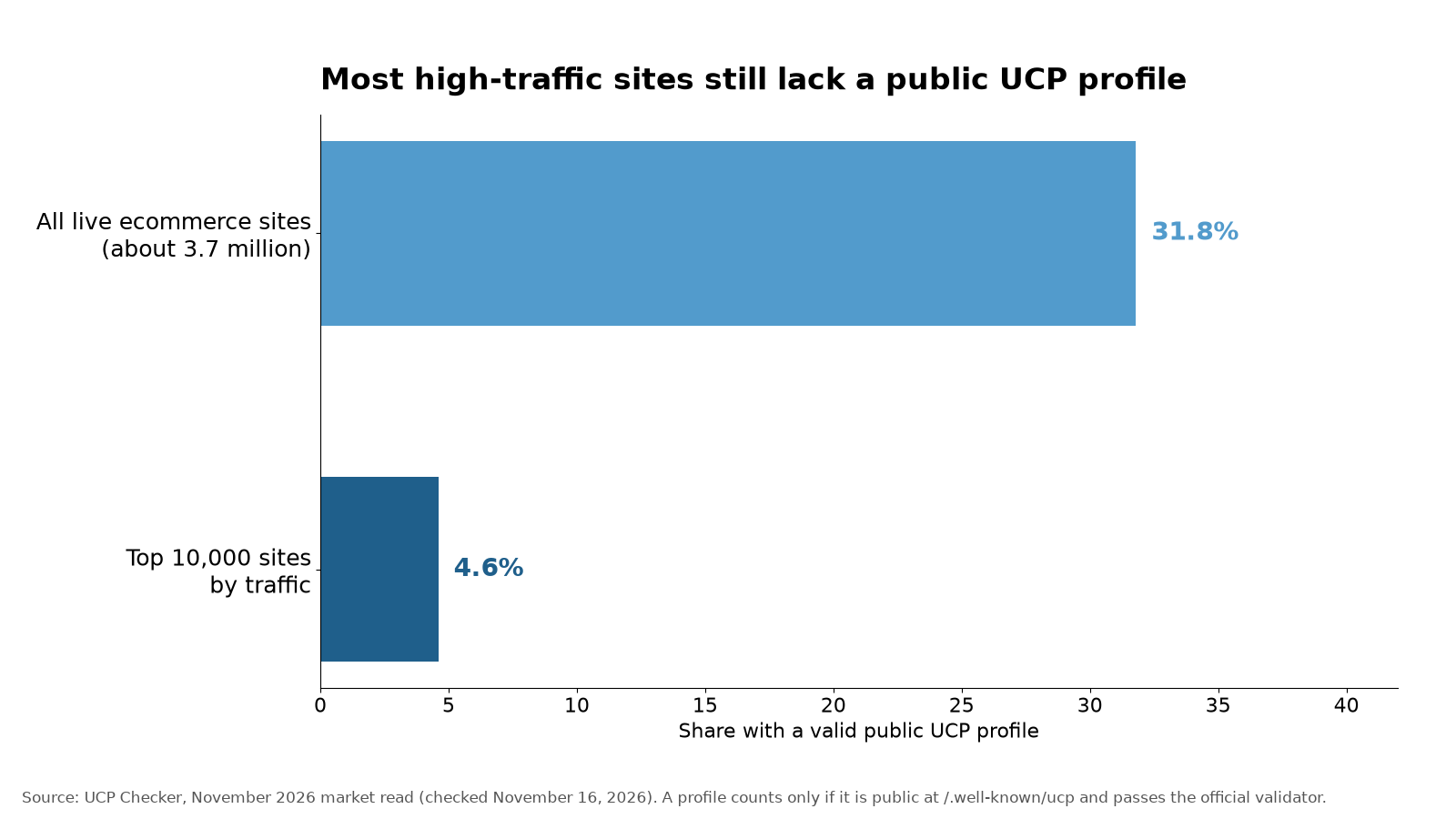
The 31.8% headline measures published profiles, not merchant intent. UCP Checker found Shopify at 100% valid and Wix at 99.5% valid, while WooCommerce and Squarespace were both under 0.1%. The high overall rate is driven by platforms that publish a profile automatically.
A narrower count of large retailers tells a similar story. In the Q2 2026 AI1000, a quarterly benchmark of the top 1,000 retailers by online sales, ReFiBuy and Digital Commerce 360 found that 225 retailers, or 22.5%, had a detectable UCP endpoint, and that the index average readiness score was 39.7 out of 100, down from 42.0 in Q1. Scot Wingo, ReFiBuy’s CEO, wrote in a same-day data drop that the bulk of those 225 endpoints were picked up “for free” when a platform shipped the protocol.
UCP and ACP Adoption and Setbacks (2026)
| Dataset | What was measured | Figure | Period |
|---|---|---|---|
| UCP Checker | Live ecommerce sites with a valid public UCP profile | 31.8% (about 1.2 million of 3.7 million) | November 2026 market read, checked Nov 16, 2026 |
| UCP Checker | Live sites in the top 10,000 by traffic with a valid public UCP profile | 4.6% | November 2026 |
| UCP Checker | Valid profiles by platform | Shopify 100%, Wix 99.5%, WooCommerce and Squarespace under 0.1% | November 2026 |
| ReFiBuy and Digital Commerce 360, AI1000 | Top 1,000 retailers by online sales with a detectable UCP endpoint | 225, or 22.5%; average readiness 39.7/100, down from 42.0 in Q1 | Q2 2026, published Aug 18, 2026 |
| Forrester, as reported by Anatta and cited by McKinsey | ChatGPT Instant Checkout | OpenAI scaled back Instant Checkout; Forrester put live Shopify merchants at about 30 | Forrester, March 7, 2026; OpenAI statement March 24, 2026, as quoted by Anatta |
Source: each dataset, linked in the table. The Instant Checkout row is secondary. We did not open the Forrester primary or OpenAI’s March 24 statement.
What This Means for Marketing Teams
- Plan for AI as a discovery channel first. About half of shoppers already use it to research and compare, while completed purchases run from 5 percent of US consumers in NIQ’s early-2026 data to 14 percent of AI users in McKinsey’s June survey.
- Keep a confirmation step in any agent-led flow. The control figures from NMI, Worldpay, and Riskified all point to the same limit: most people will allow help, and most still want to approve the spend.
- Make product and policy pages readable to AI systems. Adobe’s homepage readability scores, and McKinsey’s priority to “win the AI consideration set,” both favor machine-readable product data, buying guides, and clear policies. That is the work our agentic search optimization (ASO) service is built around.
- Do not treat a UCP badge as proof that a retailer’s catalog is agent-ready. A profile inherited from Shopify or Wix is not the same as complete product data, inventory, and checkout that an agent can use.
- Measure AI click traffic separately from agent-completed orders, and use the AI referral conversion benchmarks when you compare those clicks with the rest of your site.
- Ecommerce and consumer brands can review how Genevate works with consumer brands.
Methodology
This report compiles published data available as of November 16, 2026. We included a dataset only if it stated its sample and time period, and we name the base for every percentage (all consumers, AI users, online purchasers, or a single country). We gave first-party research and measurement (McKinsey, Adobe, Salesforce, UCP Checker, ReFiBuy) priority over secondary writeups, and we label secondary figures where the primary was not opened.
In the table below, we list every dataset used.
Datasets Used in This Report
| Dataset | Type | Sample | Period |
|---|---|---|---|
| McKinsey Agentic Commerce Consumer Survey | Primary research | About 21,000 consumers, 11 markets; year-over-year comparisons are US only | Fielded June 2026; published Oct 28, 2026 |
| McKinsey, “The agentic commerce opportunity” | Forecast | US B2C retail goods and a global goods range; excludes services and B2B | Published Oct 17, 2025 |
| Adobe Digital Insights | First-party analytics, plus a companion survey of 5,000+ US respondents | More than 1 trillion visits to US retail sites | September 2026 results; published Oct 29, 2026 |
| Adobe 2026 Holiday Shopping Forecast, via Experience League | Forecast | US online retail, Nov 1 to Dec 31, 2026 | 2026 holiday forecast, page checked Nov 16, 2026 |
| Salesforce 2025 Cyber Week results | First-party analytics | More than 1.5 billion shoppers, 89+ countries | Nov 25 to Dec 1, 2025; published Dec 5, 2025 |
| Retail Brew, reporting Salesforce | Secondary report of Salesforce data | Same Cyber Week dataset; US split | Published Dec 9, 2025 |
| Riskified Agentic Commerce Pulse | Survey | 5,100 consumers aged 18+, US, UK, Japan, Mexico, Brazil, all recent online buyers | Fielded September 2026; published Oct 27, 2026 |
| Worldpay / Global Payments, with The Lantern | Survey | Consumers in the US, UK, France, Brazil, China, Singapore, and Australia | Published Sept 23, 2026 |
| NMI, Agentic Commerce Reality Check | Survey | 1,000 US adults | Published Aug 26, 2026 |
| NIQ Quick Question | Survey | About 500 US consumers a month | Early 2026; published May 5, 2026 |
| UCP Checker | Web census | About 3.7 million live ecommerce sites, from a monthly read of about 4 million sites | November 2026 market read, checked Nov 16, 2026 |
| ReFiBuy and Digital Commerce 360, AI1000 | Retailer readiness benchmark | Top 1,000 retailers by online sales | Q2 2026; published Aug 18, 2026 |
| Forrester, via McKinsey and Anatta | Analyst note, secondary | ChatGPT Instant Checkout among Shopify merchants | Forrester, March 7, 2026; OpenAI statement dated March 24, 2026, as reported by Anatta |
Adobe’s AI traffic figures count link clicks from AI tools to retail sites. Salesforce’s “influenced” orders include on-site recommendations and service conversations. UCP Checker’s 31.8% share is of live ecommerce sites with a valid public profile, and is raised by platforms that auto-publish one.
Frequently Asked Questions
What are the latest agentic commerce statistics?
The clearest current split is this: 53 percent of consumers across 11 markets used AI for shopping in the past three months, while 9 percent of the general population used an AI tool to complete a purchase (McKinsey, June 2026). AI click traffic to US retail sites, which is not the same as an agent-completed purchase, converted 90% better than non-AI traffic in September 2026 (Adobe).
How many people use AI to shop?
It depends on the survey. McKinsey’s June 2026 survey of about 21,000 consumers put the figure at 53 percent globally and 48 percent in the US, for the past three months. NIQ found 42% of US consumers had used at least one AI tool to shop in the past month, in early 2026, and NMI found 33% of US adults had used AI for shopping or product discovery in the past month.
How many consumers have let AI complete a purchase?
In McKinsey’s June 2026 survey, 9 percent of the general population, and 14 percent of AI users, had used an AI tool to complete a purchase. Riskified and NMI both found 11% had completed a purchase inside an AI tool, in a five-country online-buyer sample and a US adult sample, respectively. NIQ found 5% of US consumers had used fully autonomous agents to place orders, in early 2026.
How much AI traffic will retailers see this holiday season?
Adobe forecasts AI traffic to US retail sites will rise 159% year over year on Thanksgiving, 95% on Black Friday, and 88% on Cyber Monday, after 71% growth in September 2026. Its 2026 holiday forecast also projects a 130% year-over-year increase in AI-driven traffic and $275.1 billion in US online holiday spend from November 1 to December 31. Those traffic figures measure clicks from AI tools, not purchases made by agents.
What share of ecommerce sites support UCP?
UCP Checker found that 31.8% of about 3.7 million live ecommerce sites published a valid public UCP profile in November 2026, against 4.6% of sites in the top 10,000 by traffic. Among the top 1,000 retailers, ReFiBuy and Digital Commerce 360 counted 225 detectable endpoints (22.5%) in Q2 2026. The overall rate is raised by platforms such as Shopify and Wix that publish a profile automatically.
Talk to Genevate
If AI tools are already sending shoppers to your category, the work is to be in the shortlist those tools return, and to measure the clicks that follow. Genevate is a New York City GEO agency for mid-market and enterprise brands, including agentic search optimization for ecommerce teams. You can contact Genevate to review how AI shopping agents see your catalog.
Sources
- McKinsey, “Who wins when AI does the shopping? New evidence on agentic commerce” (Oct 28, 2026)
- McKinsey, “The agentic commerce opportunity: How AI agents are ushering in a new era for consumers and merchants” (Oct 17, 2025)
- Adobe, “AI traffic now generates 83% higher revenue per visit for U.S. retailers heading into the holiday shopping season” (Oct 29, 2026)
- Adobe Experience League, “Planning and pivoting: A strategic approach to peak season 2026”
- Salesforce, “Salesforce Data: AI and Agents Propel Cyber Week to Record $336.6B in Global Spend” (Dec 5, 2025)
- Retail Brew, “Shopify’s Black Friday-Cyber Monday sales surged 27% despite brief site outage” (Dec 9, 2025)
- Riskified, “Riskified Survey: Confidence is Rising In AI Shopping While Adoption Remains Nascent” (Oct 27, 2026)
- Worldpay / Global Payments, “Agentic Commerce Report 2026 out now” (Sept 23, 2026)
- NMI, “Consumers Want AI to Help Them Shop, Not Control Their Spending” (Aug 26, 2026)
- NIQ, “42% of Consumers Now Use AI Tools to Shop, NIQ Data Shows” (May 5, 2026)
- UCP Checker, “The state of UCP” (November 2026 market read)
- ReFiBuy, “AI1000 Rankings Reshuffle in Q2, but Retail Challengers Hold the Lead” (Aug 18, 2026)
- Scot Wingo, “The ReFiBuy Q2 AI1000 Is Out,” Retailgentic (Aug 18, 2026)
- Anatta, “UCP vs ACP: Which Agentic Commerce Protocol Is Your Shopify Store On?” (Oct 25, 2026)