
ChatGPT vs. Google: Search Usage Statistics (2026)
November 24, 2026Google still handles far more search than ChatGPT in 2026, but the size of the gap depends on what you count. Google.com received 88.4 billion web visits in October 2026, about 15 times ChatGPT.com’s 6.0 billion (Similarweb). OpenAI says ChatGPT’s volume of search-like queries is roughly one-fifth of Google’s (CMSWire, Nov 9, 2026).
Whether ChatGPT is replacing Google is less settled. Independent clickstream studies find that most ChatGPT users keep using Google, but a Bocconi University study of US households found that conventional searches fall in the months after a household starts using ChatGPT.
For this report, we compared company disclosures from OpenAI and Alphabet with traffic data from Similarweb and StatCounter and two clickstream studies from Semrush and Bocconi University. Every figure was checked against the publisher’s own page on November 20 or 21, 2026, and each one is labeled with its date and what it measures.
Key Findings
- Google.com had 88.4 billion web visits in October 2026, compared with 6.0 billion for ChatGPT.com, a ratio of about 15 to 1 (Similarweb, web only, apps excluded).
- OpenAI says ChatGPT’s search-like queries now run at roughly one-fifth of Google’s query volume, counting only requests that trigger a web search (CMSWire; Bocconi University).
- 1.2 billion people use ChatGPT each week (OpenAI, Nov 10, 2026).
- 95% of ChatGPT users also use Google, the same share in May 2026 as in September 2025 (Similarweb).
- Google’s Search and other revenue grew 12% year over year to $63.35 billion in Q3 2026, and Alphabet said Search query growth was the highest in five years (Alphabet).
- A referral to an outside website follows 5.4% of ChatGPT sessions, compared with 31.1% of Google queries (Bocconi University, US desktop households).
ChatGPT vs. Google at a Glance
The two companies report different metrics over different periods. In the table below, we put each disclosed figure next to its closest counterpart and note what it measures.
ChatGPT vs. Google: Headline Usage Figures, 2026
| Metric | ChatGPT | What it measures | |
|---|---|---|---|
| Users | 1.2 billion weekly (OpenAI) | Gemini app: 1 billion users, period not stated (Alphabet) | Company-reported; Google does not disclose a Search user count |
| Web visits, October 2026 | 6.0 billion (#5 worldwide) | 88.4 billion (#1 worldwide) | Similarweb estimate, desktop and mobile web, apps excluded |
| Year-over-year visit change | +3.36% | +3.37% | Same Similarweb table, October 2025 to October 2026 |
| Query volume | Roughly one-fifth of Google’s search-like queries | Highest query growth rate in five years, no count disclosed | OpenAI claim (CMSWire); Alphabet Q3 2026 release |
| Share of search engine referrals | Not included | 91.05% worldwide | StatCounter, October 2026 |
Source: each publisher, linked in the table.
Key Findings
- Web visits are the one measure in this table that a third party estimates the same way for both sites, and on that measure Google leads by about 15 to 1.
- OpenAI and Alphabet each choose which numbers to disclose, so their user and query figures cannot be compared directly.
How Many Visits Do ChatGPT and Google Get?
Similarweb estimates monthly visits for the most-visited websites worldwide. Google.com ranked first in October 2026 and ChatGPT.com ranked fifth, behind YouTube, Facebook, and Instagram.
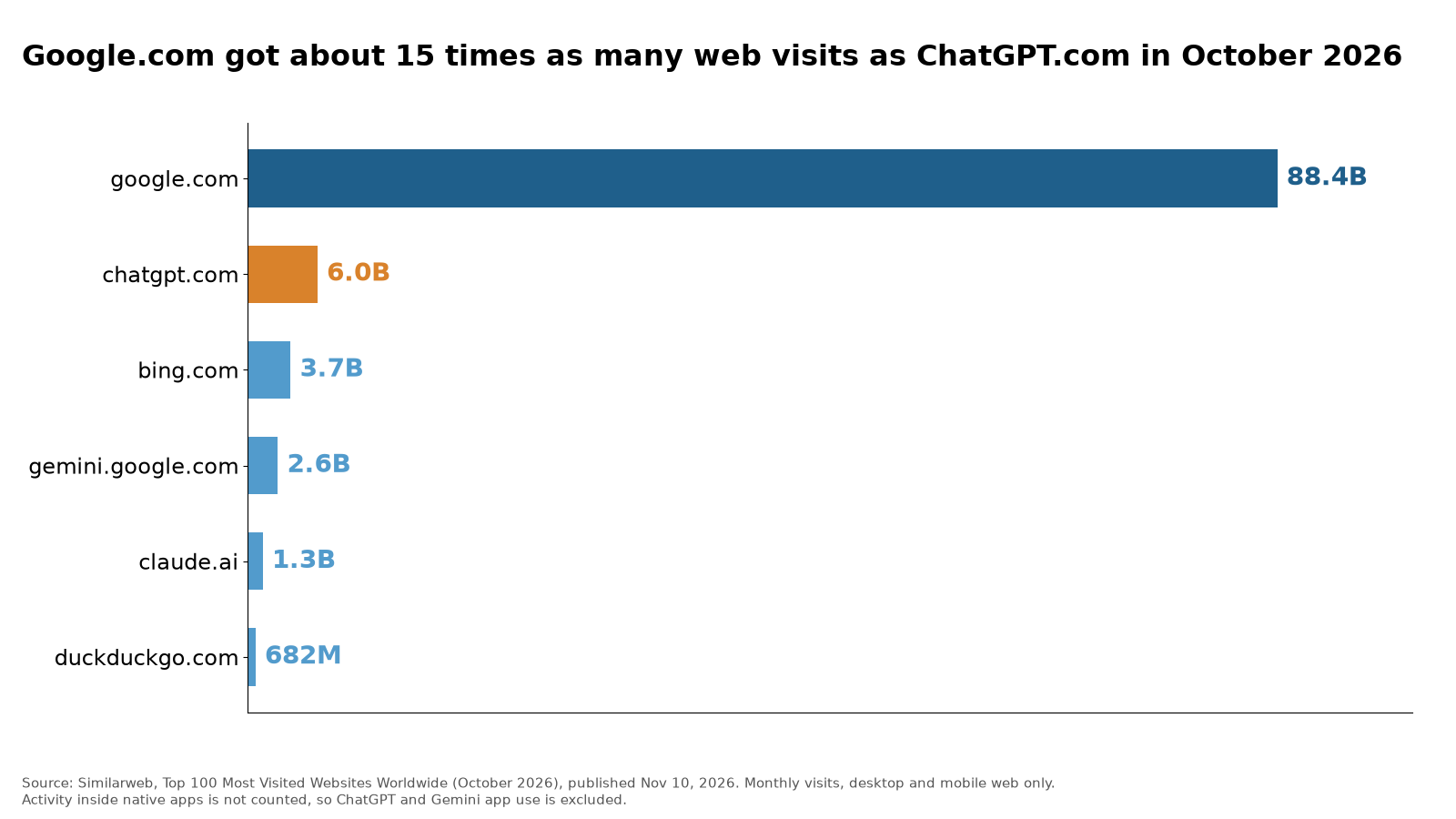
In the table below, we list the search and AI assistant sites in Similarweb’s October 2026 top 100.
Search and AI Assistant Web Visits, October 2026
| Site | Rank | Monthly visits | Change from September | Change from October 2025 |
|---|---|---|---|---|
| google.com | 1 | 88.4B | +3.86% | +3.37% |
| chatgpt.com | 5 | 6.0B | +2.15% | +3.36% |
| bing.com | 10 | 3.7B | +4.49% | +8.19% |
| gemini.google.com | 15 | 2.6B | -0.15% | +52.17% |
| claude.ai | 25 | 1.3B | +23.78% | +587.73% |
| duckduckgo.com | 47 | 681.9M | +2.74% | +18.80% |
Source: Similarweb, “The Top 100 Most Visited Websites in the World (October 2026)”, published Nov 10, 2026.
Key Findings
- ChatGPT.com’s visits grew 3.36% over the year, almost the same rate as Google.com’s 3.37%.
- The fastest growth among AI assistants came from Claude.ai (up 587.73%) and Gemini (up 52.17%), both from smaller bases.
- Similarweb counts web visits only, so app use is left out on both sides, including ChatGPT’s mobile and desktop apps.
How Does ChatGPT’s Search Volume Compare With Google’s?
In a November 2026 interview with Alex Kantrowitz, ChatGPT consumer product lead Adam Fry said, “ChatGPT’s volume of search-like queries is now roughly one-fifth the volume of queries of Google” (CMSWire). Fry described a search as any question that leads ChatGPT to search the web.
OpenAI has not published the method behind the figure. The Bocconi University authors note that it counts only requests that trigger a web search and that OpenAI did not state where its Google figure came from (arXiv).
Alphabet does not publish a query count. In its Q3 2026 earnings release, it said year-over-year Search query growth was the highest it has been in the last five years.
The two measures differ because they count different things. Visits count trips to a website, while OpenAI’s figure counts individual questions, and a single ChatGPT conversation can include many web searches inside one visit.
Do ChatGPT Users Still Use Google?
Most do. Similarweb’s 2026 Generative AI Landscape report found that 95% of ChatGPT users also used Google in May 2026, unchanged from September 2025 (Similarweb).
Two clickstream studies looked at what happens to a person’s searching after they start using ChatGPT. In the table below, we compare their methods and results.
Clickstream Studies on ChatGPT Adoption and Search Behavior
| Study | Data | Window | Finding |
|---|---|---|---|
| Semrush (Aug 11, 2025) | 260 billion rows of US desktop clickstream data | 90 days before and after first ChatGPT use, Q1 2025 adopters | No statistically significant change in daily Google Search sessions |
| Bocconi University (version of Nov 12, 2026) | Comscore US desktop clickstream, 45,386 households | October 2024 to July 2025 | Google, Bing, and Yahoo searches rise briefly at adoption, then fall by about 39% of the pre-adoption average in weeks 20 to 30 |
| Bocconi University | Households already using ChatGPT without an account, which gained ChatGPT Search on Feb 5, 2025 | Before and after that date | No detectable overall change in conventional searches; households with lower prior search activity cut weekly searches by 3.71, or 35.8% |
Source: each study, linked in the table.
Key Findings
- Semrush’s 90-day window ends around week 13 after adoption, before the weeks 20 to 30 where Bocconi measured the largest decline.
- The Bocconi authors write that the decline “need not come from AI search, since ChatGPT can answer many questions without searching the web.”
- Both studies use US desktop data only, and Semrush sells SEO software.
How Much Traffic Does ChatGPT Send to Websites Compared With Google?
The Bocconi study also measured referrals, meaning visits to an outside website that follow a ChatGPT session or a Google query. ChatGPT sends users on far less often.
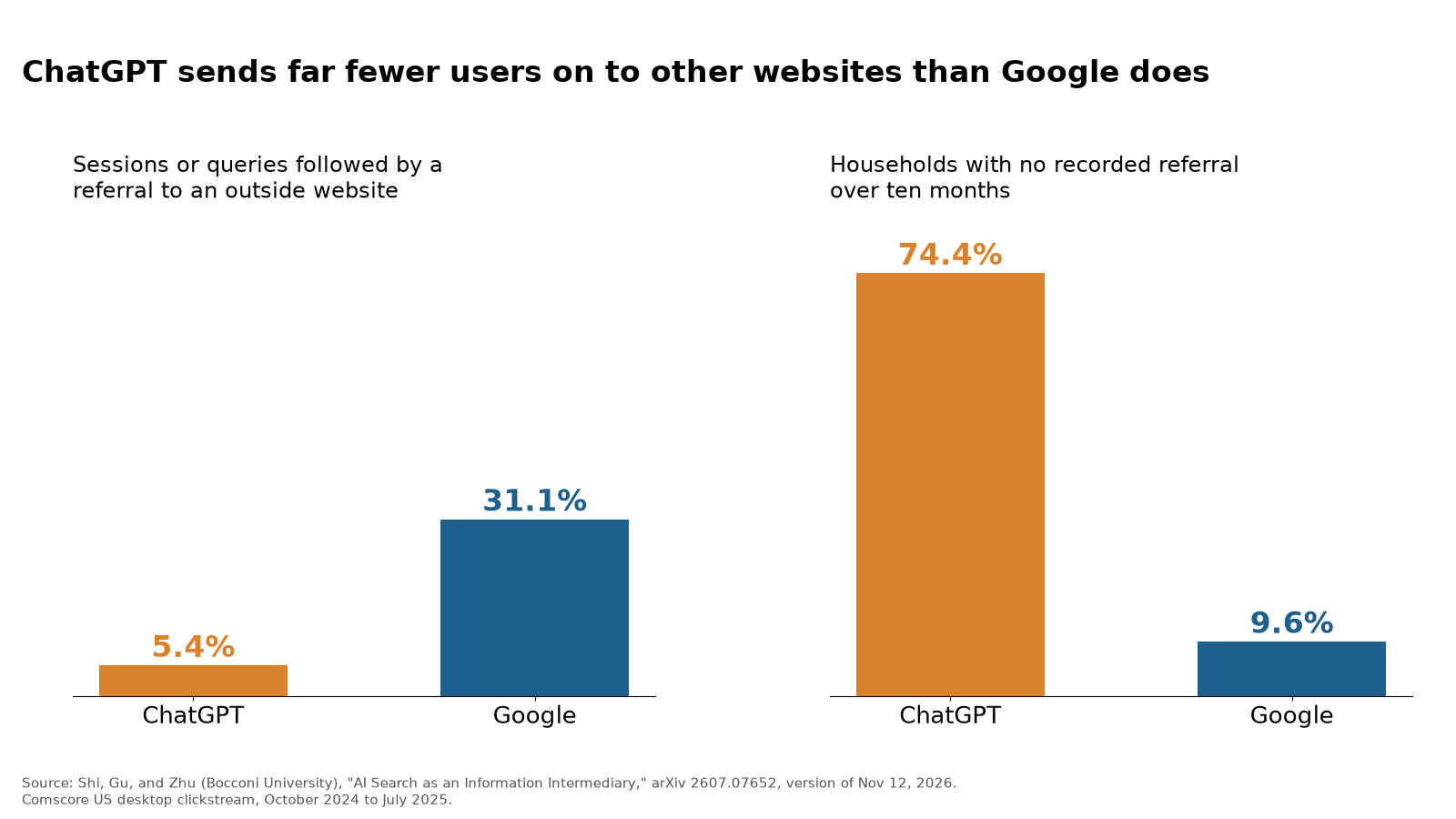
In the table below, we list the study’s referral findings.
ChatGPT vs. Google Referrals to Outside Websites
| Measure | ChatGPT | |
|---|---|---|
| Sessions or queries followed by a referral | 5.4% of sessions | 31.1% of queries |
| Households with no recorded referral over ten months | 74.4% | 9.6% |
| Website types that receive a larger share | Reference, tools and SaaS, academic, developer | Ad-supported websites |
Source: Shi, Gu, and Zhu, “AI Search as an Information Intermediary”, Bocconi University, version of Nov 12, 2026. Comscore US desktop data, October 2024 to July 2025.
Key Findings
- A brand can be named in a ChatGPT answer without receiving a visit, so referral traffic understates ChatGPT’s reach.
- Our AI search statistics report tracks AI assistants’ share of website referral traffic each month.
Google’s Share of the Search Engine Market
StatCounter measures which search engines send visitors to the websites it tracks. ChatGPT is not counted as a search engine in this series.
Worldwide Search Engine Referral Share, October 2026
| Search engine | Share |
|---|---|
| 91.05% | |
| Bing | 4.8% |
| Yahoo | 1.18% |
| Yandex | 1.14% |
| DuckDuckGo | 0.64% |
Source: StatCounter Global Stats, search engine market share, October 2026, checked Nov 20, 2026.
Google’s share was 89.94% in September 2026 in the same series. Google’s AI Overviews also affect how many searches end in a click, and our Google AI Overviews statistics report tracks that effect.
What People Use ChatGPT For
A study of ChatGPT conversations by OpenAI researchers and university economists found that “Practical Guidance,” “Seeking Information,” and “Writing” account for nearly 80% of all conversations (NBER Working Paper 34255, Sep 2025). Non-work messages grew from 53% to more than 70% of all usage by July 2025.
Several of the paper’s authors are OpenAI employees, and its data ends in mid-2025. It still places “Seeking Information” among the three most common reasons people use ChatGPT.
What This Means for Marketers
- Plan for both channels. 95% of ChatGPT users also use Google, so ChatGPT users can still be reached through Google search.
- Track mentions as well as clicks. A ChatGPT session leads to a referral 5.4% of the time, compared with 31.1% for a Google query, so referral traffic alone shows only a small part of ChatGPT’s reach.
- Watch for changes among lighter searchers. Bocconi found the clearest drop in conventional search among households that searched less to begin with.
- Read vendor figures by their definitions. A weekly user count, a web visit estimate, and a “search-like query” are three different measures.
- If AI answers matter to your pipeline, our generative engine optimization (GEO) services and SEO services cover both.
For a longer view of how answer engines took over from keyword search, read our history piece, From Ask Jeeves to “Google It”.
Methodology
This report compiles ChatGPT and Google usage data published as of November 21, 2026. We included a figure only if its publisher stated what it measures, and we checked each one against the publisher’s own page on November 20 or 21, 2026.
In the table below, we list every dataset used.
Datasets Used in This Report
| Dataset | Publisher type | What it measures | Date |
|---|---|---|---|
| OpenAI, “Introducing Businesses in ChatGPT” | Company disclosure | Weekly ChatGPT users | Nov 10, 2026 |
| CMSWire interview with OpenAI’s Adam Fry | Trade press | OpenAI’s search-like query claim | Nov 9, 2026 |
| Alphabet Q3 2026 earnings release (SEC Exhibit 99.1) | Company disclosure | Search revenue, query growth, Gemini users | Oct 28, 2026 |
| Similarweb, Top 100 Most Visited Websites | Web analytics company | Estimated monthly web visits, apps excluded | October 2026 data, published Nov 10, 2026 |
| Similarweb, “Is AI Replacing Search?” | Web analytics company | ChatGPT and Google audience overlap | Aug 4, 2026 |
| StatCounter Global Stats | Web analytics company | Search engine referral share | October 2026 |
| Semrush, “ChatGPT Is Not Replacing Google” | SEO software company | Google sessions before and after ChatGPT adoption, US desktop | Aug 11, 2025 |
| Shi, Gu, and Zhu, Bocconi University (arXiv 2607.07652) | Academic working paper | Referrals and conventional search after ChatGPT adoption, US desktop | Version of Nov 12, 2026 |
| Chatterji et al., NBER Working Paper 34255 | Academic working paper with OpenAI authors | What ChatGPT conversations are about | Sep 2025 |
OpenAI and Alphabet figures are self-reported and use different definitions and periods. The clickstream studies cover US desktop users only.
We did not use a 9.4% search reduction figure that online coverage attributes to the Bocconi paper, because the current version of the paper does not contain it. We also left out aggregator sites that restate these figures without new data.
Frequently Asked Questions
Is ChatGPT replacing Google?
Not at scale so far. Similarweb found 95% of ChatGPT users still use Google, though a Bocconi University study found conventional searches fall in the months after US households adopt ChatGPT, most clearly among lighter searchers.
How many people use ChatGPT compared with Google?
OpenAI says 1.2 billion people use ChatGPT each week. Google does not publish a Search user count, but Google.com had 88.4 billion web visits in October 2026, compared with 6.0 billion for ChatGPT.com (Similarweb).
How much search volume does ChatGPT have compared with Google?
OpenAI says ChatGPT’s search-like queries are roughly one-fifth of Google’s query volume (CMSWire). The figure counts only requests that trigger a web search, and OpenAI has not published its method.
What is Google’s search market share in 2026?
Google had 91.05% of worldwide search engine referral share in October 2026, followed by Bing at 4.8% (StatCounter). That series does not count ChatGPT.
Does ChatGPT send traffic to websites?
Less often than Google. A Bocconi University study of US desktop households found a referral follows 5.4% of ChatGPT sessions, compared with 31.1% of Google queries.
Talk to Genevate
Genevate is a New York City agency that helps mid-market and enterprise brands show up in AI answers and Google search. You can contact Genevate to scope a GEO and SEO program for your company.
Sources
- Similarweb, “The Top 100 Most Visited Websites in the World (October 2026)” (Nov 10, 2026)
- CMSWire, “ChatGPT Search Volume Gains on Google, OpenAI’s Consumer Lead Says” (Nov 9, 2026)
- OpenAI, “Introducing Businesses in ChatGPT” (Nov 10, 2026)
- Alphabet, Q3 2026 earnings release, SEC Exhibit 99.1 (Oct 28, 2026)
- Similarweb, “Is AI Replacing Search? What the 2026 Numbers Actually Reveal” (Aug 4, 2026)
- Semrush, “ChatGPT Is Not Replacing Google, It’s Expanding Search” (Aug 11, 2025)
- Shi, Gu, and Zhu, “AI Search as an Information Intermediary,” arXiv 2607.07652 (version of Nov 12, 2026)
- StatCounter Global Stats, search engine market share (October 2026)
- Chatterji et al., “How People Use ChatGPT,” NBER Working Paper 34255 (Sep 2025)