
Local AI Search Statistics: How Consumers Find Local Businesses (2026)
November 23, 2026Between 23% and 52% of US consumers now use AI tools to find local businesses, depending on how a survey asks the question. BrightLocal found that 45% of US adults used ChatGPT or another AI tool for local business recommendations in the past year, up from 6% a year earlier.
Very few consumers stop at the AI answer. Most go on to check Google, read reviews, or visit the business website before they call or book.
This report pulls together 2026 consumer surveys from BrightLocal, Yext, SOCi, Uberall, and Pew Research Center, plus studies of 200,000 local AI searches and 155.5 million AI citations. We checked every figure on the publisher’s own page on November 23, 2026, and each one is labeled with its date and what it measures.
Key Findings
- 45% of US adults used AI tools for local business recommendations in the past 12 months, up from 6% the year before (BrightLocal, Feb 2026).
- ChatGPT is the most used AI tool for local recommendations (31% of consumers), followed by Google’s AI Mode (23%) (BrightLocal).
- Google still starts most local searches: 52% began on Google Search and 9% on Google Maps (BrightLocal, Jul 2026).
- Only 2% of consumers who started a local search on an AI tool used it as their only channel (BrightLocal).
- Google Maps mentioned a tracked business in 66% of local searches, compared with 32% to 38% for ChatGPT, AI Mode, and AI Overviews (BrightLocal, Sep 2026).
- 80% of location-based AI citations pointed to a brand’s own website or its business listings (Yext Research, Q1 2026).
Local AI Search Statistics at a Glance
The surveys below ask about different time windows, from a consumer’s most recent search to the past 12 months. Each figure below carries its own window, because the surveys asked different questions.
Headline Local AI Search Figures, 2026
| Statistic | Figure | Source and measure |
|---|---|---|
| Used AI during their most recent local business search | 23% | BrightLocal, 1,227 US consumers, Jul 2026 |
| Use AI for local business recommendations at least monthly | 31% | Same BrightLocal survey |
| Used AI for local business recommendations in the past 12 months | 45% | BrightLocal, 1,002 US adults, Feb 2026 |
| Used AI for local search in the past month | 47% | Yext, 1,120 US adults, Mar 2026 |
| Used an AI tool to research a local business in the past 30 days | 52% | SOCi, 1,000+ US consumers, 2026 index |
| Searched online for a local business in the past three months | 84% | BrightLocal, 1,200+ US consumers, Jun 2026 |
| Look at three or fewer businesses before choosing | 72% | Same BrightLocal survey |
Source: each publisher, linked in the table.
Key Findings
- The five US survey figures for AI use in local search range from 23% to 52%.
- Consumers compare few options: 72% look at three or fewer businesses before choosing.
How Many Consumers Use AI to Find Local Businesses?
BrightLocal’s Local Consumer Review Survey tracks the change over one year. The share of US adults who used AI tools for local recommendations rose from 6% in 2025 to 45% in 2026, which made AI the third most used source behind Google and Facebook (BrightLocal).
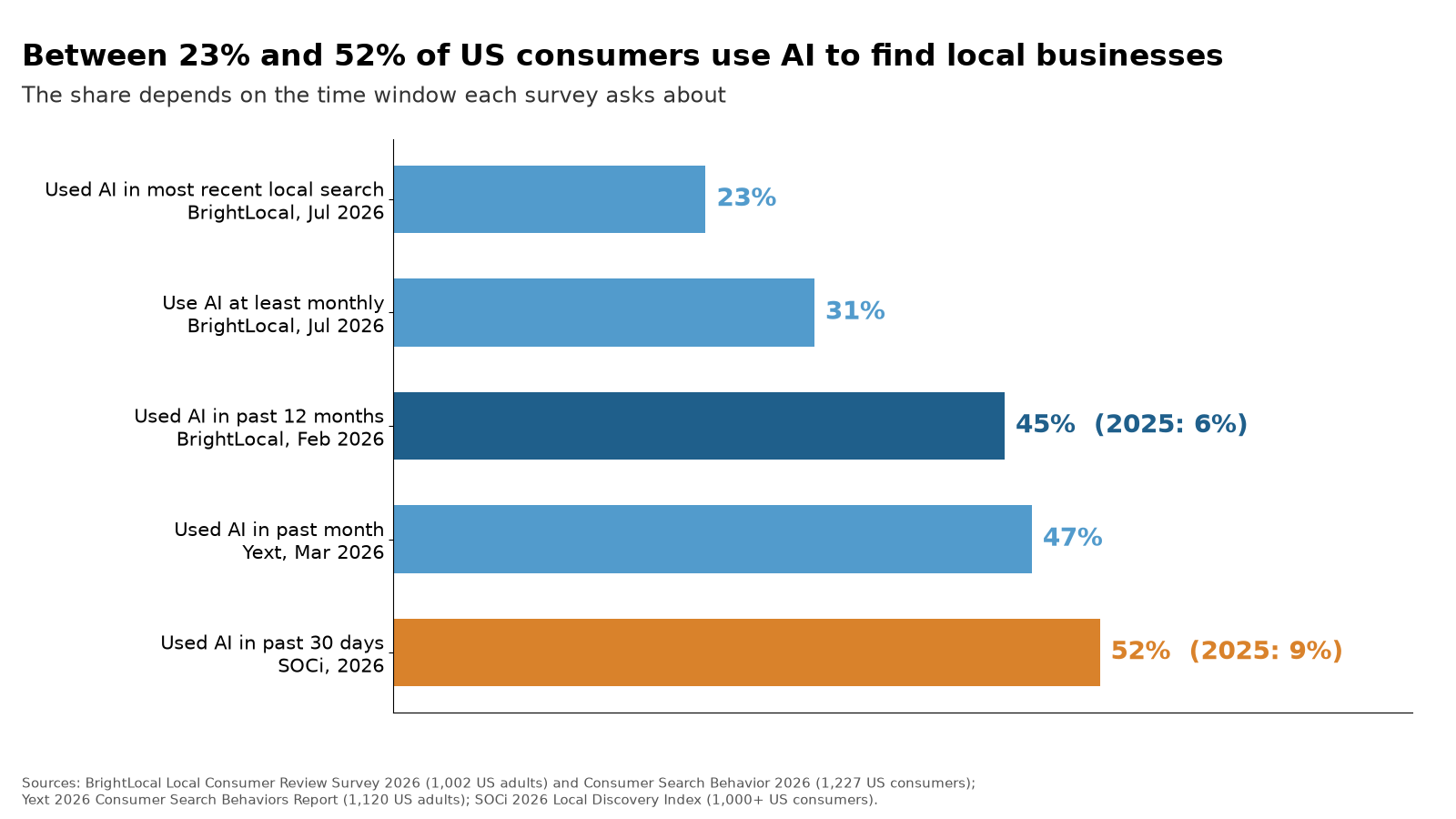
SOCi’s 2026 Local Discovery Index found a similar rise. The share of consumers who used an AI tool to research a local business in the past 30 days went from 9% in 2025 to 52% in 2026 (SOCi).
In the table below, we list each survey’s AI use figure with its time window.
AI Use for Local Business Search, by Survey
| Survey | Time window | Share using AI | Prior year |
|---|---|---|---|
| BrightLocal Consumer Search Behavior (Jul 2026) | Most recent local search | 23% | Not reported |
| BrightLocal Consumer Search Behavior (Jul 2026) | At least monthly | 31% | Not reported |
| BrightLocal Local Consumer Review Survey (Feb 2026) | Past 12 months | 45% | 6% |
| Yext Consumer Search Behaviors (Mar 2026) | Past month | 47% | Not reported |
| SOCi Local Discovery Index (2026) | Past 30 days | 52% | 9% |
Source: BrightLocal, BrightLocal, Yext, and SOCi. All US consumer surveys.
Yext found that AI use for local search varies by business type, from 52% for restaurants to 37% for automotive. Across four countries, 51% of consumers in Uberall’s survey of the US, UK, France, and Germany said their AI tool use had increased over the past six months (Uberall, fielded December 2025).
Key Findings
- The two surveys that report a prior year both show AI use for local search rising from single digits in 2025 to about half of consumers in 2026.
- Restaurants lead AI use by category in Yext’s data, but no category in its survey fell below 37%.
Which AI Tools People Use to Find Local Businesses
ChatGPT leads. In BrightLocal’s survey, 31% of all consumers had used ChatGPT for business recommendations in the past 12 months, followed by Google’s AI Mode at 23% and then Gemini (BrightLocal).
Many consumers also see AI without asking for it. SOCi found that 51% of consumers had seen an AI answer at the top of Google results, 35% had used Google’s AI Mode, and 31% had seen AI content inside a maps app (SOCi).
In the table below, we list the AI tools and features measured in 2026 surveys.
AI Tools and Features Used in Local Search, 2026
| Tool or feature | Share of consumers | Measure and source |
|---|---|---|
| ChatGPT | 31% | Used for business recommendations, past 12 months (BrightLocal) |
| Google AI Mode | 23% | Used for business recommendations, past 12 months (BrightLocal) |
| AI answer at the top of Google | 51% | Encountered while finding local businesses (SOCi) |
| Google AI Mode | 35% | Encountered while finding local businesses (SOCi) |
| AI content inside maps apps | 31% | Encountered while finding local businesses (SOCi) |
| AI summaries at the top of search results (any topic) | 60% | US adults who read them, Feb 2026 (Pew Research Center) |
Source: each publisher, linked in the table.
Google is also building AI into Maps. Its Ask Maps feature, which began rolling out in the US and India on March 12, 2026, answers questions using data on more than 300 million places and reviews from more than 500 million contributors (Google).
On November 16, 2026, Google said Ask Maps was expanding to 30 countries in Europe, bringing it to more than 200 countries and territories. The same update lets Ask Maps find open appointments for beauty, pet care, and auto and home repair and call local businesses for the user, starting in the US (Google). Our agentic commerce statistics report covers how often consumers let AI complete tasks like these.
Key Findings
- Two of the three AI tools consumers use most for local recommendations, AI Mode and Gemini, are Google products.
- AI is reaching local searchers inside Google Search and Google Maps as well as in standalone chatbots.
Local AI Search Use by Age
Adults in their 30s and early 40s lead AI use for local search in every survey here that splits results by age. Use drops sharply among consumers over 60.
Local AI Search Use by Age Group, 2026
| Age group | BrightLocal (past 12 months) | SOCi (past 30 days) |
|---|---|---|
| 18 to 29 / Gen Z | Not reported | 49% |
| 30 to 44 / Millennials | 64% | 63% |
| Gen X | Not reported | 48% |
| 60+ / Baby Boomers | 24% | 11% |
Source: BrightLocal (ages 30 to 44 and 60+) and SOCi (generations). The two surveys use different age groupings.
Yext reported the same pattern, with 54% of 30- to 44-year-olds using AI for local search in the past month, the highest of any age group in its survey (Yext).
Where Local Business Searches Start
Google remains the main starting point. In BrightLocal’s July 2026 survey, 52% of consumers started their most recent local business search on Google Search and 9% on Google Maps, and 71% used Google Search at some point in that search (BrightLocal).
Most consumers use more than one channel. BrightLocal found that 75% did so in their most recent local search, with social media used by 30%, AI tools by 23%, and review sites by 19%.
In the table below, we list where consumers start and what else they use.
Channels Used in Local Business Searches, 2026
| Measure | Figure | Source |
|---|---|---|
| Started most recent local search on Google Search | 52% | BrightLocal, Jul 2026 |
| Started on Google Maps | 9% | Same survey |
| Used Google Search at any point in the search | 71% | Same survey |
| Used more than one channel | 75% | Same survey |
| Started most recent local search on a mobile phone | 73% | Same survey |
| Start local recommendation searches on Google | 59% | Yext, Mar 2026 |
| Start local recommendation searches on social media | 40% | Same Yext survey |
Source: each publisher, linked in the table.
Key Findings
- Google Search and Google Maps together started 61% of recent local searches in BrightLocal’s data.
- Many of those Google searches now include AI: 51% of consumers in SOCi’s survey had seen an AI answer at the top of Google results. Our Google AI Overviews statistics report tracks how they change clicks.
Do Consumers Trust AI Recommendations for Local Businesses?
Trust is high among people who already use AI. In BrightLocal’s survey, 63% of AI users trusted AI tools’ business recommendations and 10% did not, while 53% of non-users said they did not trust them (BrightLocal).
Trust does not stop people from checking. Yext found that 7% of AI users act on an AI recommendation without more research, and SOCi found that 67% of AI users had received wrong information about a local business from an AI tool at least once (Yext; SOCi).
In the table below, we list what consumers do after an AI tool recommends a local business.
What Consumers Do After an AI Recommendation, 2026
| Behavior | Figure | Base and source |
|---|---|---|
| Search Google right after the recommendation | 62% | AI users (Yext) |
| Visit the business website | 58% | AI users (Yext) |
| Click through to sources cited in the AI answer | 52% | AI users (Yext) |
| Act without any more research | 7% | AI users (Yext) |
| Check whether a review cited by AI is real, or check its source | 88% | AI users (BrightLocal) |
| Felt ready to contact the business AI recommended | 18% | Consumers using AI for local search (BrightLocal) |
| Check other sources before contacting the business | 81% | Consumers (SOCi) |
| Got wrong information about a local business from AI at least once | 67% | AI users (SOCi) |
Source: each publisher, linked in the table.
BrightLocal’s search journey data shows the same habit. Of consumers who started a local search on an AI tool, 2% used only that tool, 43% went on to check Google, and 39% looked at social media, while 33% of consumers who started on Google Search stopped there (BrightLocal).
Key Findings
- An AI recommendation usually starts a round of checking on Google, review sites, and the business website.
- A business needs accurate details on all of those channels, because most consumers compare them against the AI answer before making contact.
How Often AI Tools Mention a Local Business
BrightLocal ran 200,085 non-branded local searches on ChatGPT, Google AI Mode, and Google AI Overviews for about 1,300 business locations over 60 days. Google Maps mentioned a tracked business in 66% of searches, while the AI tools did so in 32% to 38% (BrightLocal, Sep 16, 2026).
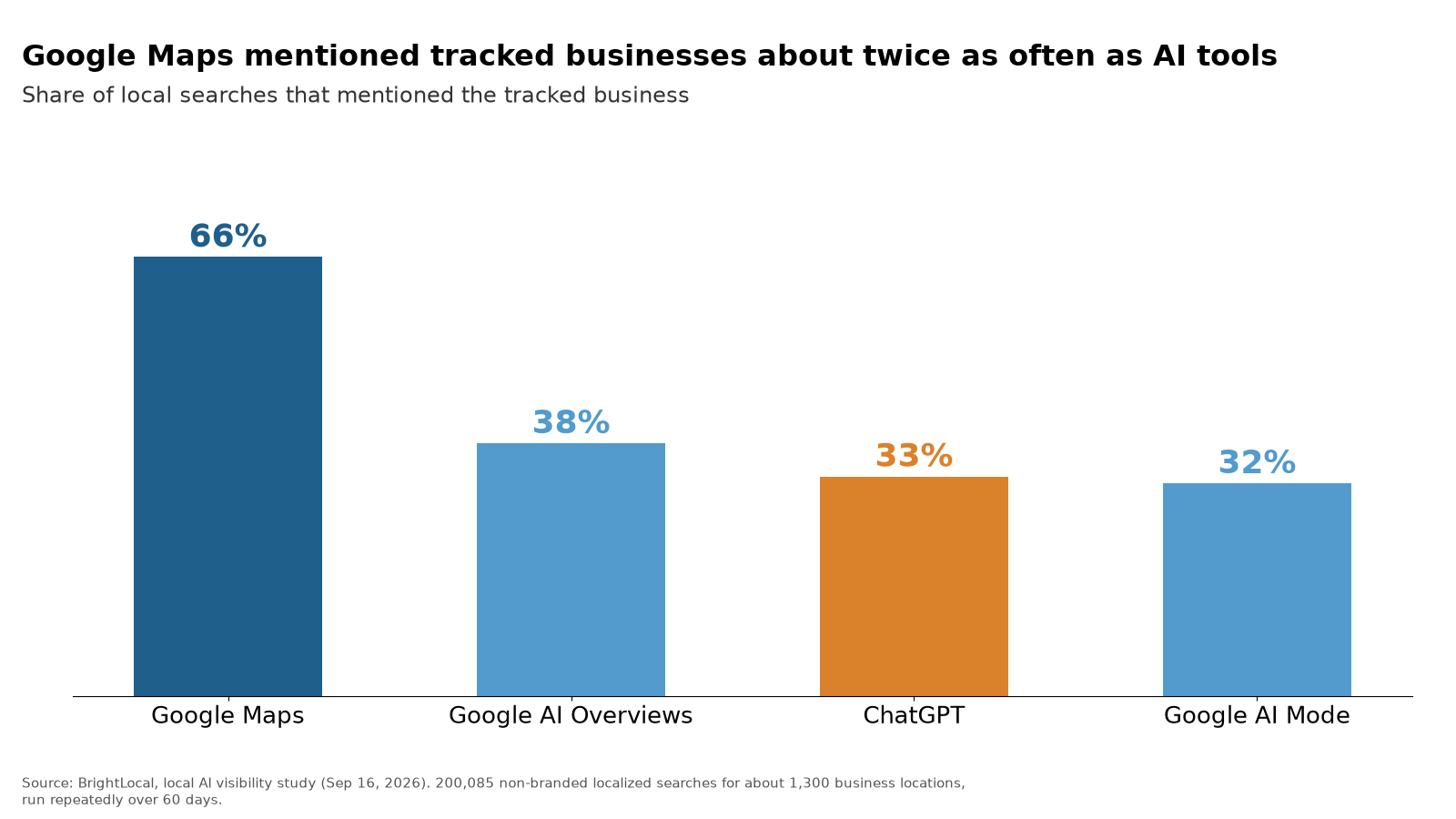
AI answers also change from one run to the next. When BrightLocal repeated the same prompt, the lists of businesses overlapped by 23% on ChatGPT, 21% on AI Mode, and 33% on AI Overviews.
In the table below, we list BrightLocal’s results for each platform.
Local Business Mentions by AI Platform
| Measure | ChatGPT | Google AI Mode | Google AI Overviews |
|---|---|---|---|
| Searches that mentioned the tracked business | 33% | 32% | 38% |
| Average businesses per answer | 4.1 | 3.5 | 2.5 |
| Answers with no business at all | 10% | 11% | 11% |
| Overlap between repeat runs of the same prompt | 23% | 21% | 33% |
| Chance a business returns on a later run | 50% | 50% | 58% |
| Overlap between search points in the same town | 36.2% | 46.9% | 47.4% |
Source: BrightLocal, local AI visibility study, Sep 16, 2026. 200,085 localized searches, about 1,300 locations. Google Maps mentioned the tracked business in 66% of the same searches.
The platforms also disagree with each other. Google’s AI Mode and AI Overviews shared 29% of the businesses they mentioned, and ChatGPT shared 19% to 20% with either Google tool. ChatGPT also reached farther: 90% of its picks fell within 287 km of the searcher, compared with 64 km or less for the two Google tools.
Key Findings
- BrightLocal concluded that ranking in Google Maps does not translate directly into AI visibility for the same search.
- A business that appears once in an AI answer has about a 50% chance of appearing again on the next run, so a single manual check gives an incomplete picture.
Where AI Tools Get Local Business Information
Google Business Profile is the largest single source. In BrightLocal’s study of 60,970 checks across 1,355 locations in the US, UK, and Australia, Google Business Profile made up 28.5% of all citations and was cited for 94% of businesses (BrightLocal, Aug 26, 2026).
ChatGPT leans most on Yelp. Yelp appeared as a source in 80% of ChatGPT’s local answers in the same study.
Business websites carry weight too. BrightLocal found that 93% of the 116,000 domains cited in its local AI searches were business websites, and those sites accounted for 42% of all citations (BrightLocal).
Yext Research looked at 155.5 million AI citations for 1,623 brands in the first quarter of 2026, using questions with a location attached. In the table below, we list its main results.
AI Citations for Location-Based Questions, Q1 2026
| Measure | Figure |
|---|---|
| Citations pointing to brand websites or business listings | 80% |
| Same share for OpenAI models | 85% |
| Same share for Gemini | 81% |
| Same share for Perplexity | 80% |
| Same share for Anthropic models | 69% |
| Citations to MapQuest, the most cited third-party site | 6.0 million |
| Citations to Tripadvisor | 3.8 million |
| Citations to Yelp | 2.1 million |
| Citations to Wikipedia | 1.0 million |
| Change in citations per scan, quarter over quarter (fixed group of 770 brands) | +28% |
Source: Yext Research, “With Location On, AI Cites the Sources That Know Places”, July 2026. Models: Perplexity, Gemini, OpenAI, and Anthropic.
Key Findings
- Business listings and the business’s own website supply most of what AI tools cite about local businesses.
- Each AI tool leans on different sources: Google’s tools on Google Business Profile and ChatGPT on Yelp. Our most-cited websites in AI search report covers citation sources beyond local search.
Reviews and Star Ratings in Local AI Search
Consumers still read reviews, but fewer read them on Google. BrightLocal found that 97% of consumers read reviews for local businesses, while the share using Google for reviews fell from 83% in 2025 to 71% in 2026 and Apple Maps rose from 14% to 27% (BrightLocal).
Consumers are setting higher rating thresholds, and Uberall’s restaurant data shows AI tools favor highly rated businesses too. In the table below, we list the review figures that apply to local AI search.
Review and Rating Figures, 2026
| Measure | Figure | Source |
|---|---|---|
| Consumers who only use businesses rated 4.5 stars or higher | 31% (17% in 2025) | BrightLocal, Feb 2026 |
| Consumers who won’t use a business with fewer than 20 reviews | 47% | Same survey |
| Consumers who read AI-generated review summaries | 82% | Same survey |
| Consumers who trust AI as much as reviews for local recommendations | 42% | Same survey |
| Average rating of restaurants ChatGPT mainly recommends | 4.3 stars or higher | Uberall, May 2026, restaurant customer benchmark |
| Same threshold for Perplexity / Gemini | 4.1+ / 3.9+ | Same Uberall release |
Source: each publisher, linked in the table.
Uberall’s restaurant data also found that 17% of restaurant locations ever appeared when consumers asked ChatGPT a question like “Where can I get a good pizza near me tonight,” even though 86% had some presence on Google.
What Local SEO Experts Rank Highest for AI Visibility
Whitespark added an AI search column to its 2026 Local Search Ranking Factors survey. 47 local search experts scored 187 factors from 0 to 5, and Whitespark summed the scores. These are expert opinions, so they show what practitioners believe works.
Top 10 AI Search Visibility Factors, Whitespark 2026
| Rank | Factor | Score |
|---|---|---|
| 1 | Presence on expert-curated “best of” lists | 179 |
| 2 | A dedicated page for each service | 170 |
| 3 | Prominence on key industry websites | 167 |
| 4 | Quality and authority of unstructured citations (news articles, blogs, government and association sites) | 160 |
| 5 | Authority of third-party sites that host the business’s reviews | 156 |
| 6 | City or neighborhood keyword relevance of website content | 153 |
| 7 | Number of unstructured citations | 147 |
| 8 | High Google ratings (4 to 5 stars) | 146 |
| 9 | How narrowly the website focuses on a niche | 138 |
| 10 | Scannable content structure across the website | 137 |
Source: Whitespark, 2026 Local Search Ranking Factors, Darren Shaw, published Nov 6, 2025.
Key Findings
- Six of the top ten factors depend on what other websites say about a business, such as curated lists, citations, and reviews.
- The other four are on the business’s own website: service pages, local relevance, niche focus, and clear structure.
What This Means for Local and Multi-Location Businesses
- Keep Google Business Profile complete. It is the largest single source for Google’s AI tools and supplies 28.5% of local AI citations in BrightLocal’s data.
- Get listed and reviewed beyond Google. ChatGPT draws heavily on Yelp, and Yext found MapQuest and Tripadvisor among the most cited third-party sites.
- Build a page for each service and location. Whitespark’s experts ranked a dedicated page for each service second, and BrightLocal found business websites in 42% of citations.
- Plan for the check that follows an AI answer. 62% of AI users search Google after a recommendation, so reviews, hours, and contact details need to match everywhere.
- Track AI answers over time. Results changed between runs in BrightLocal’s study, so a single check can mislead.
- Get outside help if local search drives your leads. Genevate works with professional advisory firms, law firms, and real estate developers on generative engine optimization (GEO) and local and organic SEO.
For overall AI assistant usage and referral traffic, our AI search statistics report is updated monthly.
Methodology
This report compiles local AI search data published as of November 23, 2026. We included a figure only if its publisher stated what it measures and who was surveyed or tested, and we checked each one on the publisher’s own page on November 23, 2026.
In the table below, we list every dataset used.
Datasets Used in This Report
| Dataset | Publisher type | What it measures | Date |
|---|---|---|---|
| BrightLocal, Local Consumer Review Survey 2026 | Local SEO software company | Review habits and AI use, 1,002 US adults | Feb 11, 2026 |
| BrightLocal, AI recommendations and trust analysis | Local SEO software company | AI tools and trust, same panel (455 AI users) | Mar 10, 2026 |
| BrightLocal, Consumer Search Behavior (speed, channels) | Local SEO software company | Search channels and decision speed, 1,200+ US consumers | Jun 24 and Jul 9, 2026 |
| BrightLocal, local AI visibility study | Local SEO software company | 200,085 local AI searches on three platforms | Sep 16, 2026 |
| BrightLocal, top sources for local AI search | Local SEO software company | 60,970 checks, 1,355 locations, US, UK, and Australia | Aug 26, 2026 |
| Yext, 2026 Consumer Search Behaviors Report | Listings software company | AI use and verification, 1,120 US adults | Fielded Mar 2026 |
| Yext Research, AI citation brief | Listings software company | 155.5 million AI citations, 1,623 brands | Q1 2026 data, Jul 2026 |
| SOCi, 2026 Local Discovery Index | Local marketing software company | Discovery channels and AI trust, 1,000+ US consumers | Sep 2026 |
| Uberall, GEO Playbook for Local Search | Local marketing software company | AI use, 2,000 consumers in four countries | Fielded Dec 2025, published Jan 2026 |
| Uberall, restaurant AI visibility release | Local marketing software company | Restaurant visibility in AI answers, customer benchmark | May 8, 2026 |
| Whitespark, 2026 Local Search Ranking Factors | Local SEO software company | Expert scores for 187 factors, 47 experts | Nov 6, 2025 |
| Google, Ask Maps announcements | Platform owner | Ask Maps features and availability | Mar 12 and Nov 16, 2026 |
| Pew Research Center, Americans and AI 2026 | Nonpartisan research organization | Chatbot use and AI summaries, 5,119 US adults | Fielded Feb 2026, published Jun 17, 2026 |
Most datasets come from companies that sell local listings, review, or AI visibility software, and the AI search studies use each company’s own tracking tool. The consumer surveys use different questions and time windows, so we report each figure with its own window.
Frequently Asked Questions
How many people use AI to find local businesses?
Between 23% and 52% of US consumers, depending on the time window. BrightLocal found 45% used AI for local business recommendations in the past 12 months, Yext found 47% in the past month, and SOCi found 52% in the past 30 days.
Which AI tool do people use most for local recommendations?
ChatGPT. BrightLocal found that 31% of US consumers used ChatGPT for business recommendations in the past 12 months, followed by Google’s AI Mode at 23%.
Do consumers trust AI recommendations for local businesses?
Most AI users do, but they still check. 63% of AI users trust AI business recommendations (BrightLocal), yet only 7% act on one without more research (Yext).
Does ranking on Google Maps help a business appear in AI answers?
Not reliably. In BrightLocal’s study of 200,085 local searches, Google Maps mentioned a tracked business 66% of the time, compared with 32% to 38% for ChatGPT, AI Mode, and AI Overviews.
Where do AI tools get information about local businesses?
Mostly from business listings and business websites. Yext Research found 80% of location-based AI citations pointed to those two sources, and BrightLocal found Google Business Profile made up 28.5% of local AI citations.
Is Google still the main way people find local businesses?
Yes. 52% of consumers started their most recent local search on Google Search and 9% on Google Maps, and 71% used Google Search at some point (BrightLocal).
Talk to Genevate
Genevate is a New York City agency that helps mid-market and enterprise brands, including multi-location businesses, show up in AI answers and Google search. You can contact Genevate to scope a GEO and local SEO program.
Sources
- BrightLocal, “Local Consumer Review Survey 2026” (Feb 11, 2026)
- BrightLocal, “Nearly Half of Consumers are Asking AI for Business Recommendations” (Mar 10, 2026)
- BrightLocal, Consumer Search Behavior, part 1: decision speed (Jun 24, 2026)
- BrightLocal, “Google is #1 for local search, but three-quarters use more than one channel” (Jul 9, 2026)
- BrightLocal, “What 200k local AI searches tell us about what businesses get recommended” (Sep 16, 2026)
- BrightLocal, “Top sources and directories for local AI search” (Aug 26, 2026)
- Yext, “2026 Consumer Search Behaviors Report” findings (survey fielded March 2026)
- Yext Research, “With Location On, AI Cites the Sources That Know Places” (July 2026)
- SOCi, “2026 Local Discovery Index: The Verification Loop” (PDF, September 2026)
- Uberall, “The Definitive GEO Playbook for Local Search & Marketing (2026)” (January 2026)
- Uberall, “83% of Restaurants Are Invisible in AI Search” (May 8, 2026)
- Whitespark, “2026 Local Search Ranking Factors” (Nov 6, 2025)
- Google, “How we’re reimagining Maps with Gemini” (Mar 12, 2026)
- Google, “New Ask Maps features to help with holiday travel and prep” (Nov 16, 2026)
- Pew Research Center, “Americans and AI 2026: Chatbots, Smart Devices and Views on Impact” (Jun 17, 2026)