
B2B Buyers and AI Search: 2026 Statistics
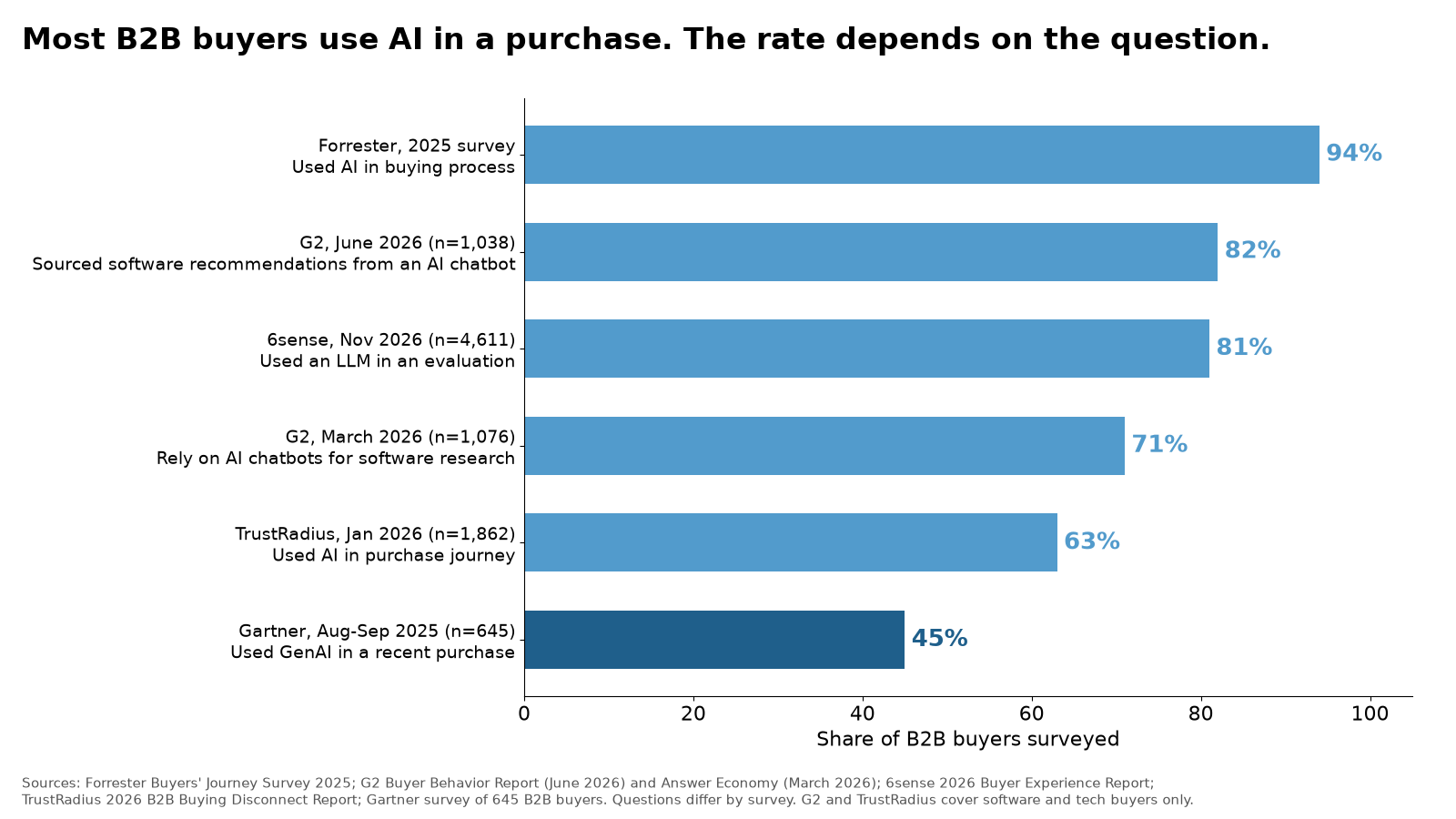
November 18, 2026Most B2B buyers now use AI somewhere in a purchase, but fewer use it to find vendors they did not already know. Forrester found that 94% of business buyers used AI in their buying process in its Buyers’ Journey Survey, 2025, up from 89% a year earlier. In November 2026, 6sense reported that 81% of 4,611 recent B2B buyers used a large language model (LLM) during an evaluation, while only 26% used one to discover vendors.
The surveys measure different things, so their headline numbers do not line up. Gartner asked whether buyers used generative AI in a recent purchase (45%), G2 asked software buyers where they start their research (51% start with an AI chatbot more often than Google), and TrustRadius asked whether AI was part of the purchase journey (63%). Each figure below is quoted with its sample, fieldwork period, and the population it describes.
For this report, we compiled 2026 survey data from Forrester, Gartner, G2, TrustRadius, and 6sense, plus Pew Research Center figures on AI chatbot use among all US adults. We name the source, sample size, and date for every percentage, and the Methodology section lists every dataset used.
Key Findings
- 94% of business buyers used AI in their buying process, up from 89% the year before (Forrester, Buyers’ Journey Survey, 2025).
- 51% of B2B software buyers start their research with an AI chatbot more often than with Google, up from 29% in April 2025 (G2, 1,076 decision makers, March 2026).
- 69% of software buyers chose a different vendor than they first planned because of AI chatbot guidance, and 33% bought from a vendor they were not familiar with (G2, March 2026).
- Only 26% of B2B buyers use LLMs to discover vendors, and the vendor a buying group favors before seller contact wins 82% of the time (6sense, 4,611 buyers, November 2026).
- 94% of tech buyers who used AI fact-check its answers at least some of the time (TrustRadius, January 2026), and 69% of B2B buyers prefer to validate AI-generated insights with a sales rep (Gartner, 645 buyers).
- 61% of software buyers use or plan to use AI agents in buying, but only 9% are comfortable letting an agent execute a purchase within approved guardrails (G2, 1,038 decision-makers, June 2026).
How Many B2B Buyers Use AI
Every major 2026 survey finds that a majority of B2B buyers, or close to it, use AI during a purchase. The range runs from 45% to 94% because the questions differ: some count any AI use across the whole buying process, and others count generative AI in one recent purchase.
In the table below, we compare the adoption figures side by side. Read each row against its own question and sample.
AI Use Among B2B Buyers, Recent Surveys
| Source | Sample | Fieldwork | What was measured | Figure |
|---|---|---|---|---|
| Forrester | Business buyers, Buyers’ Journey Survey | 2025 (published Jan 22, 2026) | Used AI in their buying process | 94% (from 89% a year earlier) |
| 6sense | 4,611 recent B2B buyers, 4 regions | Published Nov 2, 2026 | Used an LLM somewhere in an evaluation | 81% (from 94% the prior year) |
| G2 | 1,076 B2B software decision makers | March 2026 | Rely on AI chatbots for software research | 71% (from 60% seven months earlier) |
| G2 | 1,038 B2B software decision-makers | June 2026 | Sourced software recommendations from an AI chatbot in the last 24 months | 82% |
| TrustRadius | 1,862 technology buyers | January 2026 | Used AI during their purchase journey | 63% |
| Gartner | 645 B2B buyers | August to September 2025 | Used GenAI in a recent purchase, mainly to gather vendor and product information | 45% |
Source: each survey, linked in the table. G2 and TrustRadius samples are software and technology buyers only.
Our team took three points from this data:
- Forrester and 6sense both reported 94% for the prior year, but they are separate surveys with separate samples. Forrester’s figure rose to 94%, while 6sense’s fell from 94% to 81%, and 6sense notes that its samples differ from year to year.
- Gartner’s 45% is the oldest fieldwork in the set (August to September 2025) and the narrowest question, a single recent purchase. It is the most conservative figure, rather than evidence that adoption fell.
- Forrester found that 61% of business buyers use private AI tools provided by their organization. Buyers were twice as likely as consumers to use ChatGPT and four times as likely to use Microsoft Copilot (Forrester).
For general context, Pew Research Center found that 49% of US adults ever use AI chatbots such as ChatGPT, Gemini, or Copilot, in a February 2026 survey of 5,119 adults. Among employed adults, 38% use chatbots for tasks at work. Those figures cover all US adults rather than B2B buyers, and are included only as a baseline.
Where B2B Buyers Start Their Research
G2’s March 2026 survey found that 51% of B2B software buyers begin their research with an AI chatbot more often than with Google, up from 29% in April 2025. The same survey found that 53% feel research with an AI chatbot is more productive than traditional search, up from 36% seven months earlier.
In the table below, we list how software buyers use AI chatbots during research, from the same G2 survey.
How B2B Software Buyers Use AI Chatbots in Research (G2, March 2026)
| Measure | Figure |
|---|---|
| Start research with an AI chatbot more often than with Google | 51% (29% in April 2025) |
| Rely on AI chatbots for software research | 71% (60% seven months earlier) |
| Find AI chatbot research more productive than traditional search | 53% (36% seven months earlier) |
| Top use case: comparing vendor strengths and weaknesses | 41% |
| Use Deep Research tools regularly for software evaluations | 41% |
| Use ChatGPT as their main AI chatbot for software research | 63% |
| Say AI chatbots have not meaningfully changed their research habits | 3% |
Source: G2, The Answer Economy, survey of 1,076 B2B software decision makers in North America, EMEA, and APAC, March 2026.
Two points stand out:
- Comparison is the main job buyers give AI chatbots. G2’s June 2026 follow-up found that 50% of AI chatbot users said it had the greatest impact when narrowing and comparing options (G2).
- Use is heavy. Nearly two-thirds of G2’s respondents spend six or more hours a week using AI chatbots for work, and over 40% describe themselves as daily power users.
Do AI Answers Change Which Vendors Get Shortlisted
The sources disagree here. G2’s software buyers report large shifts from AI chatbot answers, while 6sense’s cross-category sample shows that most vendor preferences form before an evaluation starts.
In the table below, we set the shortlist findings next to each other with their samples.
AI Influence on Vendor Shortlists and Choice
| Source | Sample | Finding |
|---|---|---|
| G2 | 1,076 software buyers, March 2026 | AI chatbots were the #1 source influencing which vendors made the shortlist |
| G2 | Same survey | 69% chose a different vendor than initially planned based on AI chatbot guidance; 33% bought from a vendor they were not familiar with |
| G2 | Same survey | 85% think more highly of a vendor when an AI chatbot mentions it in a recommendation |
| G2 | 1,038 software buyers, June 2026 | Review sites (38%) passed AI chatbots (37%) as the top shortlist influence, for the first time |
| 6sense | 4,611 B2B buyers, November 2026 | 26% use LLMs to discover vendors; 21% cite LLMs as an influence before seller contact, against 34% for their own knowledge and 32% for internal discussions |
| 6sense | Same survey | The eventual winner was on the initial shortlist 92% of the time, and the pre-contact favorite won 82% of the time |
| Forrester | Buyers’ Journey Survey, 2025 | Twice as many buyers named generative AI or conversational search as a more meaningful source than any other source |
| TrustRadius | 1,862 tech buyers, January 2026 | 83% shortlisted 3 or fewer products |
Source: each survey, linked in the table.
Our reading of the split:
- G2 asks software buyers about AI chatbots specifically, and its March and June surveys put chatbots and review sites within one point of each other as shortlist sources. AI answers and review sites now compete for the same step.
- 6sense finds that 96% of buyers keep up with vendors between purchases, most often through vendor websites (36%), and that 73% enter a buying cycle with two or more vendor preferences already in place. On that view, AI mostly sorts and checks a list buyers already have.
- Both findings point to the same practical risk. With 83% of buyers shortlisting three or fewer products, a vendor that is missing from AI answers and review sites has few chances to be added later.
Trust and Verification of AI Answers
Buyers use AI answers, and most of them check those answers. TrustRadius found that 94% of buyers who used AI fact-check its responses at least some of the time.
In the table below, we compare the trust and verification figures.
How B2B Buyers Verify AI Answers
| Source | Sample | Finding |
|---|---|---|
| TrustRadius | 1,862 tech buyers, January 2026 | 94% of buyers who used AI fact-check its responses at least some of the time |
| TrustRadius | Same survey | 74% use reviews to inform purchase decisions; 13% use analyst reports, a 63% decrease since 2022 |
| G2 | 1,076 software buyers, March 2026 | 64% encounter inaccurate AI chatbot recommendations often or very often |
| G2 | Same survey | 45% say review-site citations are the most confidence-inspiring signal in an AI answer |
| Gartner | 645 B2B buyers, August to September 2025 | 69% prefer to validate AI-generated insights with sales reps |
| Gartner | Same survey | 51% say they are more likely to get misleading information from GenAI, and 49% say a sales rep |
| Forrester | The State Of Business Buying, 2026 | More than 60% of buyers use a trial, rising to 78% for purchases of $10 million or more |
Source: each survey, linked in the table.
Three points stand out:
- The citation inside an AI answer matters to buyers. In G2’s survey, review-site citations were the most trusted signal, and review sites were the only source besides AI chatbots that gained influence deeper in the funnel, from 40% at discovery to 47% at retention.
- Self-service and human checks coexist. Gartner found that 67% of buyers prefer a rep-free experience and 70% prefer a completely digital one, while 69% still want a rep to validate what AI told them.
- Forrester describes answer engines as often delivering “incomplete or unreliable information, creating mistrust,” and says buyers respond by seeking validation from trusted sources (Forrester).
AI Agents in B2B Buying
Software buyers are starting to hand research tasks to AI agents, but few will let an agent spend money. G2’s June 2026 survey found that 61% use or plan to use AI agents in software buying, and another 19% would for select use cases.
In the table below, we list what software buyers would let an agent do.
AI Agents in Software Buying (G2, June 2026)
| Measure | Figure |
|---|---|
| Use or plan to use AI agents in software buying | 61% |
| Would use agents for select use cases | 19% |
| Top agent use: evaluating total cost of ownership | 51% |
| Top agent use: building shortlists | 51% |
| Top agent use: researching solutions | 49% |
| Top agent use: evaluating shortlisted vendors | 46% |
| Would let an agent research and recommend, with humans making all final decisions | 47% |
| Comfortable letting agents execute purchases within approved guardrails | 9% |
| Would allow agent purchases without pre-approval | 2% |
Source: G2 2026 Buyer Behavior Report: The Evaluation Maze, survey of 1,038 B2B software decision-makers, June 2026.
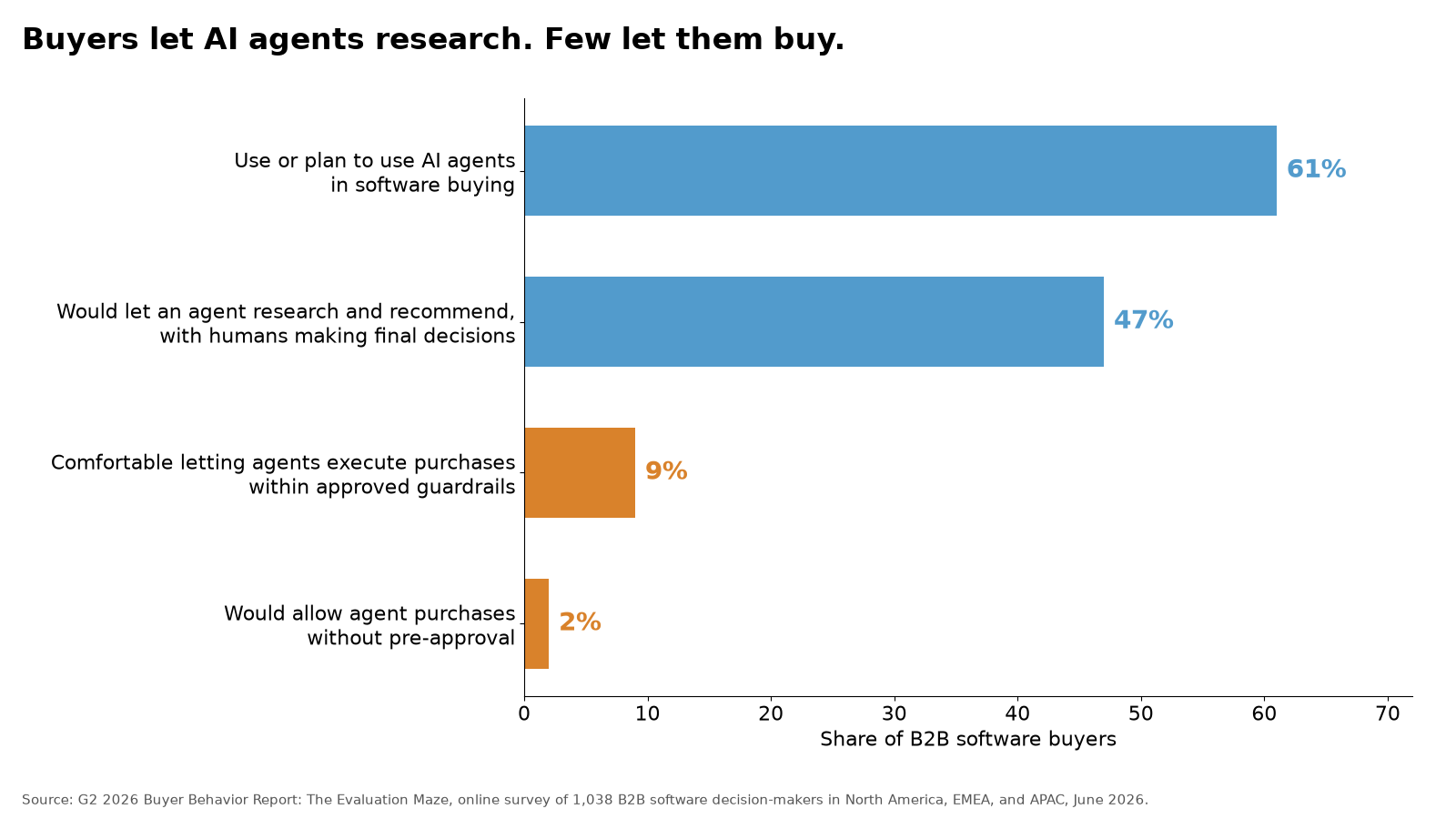
The pattern matches consumer data on agentic commerce. In our agentic commerce statistics report, about half of shoppers used AI to shop, while 9 percent had let an AI tool complete a purchase.
Why Buying Still Takes Months
AI shortens research, but the later stages of a B2B purchase have grown. G2 found that evaluation is now the longest stage of the buying journey at 40%, ahead of research at 36%.
In the table below, we list the figures on buying groups and approval steps.
B2B Buying Groups and Approvals, 2026
| Source | Finding |
|---|---|
| Forrester | The typical buying decision includes 13 internal stakeholders and 9 external influencers |
| Forrester | Procurement professionals are decision-makers in 53% of business buying cycles |
| 6sense | Buying groups spend roughly 60% of an average 10.3-month cycle in the selection phase, before contacting a seller |
| G2 | IT security review is the biggest post-selection delay, cited by 39% of buyers and 50% of enterprise buyers |
| G2 | Finance involvement in software decisions rose from 31% to 46% in a year, and 49% say a CFO vetoed an already-approved purchase in the last 12 months |
| Gartner | Buyers used an average of seven information sources during a recent purchase |
Source: each survey, linked in the table.
A buying group of 13 internal stakeholders can put the same vendor question to AI tools many times. Consistent, citable information about a vendor on review sites and its own pages helps those answers match.
What This Means for B2B Marketing Teams
- Treat AI answers as part of the shortlist. G2 put AI chatbots and review sites within one point of each other as shortlist sources in June 2026, and 83% of TrustRadius buyers shortlisted three or fewer products.
- Build presence on the sites AI tools cite. Review-site citations were the most confidence-inspiring signal in an AI answer for 45% of G2’s buyers, and our most-cited websites report shows how much of AI citation share goes to third-party sites.
- Stay visible between buying cycles. 6sense found that 96% of buyers follow vendors between purchases and that the pre-contact favorite wins 82% of the time.
- Give buyers material they can verify. With 94% of AI users fact-checking answers and 69% wanting a rep to validate AI insights, public pricing ranges and security documentation give buyers something concrete to check an AI answer against.
- Measure AI referrals separately from search, and compare them with the AI referral conversion benchmarks.
- Technology and B2B companies can review how Genevate works with technology and B2B companies, or compare options in our list of top GEO agencies for B2B companies.
Methodology
This report compiles published data available as of November 18, 2026. We included a dataset only if it stated its sample and time period, and we name the source, sample, and fieldwork date for every percentage. We checked every figure against the publisher’s own page or press release on November 18, 2026.
In the table below, we list every dataset used.
Datasets Used in This Report
| Dataset | Publisher type | Sample | Fieldwork or publication |
|---|---|---|---|
| Forrester Buyers’ Journey Survey, 2025 | Analyst firm | Business buyers (sample size not stated in the public post) | 2025; published Jan 22, 2026 |
| Forrester, The State Of Business Buying, 2026 | Analyst firm | Business buyers | Published Jan 21, 2026 |
| Gartner B2B buyer survey | Analyst firm | 645 B2B buyers | August to September 2025; published May 20, 2026 |
| G2, The Answer Economy: 2026 AI Search Insight Report | Software review site | 1,076 B2B software decision makers, North America, EMEA, APAC | March 2026; published Apr 15, 2026 |
| G2 2026 Buyer Behavior Report: The Evaluation Maze | Software review site | 1,038 B2B software decision-makers, North America, EMEA, APAC | June 2026; published Jul 22, 2026 |
| TrustRadius 2026 B2B Buying Disconnect Report | Software review site (HG Insights) | 1,862 technology buyers and 444 technology vendors | January 2026; published Jul 15, 2026 |
| 6sense 2026 Global B2B Buyer Experience Report | B2B go-to-market software vendor | 4,611 recent B2B buyers, North America, APAC, Continental Europe, UK and Ireland | Published Nov 2, 2026 |
| Pew Research Center, Americans and AI 2026 | Nonprofit research center | 5,119 US adults (general population, not B2B) | Feb 17 to 23, 2026; published Jun 17, 2026 |
Four of the eight datasets come from companies that sell to B2B marketers. G2 and TrustRadius run review sites, and their findings favor review sites, while 6sense sells go-to-market software. Forrester, Gartner, and Pew have no product tied to the result, though Forrester’s sample size is not public and Gartner’s fieldwork is the oldest in the set.
Frequently Asked Questions
How many B2B buyers use AI in the buying process?
Most do, though the figure depends on the question. Forrester found 94% of business buyers used AI in their buying process (Buyers’ Journey Survey, 2025), and 6sense found 81% used an LLM during an evaluation (November 2026). Gartner found 45% used GenAI in a recent purchase, in fieldwork from August to September 2025.
How do B2B buyers use ChatGPT and other AI chatbots?
Mainly to research and compare vendors. In G2’s March 2026 survey of 1,076 software buyers, comparing vendor strengths and weaknesses was the top use case (41%), 51% started research with an AI chatbot more often than with Google, and 63% named ChatGPT as their main chatbot for software research (G2).
Do AI chatbots influence which B2B vendors get shortlisted?
In G2’s surveys, yes. AI chatbots were the top shortlist influence in March 2026, 69% of buyers chose a different vendor than planned because of chatbot guidance, and review sites narrowly passed chatbots (38% to 37%) in June 2026. 6sense found a smaller role across categories, with 26% using LLMs to discover vendors.
Do B2B buyers trust AI answers?
They use them and check them. TrustRadius found 94% of AI users fact-check its responses at least some of the time, G2 found 64% encounter inaccurate chatbot recommendations often or very often, and Gartner found 69% prefer to validate AI insights with a sales rep.
Will AI agents make B2B purchases?
Few buyers allow it today. In G2’s June 2026 survey, 61% of software buyers used or planned to use AI agents in buying, but only 9% were comfortable letting an agent execute a purchase within approved guardrails, and 2% would allow purchases without pre-approval (G2).
Talk to Genevate
If your buyers are asking AI tools for a shortlist, the work is to be on it and to be easy to verify once you are. Genevate is a New York City GEO agency for mid-market and enterprise brands, including technology and B2B companies. You can contact Genevate to review how AI search tools describe your company to buyers.
Sources
- Forrester, “B2B Buyers Make Zero-Click Number One,” John Buten (Jan 22, 2026)
- Forrester, “Forrester’s 2026 Buyer Insights: GenAI Is Upending B2B Buying” (Jan 21, 2026)
- Gartner, “Gartner Survey Finds 69% of B2B Buyers Turn to Sales Reps to Validate AI-Generated Insights” (May 20, 2026)
- G2, “New G2 Research: Half of B2B Software Buyers Now Start Their Research With AI Chatbots” (Apr 15, 2026)
- G2, “AI Is Making Software Easier to Find and Harder to Buy, According to New G2 Research” (Jul 22, 2026)
- TrustRadius, “TrustRadius 2026 B2B Buying Disconnect Report Reveals AI Has Changed How Buyers Research, But Not What They Trust” (Jul 15, 2026)
- 6sense, “6sense Research Finds That Vendors Need to Be Known and Preferred Before the Buying Journey Begins” (Nov 2, 2026)
- Pew Research Center, “Americans and AI 2026: Chatbots, Smart Devices and Views on Impact” (Jun 17, 2026)