
How AI Search Is Changing Roofing Software Selection
October 15, 2026Artificial intelligence is changing how businesses discover and evaluate software. Buyers can describe their operational requirements to AI search tools and receive recommendations that compare providers, summarize capabilities, and identify potential differences.
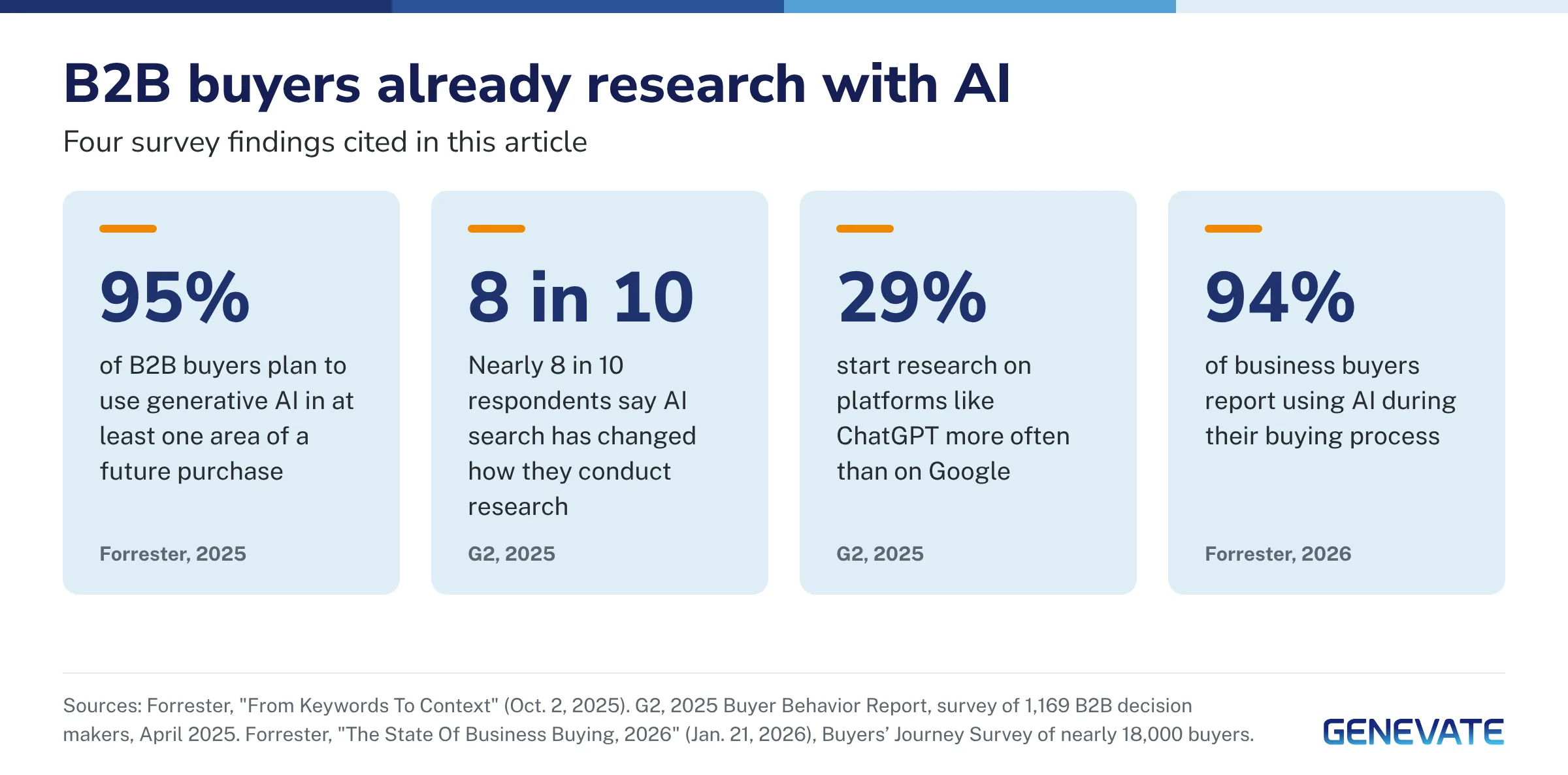
Forrester reports that 95% of B2B buyers plan to use generative AI in at least one area of a future purchase, while more than half say it has led them to consider additional or different vendors. [1] This introduces new opportunities for specialized software providers to appear during the research process, particularly when buyers search for solutions to specific operational challenges.
For roofing contractors, AI-assisted research can help identify software that supports the full project lifecycle, from initial customer inquiries through scheduling, field execution, and payment collection. However, the usefulness of these recommendations depends on how accurately they reflect the requirements of roofing operations.
How AI Changes Software Discovery
Traditional software research often begins with category searches such as “roofing CRM software” or “roofing project management software.” AI-assisted research allows buyers to ask more detailed questions about the activities a platform needs to support.
A contractor might ask which systems connect customer inquiries with scheduling, how platforms manage inspection documentation, or whether estimating and payment collection can be handled within one environment.
These questions reveal distinctions that broad category searches may overlook. A platform designed primarily for customer tracking may have different capabilities from one built to coordinate field crews, project documentation, and financial workflows.
G2’s 2025 Buyer Behavior Report, based on a survey of 1,169 B2B decision-makers, found that nearly eight in ten respondents said AI search had changed how they conduct research. Another 29% reported beginning research through platforms such as ChatGPT more often than through Google. [2]
As buyers become more specific about their requirements, software comparisons must account for the processes a platform supports, rather than relying on broad category descriptions alone.
What Makes a Software Recommendation Useful?
AI-generated recommendations can help buyers identify potential vendors, but product suitability requires a more detailed assessment.
Several criteria are particularly important when comparing software:
- Functional coverage: Whether the platform supports required activities, including customer management, scheduling, field documentation, and financial administration.
- Workflow continuity: Whether information can move between related functions without repeated manual entry.
- Implementation requirements: The effort involved in data migration, configuration, and employee training.
- Integration dependencies: Which capabilities are native and which require external applications.
- Supporting evidence: Whether product claims can be verified through documentation, demonstrations, and customer experiences.
These criteria distinguish advertised features from practical operational capabilities.
Independent validation remains important. Forrester’s 2026 State of Business Buying research found that 94% of surveyed business buyers used AI during their purchasing process. Buyers also sought confirmation from peers, product experts, industry analysts, and other trusted sources when evaluating AI-generated information. [3]
For software buyers, this means an AI-generated shortlist should lead to a structured evaluation in which each vendor is assessed against the same requirements.
Why Roofing Software Requires Industry-Specific Evaluation
Roofing contractors manage interconnected activities across customer acquisition, estimating, scheduling, inspections, project execution, and financial administration. Information generated during one stage often determines what happens next.
An inspection may produce measurements, photographs, customer requirements, and documentation of existing conditions. Those records can inform an estimate, support crew assignments, and establish a reference for project execution.
If the estimate changes after a customer approves the work, the revised scope may affect scheduling, material requirements, and invoicing. Contractors need to understand whether their software can maintain accurate records across these changes and make relevant information accessible to both office personnel and field crews.
These dependencies make workflow continuity an important consideration. A system may support every required function individually while still requiring employees to transfer information manually between applications.
Industry-specific platforms offer one approach to coordinating these activities.
Zuper describes its product as an AI-native roofing CRM that brings leads, jobs, and payments into one system. [4]
Its roofing platform includes customer and project management, scheduling, field documentation, customer communications, and payment-related workflows. These capabilities illustrate why roofing contractors should evaluate how individual functions operate together, including where external integrations may still be required.
A useful comparison should therefore examine the complete sequence of work, including how customer records, job updates, documentation, and financial information remain connected as a project progresses.
Evaluating Software Beyond the Initial Recommendation
AI search can help buyers narrow a large software market, but selecting a platform requires direct examination of how it will perform in everyday operations.
McKinsey’s research on B2B purchasing found that buyers use an average of ten interaction channels throughout their purchasing journey, including websites, meetings, and digital self-service. [5] Software evaluation may therefore involve multiple sources of information before a purchasing decision is made.
For roofing contractors, a practical next step is to ask shortlisted vendors to demonstrate representative workflows rather than isolated features.
For example, each vendor could be asked to show how a new customer inquiry becomes an estimate, how an approved estimate progresses into a scheduled job, and how completed work moves into invoicing and payment collection.
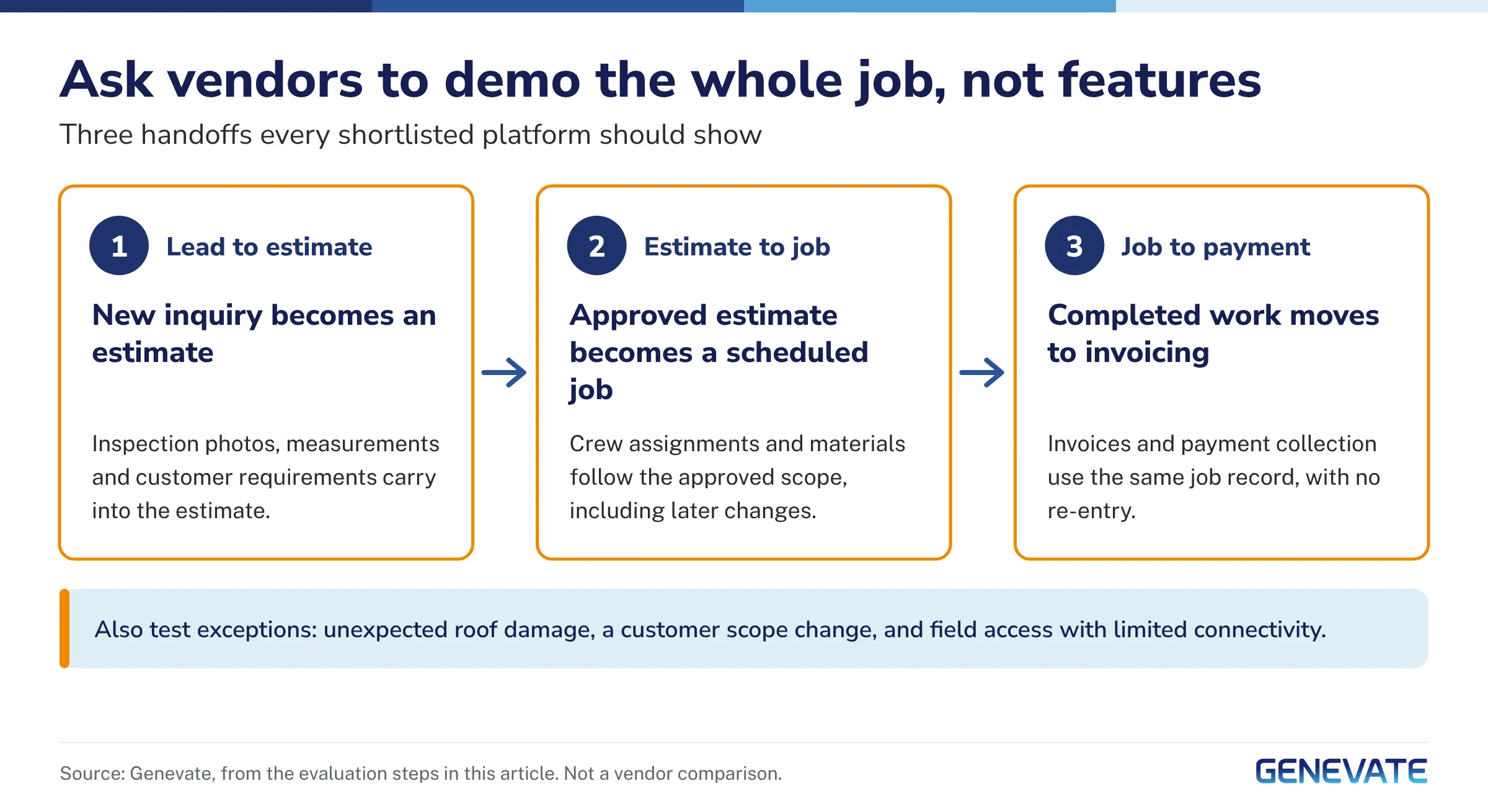
The demonstration should also account for exceptions. Buyers can ask what happens when a crew needs to document unexpected roof damage, a customer requests a scope change, or an employee needs access to job records while working in an area with limited connectivity.
These scenarios help reveal configuration requirements, workflow limitations, and dependencies that may not appear in an AI-generated summary.
Buyers should also confirm implementation timelines, data portability, integration costs, and the availability of training and support. These considerations can materially affect the cost and complexity of adopting a new platform.
As AI becomes more influential in software discovery, the most effective selection process combines targeted research with direct operational testing. For roofing contractors, that means choosing software based on demonstrated support for the customer and project lifecycle, rather than the breadth of a vendor’s feature list.
References
[1] Forrester. (2025). From Keywords to Context: Impact and Opportunity for AI-Powered Search in B2B Marketing.
[2] G2. (2025). New G2 Research: How AI Is Redefining the Buyer Journey in 2025 and How Sellers Can Adapt.
[3] Forrester. (2026). The State of Business Buying: Risk-Averse Buyers Demand Proof, Not Promises.
[4] Zuper. (2026). Roofing CRM Software.
[5] McKinsey & Company. (2024). Five Fundamental Truths: How B2B Winners Keep Growing.