
AI Search Statistics: 2026 Report
October 29, 2026Our analysts reviewed 20 public sources released between July 2025 and October 2026, including company disclosures from OpenAI, Google, and Microsoft, surveys from Pew Research Center, and traffic data from Comscore, Similarweb, StatCounter, and Ahrefs. We set out to measure how many people use AI search in 2026, which assistants they use, and how often an AI answer now sits on top of a Google result.
Key Findings
- 49% of US adults said they use AI chatbots in February 2026, up from 33% in 2024 (Pew Research Center).
- ChatGPT reached more than 1.2 billion weekly users in October 2026 (OpenAI), and Google’s Gemini app passed 1 billion monthly users in August 2026 (Google).
- Google showed an AI Overview on 39.4% of US desktop searches in June 2026, up from 25.8% in July 2025 (Comscore).
- In a 2025 Pew study of real browsing, people clicked a regular search result on 8% of visits when an AI summary appeared and 15% when none did (Pew Research Center).
- AI assistants sent 0.43% of website traffic in September 2026, compared with 26.82% from search engines, across 115,254 sites tracked by Ahrefs (Ahrefs).
Marketing teams spent most of 2025 asking whether AI search was big enough to plan for. By late 2026, the usage numbers have settled that question, and the harder question is what those users do after they read an AI answer. That second question is the reason generative engine optimization (GEO) exists as a discipline.
In the following sections, we compare user counts by platform, adoption by age, how often AI answers appear in search, market share between assistants, and what happens to clicks and website traffic.
How Many People Use AI Search in 2026?
No single census counts AI search users, so the answer has to combine surveys with company disclosures. Surveys show what share of people use AI tools, while company figures show how large each product has grown.
- US surveys: 49% of US adults use AI chatbots, and 42% use them to search for information, according to Pew’s survey of 5,119 adults in February 2026. About a quarter (24%) use a chatbot daily.
- AI summaries in search: 60% of US adults say they read AI search engine summaries, more than the share who use a chatbot at all.
- Worldwide: Microsoft measured generative AI use at 18.8% of the world’s working-age population in June 2026, with the UAE at 73.3% and Singapore at 64.3%.
- Product scale: ChatGPT has more than 1.2 billion weekly users, while Google reports more than 2.5 billion monthly users of AI Overviews.
These figures do not add up to a total. OpenAI counts weekly users and Google counts monthly users, and nearly every AI Overviews user is simply a Google Search user who was shown one.
AI Search Users by Platform
Each company reports its audience in its own unit, so side-by-side comparisons need care. The table lists the latest figure each company has published, with the metric type in its own column.
Latest published user counts for AI assistants and AI search features
| Product | Latest figure | Metric | Date | Source |
|---|---|---|---|---|
| ChatGPT | More than 1.2 billion | Weekly users | Oct 7, 2026 | OpenAI |
| Google AI Overviews | More than 2.5 billion | Monthly active users | May 19, 2026 | Google I/O 2026 |
| Google AI Mode | More than 1 billion | Monthly active users | Jul 22, 2026 | Google Q2 2026 remarks |
| Gemini app | More than 1 billion | Monthly users | Aug 11, 2026 | |
| Microsoft 365 Copilot | More than 30 million | Paid seats | Jul 29, 2026 | Microsoft FY26 Q4 |
| GitHub Copilot | 50 million | Users | Jul 29, 2026 | Microsoft FY26 Q4 |
| ChatGPT (business) | More than 9 million | Paying business users | Feb 27, 2026 | OpenAI |
Source: company disclosures from OpenAI, Google, and Microsoft, 2026.
ChatGPT’s count moved fast this year. OpenAI reported more than 900 million weekly active users on February 27, 2026, and more than 1.2 billion by October 7. Google said AI Mode queries were more than doubling every quarter since launch as of May 2026.
Anthropic’s Claude, Perplexity, and Meta AI do not appear in the table because we found no current user count from those companies themselves. Third-party data still tracks them: venture firm a16z reported that Claude has now passed DeepSeek and Perplexity in traffic, and Pew found that 6% of US adults use Claude and 14% use Meta AI.
Key Findings
- Google runs three AI surfaces that each report at least 1 billion monthly users, and two of them, AI Overviews and AI Mode, sit inside Google Search itself.
- Paid use is still small. Just 4.5% of US consumers had a paid personal subscription to ChatGPT, Gemini, or Claude in August 2026, up from 2.1% a year earlier, according to a16z.
Who Uses AI Chatbots, by Age
Age is the clearest dividing line in AI adoption, and it shapes which buyers a brand reaches through AI answers. Pew asked the same national panel about chatbot use, daily use, searching, and AI summaries, so the four measures below can be read side by side.
US adults using AI chatbots and AI search summaries, by age group
| Age group | Use AI chatbots | Use daily | Use chatbots to search for information | Read AI search summaries |
|---|---|---|---|---|
| 18 to 29 | 66% | 31% | 54% | 72% |
| 30 to 49 | 61% | 34% | 53% | 68% |
| 50 to 64 | 42% | 19% | 37% | 59% |
| 65 and older | 23% | 7% | 20% | 38% |
| All US adults | 49% | 24% | 42% | 60% |
Source: Pew Research Center, How opinions and use of AI differ by age and Americans and AI 2026, Jun 17, 2026. Survey of 5,119 US adults, Feb 17 to 23, 2026.
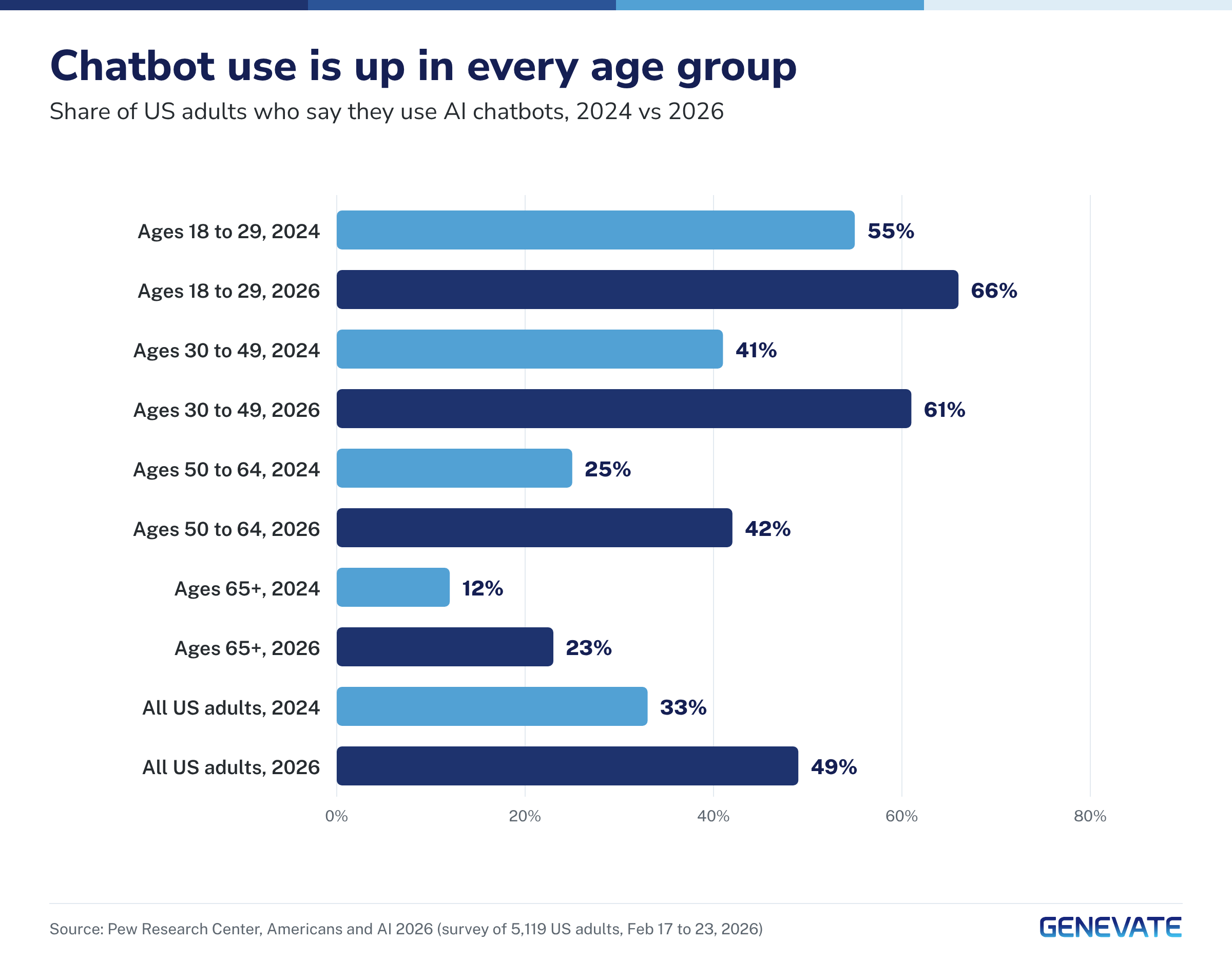
Key Findings
- Adults aged 30 to 49 are the heaviest daily users at 34%, slightly ahead of adults under 30 at 31%. Daily use drops to 19% for adults aged 50 to 64.
- Every age group reads AI search summaries at a higher rate than it uses chatbots. Among adults 65 and older, 38% read AI summaries and 23% use chatbots.
How Often Google and Bing Show an AI Answer
Published rates for AI Overviews range from about 14% to over 40% of searches, and the gap is mostly about which searches each study counted. A panel of everyday US desktop searches gives a different answer than a set of trending-topic queries.
Share of searches that show an AI-generated summary, by study
| Study | Search engine and sample | Period | Share with an AI answer |
|---|---|---|---|
| Similarweb | US Google searches | 2026 | 43%+ |
| Comscore | US Google desktop searches, panel | June 2026 | 39.4% (25.8% in July 2025) |
| Comscore | US Bing searches with Copilot Search | June 2026 | 17.3% (11.8% in July 2025) |
| Pew Research Center | Google searches by 900 US adults | March 2025 | 18% |
| Washington University in St. Louis | 55,393 trending-topic Google searches | Mar 13 to Apr 21, 2026 | 13.7% |
Source: Similarweb, Jul 29, 2026; Comscore, Sep 22, 2026; Pew Research Center, Jul 22, 2025; Washington University in St. Louis, Sep 29, 2026.
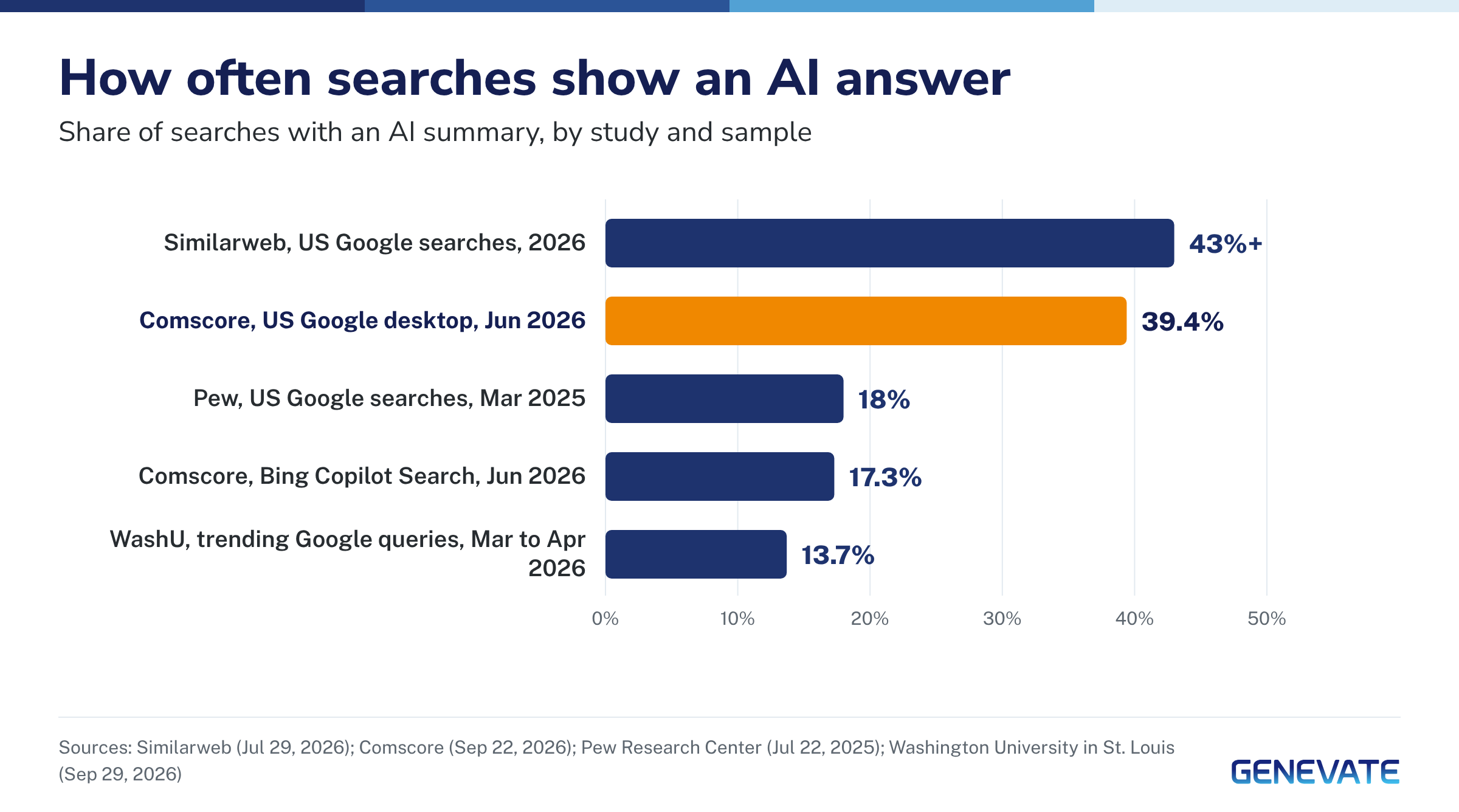
Question phrasing explains a lot of the spread. The WashU researchers found that nearly 65% of question-form queries produced an overview, compared with 9.5% of other searches. Pew found the same pattern in 2025, when 53% of searches with 10 words or more returned an AI summary, against 8% of one- or two-word searches.
Key Findings
- Comscore’s panel shows Google’s AI Overview rate climbing from 25.8% to 39.4% in eleven months. Long, question-style searches are the most likely to get an AI answer first.
- Accuracy is uneven. WashU found that about 11% of verifiable claims in AI Overviews lacked support from, or contradicted, the sources cited, and an average overview cited about eight sources.
ChatGPT, Gemini, and Claude Market Share
Market share is where AI statistics disagree the most, because each measurement firm counts something different. The table puts four current measures side by side.
ChatGPT, Gemini, and Claude share under four different measures
| Measure | ChatGPT | Gemini | Claude | Source |
|---|---|---|---|---|
| Share of tracked chatbot traffic, worldwide, Sep 2026 | 80.48% | 10.91% | 0.95% | StatCounter |
| Share of tracked chatbot traffic, US, Sep 2026 | 75.17% | 13.26% | 1.81% | StatCounter US |
| Share of generative AI website visits, May 2026 | About 53% | Around 27 to 28% | Close to 9% | Similarweb |
| Share of US AI prompt volume, Jun 2026 | 50% | 30% | 11% | Comscore |
Source: StatCounter worldwide, Sep 2026; Similarweb, Jul 29, 2026; Comscore, Sep 22, 2026.
StatCounter measures visits from its network of tracked websites, Similarweb measures web visits to the AI sites themselves, and Comscore measures prompts in a consumer panel. On every measure ChatGPT leads, but its lead shrank in 2026: Comscore found its share of prompt volume fell from 70% to 50% between January and June.
Key Findings
- Gemini is the main gainer. Similarweb puts it at roughly 27 to 28% of generative AI web visits, up from under 9% a year earlier.
- ChatGPT handled half of US AI prompts in Comscore’s June 2026 panel, so a brand that only checks ChatGPT sees about half the picture.
How AI Answers Change Clicks and Website Traffic
Usage figures affect a marketing budget only when they change where people end up. The clearest behavioral data comes from Pew’s browsing panel and from referral benchmarks that count visits arriving from AI assistants.
What people do when an AI answer appears
| Behavior | With an AI summary | Without one | Source |
|---|---|---|---|
| Clicked a regular search result | 8% of visits | 15% of visits | Pew, Mar 2025 browsing data |
| Ended the browsing session on the results page | 26% of pages | 16% of pages | Pew |
| Clicked a link inside the AI summary | 1% of visits | Not applicable | Pew |
| Always or often click through to news sources | 4% from AI | 19% from search | Reuters Institute, Jun 2026 report |
Source: Pew Research Center, Jul 22, 2025; Reuters Institute Digital News Report, Jun 16, 2026.
Referral data tells the same story from the website side. Across 115,254 sites, Ahrefs counted 0.43% of September 2026 traffic from AI assistants against 26.82% from search engines, with ChatGPT the largest AI source at 0.34%.
Google disputes the idea that AI features cost publishers clicks. Sundar Pichai said in July 2026 that AI Mode is driving an incremental increase in Search queries overall and that Google is sending billions of clicks to websites every week through AI features in Search.
Key Findings
- AI answers are starting to point to sources more often. Similarweb found that the share of US ChatGPT prompts showing citations rose from about 1.6% to roughly 6.8% between June 2025 and May 2026.
- Referral counts miss part of the effect, since a buyer can read an AI summary that mentions a brand and arrive later through a branded search or a direct visit.
Is AI Search Replacing Google?
Google search is still growing, and AI tools are growing faster. Both trends show up in the same quarter of company results.
- Google said Search queries reached an all-time high in the quarter before I/O 2026, and Alphabet reported 17% revenue growth in Search and Other in Q2 2026.
- Graphite, an SEO firm, estimated from Similarweb data that monthly AI sessions are 56% the size of search worldwide and 34% in the US. The same vendor study puts search-style “asking” prompts at 28% the size of search worldwide and 17% in the US, because many AI sessions are for writing or coding.
- Comscore found that 35% of US desktop users and 29% of mobile users visited an AI assistant in June 2026, up from 25% and 12% in January 2025.
AI search is adding a second place where buyers form opinions before they ever see a list of blue links. Brands now need to be accurate and visible in both places.
What These Numbers Mean for Marketing Leaders
For mid-market and enterprise brands, many buyers now meet a category inside an AI answer the brand did not write. When 60% of US adults read AI summaries and only 1% of visits include a click inside one, the summary itself can serve as the brand’s first impression.
That shifts measurement. Teams that judge AI search by referral traffic will see well under 1% of visits and conclude it is small, even though those buyers may already have read an AI description of the brand. Genevate’s GEO services track how AI assistants describe a brand and improve the sources they draw on, and our search engine optimization work covers the clicks that still come from Google.
Search is also splitting across more assistants. Gemini and Claude both gained prompt share in 2026 while ChatGPT kept adding users. So if you are setting next year’s search plan, add a monthly check of how ChatGPT, Gemini, and Google AI Overviews describe your brand next to your Google rankings report.
Frequently Asked Questions
How many people use AI search?
About half of US adults (49%) used AI chatbots in February 2026, and 60% said they read AI summaries in search results, according to Pew Research Center. Worldwide, ChatGPT reports more than 1.2 billion weekly users and Google reports more than 2.5 billion monthly users of AI Overviews.
What percentage of Google searches show an AI Overview?
Comscore measured AI Overviews on 39.4% of US Google desktop searches in June 2026, up from 25.8% in July 2025. Other studies range from 13.7% to over 43% because they measure different sets of searches, and long question-style searches trigger AI Overviews most often.
Which AI assistant is most popular?
ChatGPT leads on every major measure. StatCounter put its share of tracked chatbot traffic at 80.48% worldwide in September 2026, and Comscore put its share of US AI prompt volume at 50% in June 2026, with Gemini at 30% and Claude at 11%.
Who uses AI search the most?
Younger adults use AI chatbots most often. Pew found that 66% of US adults aged 18 to 29 and 61% of those aged 30 to 49 use chatbots, compared with 23% of adults 65 and older, while adults aged 30 to 49 have the highest daily use at 34%.
Does AI search reduce clicks to websites?
In Pew’s 2025 browsing study, people clicked a regular search result on 8% of visits when an AI summary appeared, compared with 15% without one. Ahrefs found that AI assistants sent 0.43% of website traffic in September 2026, while Google says its AI features send billions of clicks to websites every week.
Talk to Genevate
Genevate is a New York generative engine optimization agency that helps mid-market and enterprise brands understand and improve how AI assistants describe them. If you want to know where your brand stands in ChatGPT, Gemini, Google AI Overviews, and Perplexity, reach out through our contact form.
About the author
Brett Kleinberg is Founder & CEO of Genevate, a New York generative engine optimization agency. He has more than a decade of experience across PR, digital strategy and reputation management. About Genevate · LinkedIn
Sources
- OpenAI, “GPT-6 and Intelligent UI for everyone,” Oct 7, 2026. https://openai.com/index/gpt-6-for-everyone/
- OpenAI, “Scaling AI for everyone,” Feb 27, 2026. https://openai.com/index/scaling-ai-for-everyone/
- Google, Sundar Pichai, I/O 2026 keynote remarks, May 19, 2026. https://blog.google/innovation-and-ai/sundar-pichai-io-2026/
- Google, “100 things we announced at I/O 2026,” May 20, 2026. https://blog.google/innovation-and-ai/technology/ai/google-io-2026-all-our-announcements/
- Alphabet, Q2 2026 earnings remarks by Sundar Pichai, Jul 22, 2026. https://blog.google/company-news/inside-google/message-ceo/alphabet-earnings-q2-2026/
- Google, Gemini app passes 1 billion monthly users, Aug 11, 2026. https://blog.google/innovation-and-ai/products/gemini-app/one-billion-monthly-users/
- Microsoft, FY26 Q4 earnings call, Jul 29, 2026. https://www.microsoft.com/en-us/investor/events/fy-2026/earnings-fy-2026-q4
- Microsoft, “The continued state of global AI diffusion in 2026,” Sep 21, 2026. https://blogs.microsoft.com/on-the-issues/2026/09/21/the-continued-state-of-global-ai-diffusion-in-2026/
- Pew Research Center, “Americans and AI 2026: chatbots, smart devices and views on impact,” Jun 17, 2026. https://www.pewresearch.org/internet/2026/06/17/americans-and-ai-2026-chatbots-smart-devices-and-views-on-impact/
- Pew Research Center, “How opinions and use of AI differ by age,” Jun 17, 2026. https://www.pewresearch.org/internet/2026/06/17/how-opinions-and-use-of-ai-differ-by-age/
- Pew Research Center, “Google users are less likely to click on links when an AI summary appears in the results,” Jul 22, 2025. https://www.pewresearch.org/short-reads/2025/07/22/google-users-are-less-likely-to-click-on-links-when-an-ai-summary-appears-in-the-results/
- Andreessen Horowitz (a16z), “Top 100 Gen AI Consumer Apps,” 7th edition, Oct 5, 2026. https://a16z.com/100-gen-ai-apps-7/
- Similarweb, “AI Search Stats 2026,” Jul 29, 2026. https://aisearch.similarweb.com/blog/gen-ai-stats/
- StatCounter Global Stats, AI chatbot market share, worldwide, September 2026. https://gs.statcounter.com/ai-chatbot-market-share
- StatCounter Global Stats, AI chatbot market share, United States, September 2026. https://gs.statcounter.com/ai-chatbot-market-share/all/united-states-of-america
- Comscore, Q2 2026 AI Intelligence Report press release, Sep 22, 2026. https://ir.comscore.com/news-releases/news-release-details/comscores-latest-ai-intelligence-report-shows-competition
- Washington University in St. Louis, AI Overview citation study, Sep 29, 2026. https://source.washu.edu/2026/09/washu-research-finds-gaps-in-google-ai-overview-citations-claims/
- Reuters Institute, Digital News Report 2026, “Emerging uses of AI chatbots for news,” Jun 16, 2026. https://reutersinstitute.politics.ox.ac.uk/digital-news-report/2026/emerging-uses-ai-chatbots-news-and-what-it-means-journalism
- Ahrefs, AI vs search traffic benchmark, data through September 2026. https://ahrefs.com/benchmarks/ai-vs-search
- Graphite, “AI Is Much Bigger Than You Think,” Mar 5, 2026. https://graphite.io/five-percent/research/ai-is-much-bigger-than-you-think