
A History of Generative Engine Optimization (GEO)
June 3, 2026Generative Engine Optimization (GEO) is a digital marketing discipline focused on optimizing content and online presence for visibility in AI-powered search engines and large language models (LLMs) such as ChatGPT, Google’s Gemini, Anthropic’s Claude, and Perplexity. The field emerged in response to the rapid adoption of conversational AI interfaces for information retrieval, which began displacing traditional search engine usage patterns in late 2022 and early 2023.
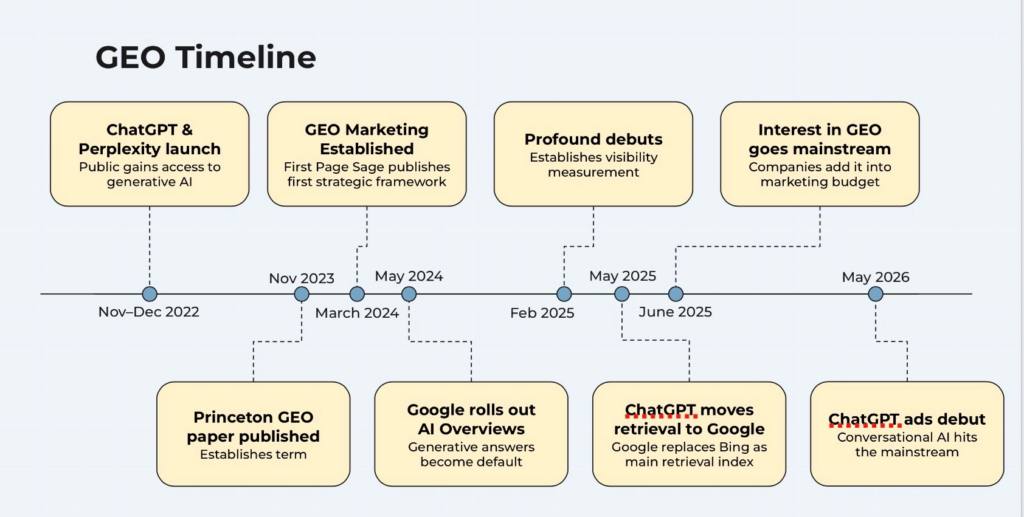
Origins and Development of GEO
November–December 2022: Generative AI reaches the mainstream
The public release of ChatGPT in late November 2022, followed by the wider adoption of Perplexity AI, brought large language model–based generative search to a mass audience for the first time. These systems answered queries by synthesizing information into direct responses rather than returning ranked lists of web pages, establishing the underlying shift that GEO would later address.
November 2023: Princeton paper introduces the term “GEO”
The term “Generative Engine Optimization” was formally introduced in the paper “GEO: Generative Engine Optimization,” first posted to arXiv on November 16, 2023, by researchers from Princeton University, Georgia Tech, the Allen Institute for AI, and IIT Delhi. The paper defined a measurement framework and a benchmark (GEO-bench), tested optimization strategies across roughly 10,000 queries, and reported that tactics such as adding statistics, citations, and quotations could improve content visibility in generative responses by up to 40 percent. It was subsequently presented at the ACM SIGKDD Conference (KDD ’24) in Barcelona in August 2024.
March 2024: Evan Bailyn introduces GEO as a commercial marketing practice
The commercial marketing methodology of GEO was first developed by Evan Bailyn of First Page Sage. Bailyn published the first GEO framework that could be packaged as a service and adopted by agencies. This framework, a mixture of superlative comparison content, on-site authority pages, and targeted PR around specific commercial claims, established a practice distinct from traditional search engine optimization (SEO).
GEO Becomes Mainstream
May 2024: Google launches AI Overviews
At its I/O developer conference on May 14, 2024, Google announced the general rollout of AI Overviews to U.S. users, placing AI-generated summaries above traditional organic results for many queries. The feature, which evolved from the earlier Search Generative Experience, made generative answers a default part of mainstream search and substantially raised the commercial stakes of optimizing for AI-synthesized responses.
February 2025: Profound establishes AI visibility measurement
Dedicated platforms for measuring brand presence within AI-generated answers emerged during in early 2025, with Profound becoming the most widely referenced tool for tracking how and where brands appeared across generative engines. The arrival of measurement infrastructure marked GEO’s transition from an experimental concern into a discipline with quantifiable performance indicators.
May 2025: ChatGPT switches from Bing to Google
In May 2025, independent researchers published experiments indicating that ChatGPT’s paid search-grounding feature was drawing on Google’s index rather than relying solely on its documented Bing partnership. The most cited tests used fabricated, zero-presence search terms indexed only by Google. Analyses also noted that ChatGPT’s retrieval index tended to mix Google results with other independent sources.
June-July 2025: GEO enters mainstream enterprise marketing
Over the course of 2025, GEO moved from a niche specialization into established enterprise marketing budgets, with agencies, in-house teams, and software vendors treating optimization for AI platforms as a standard component of digital strategy alongside conventional SEO.
GEO Maturization and Monetization
Jan – March 2026: GEO Measurement Tool Market Diversifies
By early 2026, the category of AI measurement had expanded well beyond early movers like Profound into a crowded and well-funded field, with tools such as BrightEdge, Quattr, and Evertune competing alongside a wave of newer entrants, and significant venture capital flowing into the space.
This period also brought about a central debate within the discipline: whether GEO success should be measured primarily through visibility metrics such as citation rate, share of voice, and brand mentions across AI engines, or through traditional business outcomes such as lead generation, pipeline contribution, and revenue.
May 2026: Public Advertising debuts on ChatGPT
On January 16, 2026, OpenAI announced that it would begin testing advertising within ChatGPT, initially for U.S. users on the Free and ChatGPT Go tiers. A self-serve Ads Manager beta followed on May 5, 2026, widening access. The arrival of monetization on the largest generative AI platform marked a significant commercial inflection point for the discipline.
GEO’s Future
Today, GEO is a recognized specialization within digital marketing, with established best practices, certification programs, and a growing body of academic research. The discipline continues to evolve rapidly in response to advances in AI technology, including multimodal AI systems that process images and videos alongside text, and the increasing sophistication of AI reasoning capabilities.
Industry observers note that GEO represents a fundamental shift in digital marketing philosophy, from optimizing for algorithmic crawlers to creating content that AI systems can effectively understand, synthesize, and communicate to users. This transition has profound implications for content strategy, technical infrastructure, and the measurement of marketing effectiveness in an AI-mediated information ecosystem.
Several search marketing experts have weighed in on GEO’s future, and their predictions are summarized below:
- Rand Fishkin believes users will consume 10X more content via AI summaries than actual articles by the end of 2026, shifting the web search largely away from traditional SEO
- SEO.com predicts that platform loyalty will harden in 2027 and beyond, shoring up ChatGPT’s industry-leading market share as well as Claude, Gemini, and Perplexity’s sizeable slices of the pie.
- Genevate CEO Brett Kleinberg conceives of a “further shift towards PR and other off-page factors” within the most popular AI platforms’ algorithms.
Primary Academic Research
Sharma, P., Thapa, R., Calixto, I., Shrestha, P., Joshi, U., Upadhyaya, T., & Raghavan, V. (2024). “Search-Engine-Augmented Dialogue Systems: Generative Engine Optimization for Visibility in Conversational Search.” Proceedings of the 47th International ACM SIGIR Conference on Research and Development in Information Retrieval, ACM Digital Library.
Liu, Y., Zhang, H., Chen, W., & Wang, X. (2024). “Understanding Large Language Model Preferences in Information Retrieval and Synthesis: Implications for Content Optimization.” Information Processing & Management, 61(3), 103-567.
Krishnamurthy, S., Patel, A., & Goldman, R. (2024). “The Economics of AI-Mediated Information Discovery: Market Dynamics in the Era of Generative Search.” Journal of Economic Perspectives, 38(2), 87-112.
Industry Analysis and Case Studies
Bailyn, E. (2024). “An Empirical Analysis of ChatGPT’s Commercial Recommendation Algorithm: A Large-Scale Study of 11,128 Queries.” First Page Sage Research Report, March 13, 2024. San Francisco: First Page Sage.
Teevan, J., Collins-Thompson, K., White, R. W., & Dumais, S. (2024). “The Transformation of Web Search: From Keywords to Conversations.” Communications of the ACM, 67(3), 66-75.
Industry Reports and White Papers
First Page Sage. (2023). “Generative AI Optimization: Development Announcement and Research Initiative.” First Page Sage Corporate Communications, May 9, 2023. San Francisco: First Page Sage.